




Hindu-phobia, Indo-phobia and US-India Relations
- In Military & Strategic Affairs
- 05:36 PM, Sep 24, 2026
- Dr. A. Adityanjee
Introduction
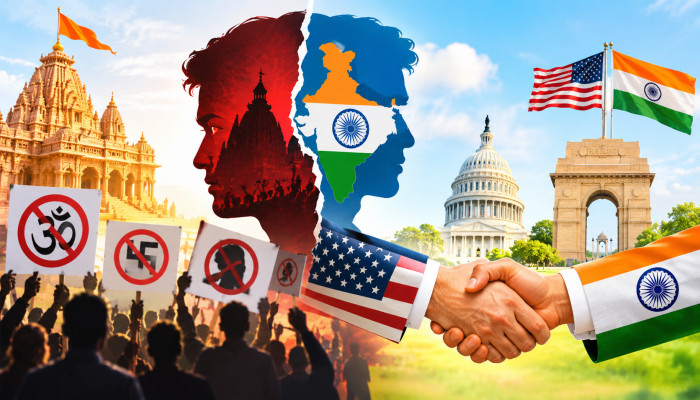
It is a universally acknowledged truth that in the Trump 2.0 administration, the bilateral relations between the US and India are going through some serious challenges. The bonhomie of the last two and a half decades is not apparent in the government-to-government (G2G) relations. The Bull-in- China-shop approach of the Trump 2.0 administration has wrecked the carefully nurtured bilateral relationship that was ascendant. A lot of things are being left unstated to avoid further strain. When we speak of links and ties between the two countries, government-to-government relations (G2G) are not the only parameter. These are reciprocal relations between businesses (B2B) of the two countries for mutual benefit. More importantly, there are people-to-people relations (P2P), civilisational ties and cultural connections (C2C) that are equally important. These relationships are far more important and can be enhanced despite a deliberate deep freeze in official positions. Governments come and go every four or five years, but cultural and civilisational ties are all enduring. Government policies are more governed by short-term geopolitical interests and not by the overall benefit of the respective societies.
Background Information
Historically, both Indian and US societies share democratic values, a pluralistic society, love for freedom and the rule of law. Both nations have a shared colonial past with imperial Britain being the colonising power. Both countries have left the imperial power Britain way behind economically. US was a safe platform for Indian revolutionaries during British colonial rule. The Ghadar Party was formed by Indian revolutionaries in the US and Canada in 1913 to fight British colonialism. Both countries have a written constitution, a vibrant and free press and an aspirational public that wants to rise professionally and economically and seeks to enhance personal and spiritual growth. Therefore, the temporary chill in bilateral government to government relations cannot be the barometer of the strength of overall relations between the two societies.
India’s Overall Financial Contributions to the US Economy
The US President has regularly harped on India’s trade advantage in exporting goods to the USA. The US goods and services (exports plus imports) trade with India totalled an estimated $239.6 billion in 2025, up 12.1 per cent ($25.8 billion) from 2024. India exported approximately $92.57 billion in goods to the United States in 2025, while US goods exports to India in 2025 were $45.4 billion, up 9.1 per cent ($3.8 billion) from 2024. The US goods trade deficit with India was $58.4 billion in 2025, a 27.8 per cent increase ($12.7 billion) over 2024. The US services trade deficit with India was $4.7 billion in 2025, a 257.3 per cent increase ($3.4 billion) over 2024. However, there are other dimensions of economic activity besides bilateral goods and services trade. Top of FormBottom of Form
Students from India are ubiquitous in the US universities despite current visa problems. During the 2024–2025 academic year, there were 363,019 Indian students enrolled in US higher education. This made India the largest international student cohort in the United States. The numbers have declined recently because of large-scale rejection of visas by the US. Indian students typically spend between $35,000 to $85,000 per year (₹31.6 Lakh to ₹76.8 Lakh). This total covers tuition, living costs, health insurance, and books. Indian students contribute roughly $14 billion to $15 billion to the U.S. economy each year. Currently, only 1,578 American students are enrolled or studying abroad in Indian universities. An American student studying in India spends an average of $4,000 to $10,000 per year (approximately ₹3,30,000 to ₹8,30,000), depending heavily on the program and location. Because most American students travel to India for short-term programs (such as a single semester or a few weeks of study abroad) rather than full multi-year degrees, their actual out-of-pocket costs are often much lower. There is an opportunity for American students to enrol in Indian universities for much cheaper education at a reasonable cost in an immersive environment in the field of arts and humanities.
Indian tourists spend about $20 billion to $24.4 billion annually on tourism in the United States. This spending makes India the second-largest overseas market for visitor spending in the U.S. Americans are the largest group of international visitors to India. While exact national spending data for Americans specifically is not broken down, international visitors spent approximately $36 billion in India.
Thousands of Americans travel to India for healthcare each year to save money. India's medical treatments are often one-third to one-tenth the cost of American prices. For example, a heart bypass costs about $5,700 in India versus $130,000 in the U.S. India has become the first choice for surgical procedures for the 40 million Americans without health insurance. Private medical costs are running at just 20% of the US equivalent and top Indian hospitals are more like five-star holiday resorts. It’s an irresistible combination: high-tech hospitals, European- and US-trained surgeons, plus a luxury holiday. This trend will continue to grow due to a failure to reform the healthcare delivery system in the US and rising medical insurance costs that have become prohibitive.
Hindu-phobia and Indo-phobia
True, there is a wave of Hindu phobia and anti-India and anti-Indian American racist rhetoric being uttered by ultra right-wing MAGA activists targeting Indian H1B visa holders. Indian Americans are the most successful model minority, with the highest per capita income of all groups in the US and that breeds jealousy and envy. Indian Americans are the business leaders and CEOs of more than 30 American transnational companies. Some of the motivated leftist-liberal-democratic socialist politicians have targeted the Indian American community in corporate sectors and by drafting new state laws by unnecessarily invoking the “caste discrimination” to hobble this successful model minority. There seems to be a double whammy against the successful model minority by low-level MAGA politicians like Bo French and Christian Fundamentalists who have made racist and Hinduphobic comments. These low-level MAGA candidates have threatened to raze the “Statue of Union” (Bhagwan Hanuman murti) in a Hindu Mandir in Texas to the ground if they win the elections. The current civil society in the US is deeply divided not only on political grounds but also on race and religion. And in that race to the bottom, Hindu Americans are targeted with equal ferocity by Caucasian Americans, Black-Americans and Latino-Americans for being “foreigners” and practising a “Satanic” religion.
The contributions of Hindu-Americans and Indian Americans to the overall success and prosperity of the US cannot be denied. Indian American households report a median annual income of approximately $151,200, ranking first among major ethnic groups in the United States. The median annual income for Indian-headed households is way higher than $105,600 for Asian-headed households overall and roughly $83,700 for the US median overall. This causes envy and jealousy instead of “celebrating the model minority” and taking inspiration. Unfortunately, sections of the Indian American community itself are fomenting this pernicious wave of Hinduphobia. Khalistani activists like Gurpatwant Singh Pannun from the Sikhs for Justice and Pro-Pakistani Muslim-Americans supported by CAIR, ISNA and the Muslim Brotherhood are contributing to this wave of religious hatred and Hinduphobia.
Land of Immigrants or Xenophobes?
US is a nation of immigrants and the land of opportunities that has welcomed talented people from all over the world. American dream is still possible to achieve despite difficult economic times. The US Census Bureau identifies people of Indian heritage as "Asian Indian". The Indian American population in the US has steadily grown from 387,000 in 1980. As of recent demographic data, there are about 4.8 to 5.2 million Indian Americans in the U.S. They make up the second-largest Asian origin group in the country and represent about 20% of the total Asian American population. And these trends will continue. With many Indian diasporas in the US choosing to naturalise, there will be a visible impact on overall US politics, civil society and every sphere of life.
Conversely, the ties back home of Indian Americans will foster bilateral relations in a structured manner. Conversely, around 700,000 to 1,500,000 Americans live in India. This includes US immigrants and Indian citizens of American descent. Many are young professionals and start-up founders. They mostly live in Bengaluru, Mumbai, and Hyderabad. India, historically, has assimilated all immigrant groups with its history of tolerance, acceptance and benevolence. Jewish Americans will testify that Jews were never discriminated against in India and received haven in India when Europe was persecuting them.
Jealousy, Thy Name is American
The extent of envy and jealousy is not confined to just the domestic issues in the US. The US President, Donald Trump, has been disparaging India as a “dead economy”, as a “currency manipulator” and as Tariff King”, while his Secretary of State, Marco Rubio, openly stated that the US will not commit the same mistake about India as they did with China. They would not allow India to develop markets to the extent that they pose a threat to the US. Furthermore, the US president threatened that any country that supports a single BRICS currency will face 500% tariffs. The most idiotic statement was made by Trump acolyte Peter Navarro, who ludicrously characterised Ukraine war as “Modi’s war”. After enacting CAATSA in 2017 under the Trump 1.0 administration, the US passed the Lindsey O Graham Sanctioning Russia and Iran Act on September 18th, 2026, which threatens the top five countries that purchase Russian crude oil with 100% tariffs while giving waivers to its own allies. It specifically targets China and India over Russian oil purchases. It appears that the US is feeling threatened by the loss of dollar hegemony. While India cannot threaten the US economic supremacy and dollar hegemony, the US is unable to accept India’s peaceful economic rise. While the US government has taken a nasty turn, American businesses have been more circumspect. JP Morgan Chase CEO Jamie Dimon opined that the US should understand how Russian oil is used by Indian refiners and engage with India before deciding how proposed sanctions and tariffs are implemented.
Civilisational Influences
India’s love of Hollywood movies, the American University system and an open society is well known. The United States earns an estimated $150 million to $200 million annually from exporting Hollywood movies to India through theatrical box office revenues. This gross theatrical number translates to roughly $60 million to $90 million flowing directly back to U.S. studios in pure export earnings after accounting for local Indian theatre splits, distribution fees, and taxes. When streaming rights (OTT), television syndication, and merchandise are added, the total export value climbs significantly higher. The US accounts for nearly 20% of the entire overseas revenue across all Indian film industries combined, making it an irreplaceable goldmine for producers. The United States is the largest overseas market for Indian cinema, typically generating 40% to 60% of Bollywood's total international box office revenue. Overall, the US market accounts for tens of millions of dollars annually, with single major blockbusters regularly earning $15 million to $22 million and some even pushing upwards of $40 million to $50 million.
Americans are slowly imbibing Indian values, especially Sanatan values. About 35 to 38 million adults in the US regularly practice yoga, which means roughly 1 in 6 adults or about 11% of the total American population practice yoga. Americans spend more than $21 billion annually on yoga gear, classes, and retreats. The average practitioner spends about $1,000 per year. This cost includes specialised apparel, mats, accessories, and class fees. Over a lifetime, an avid yogi will spend roughly $62,640 on their practice. Given the popularity of International Yoga Day, the number is likely to increase. Estimates show that approximately 3% to 4% of the US adult population identifies as strictly vegan. This translates to roughly 8 million to 10 million adult Americans as vegans. They believe in nonviolence towards animals and appreciate plant-based diets as more ethical and healthier.
Hindu-American Charter
Hindu Americans feel sandwiched between the trade disputes between the US and India as the anger against the Indian government is displaced onto them unjustly. Some Hindus in the US on non-immigrant visas have started to abandon their American dream and have left the US for good, abandoning their homes. Under the current scenario, Hindu Americans may have to divorce the two major political parties and provide issue-based support to electoral candidates if they pass the litmus test of the Hindu-American Charter. All politics are local. Hindu Americans must become politically active and must start contesting elections right from the local school boards, city councils, mayoral elections, state assembly, state senates, gubernatorial elections, US Congressional and Senate elections. Hindu Americans must not yield to injustice and give a good fight for their First Amendment rights. No one else will speak for their rights. Therefore, they must use all legal provisions to deal with both hate speech and religious discrimination.
Prior to voting for any candidate, Hindu Americans must ask probing questions on the proposed Hindu-American Charter.
- Protection of Hindu Temples and Icons like Swastika and Murtis
- School Textbook Revisions
- Protecting the First Amendment Rights of Hindu Americans
- Availability of Non-Halal Food Choices
- End to Bigoted Campaigns by Federal Government agencies
- Proclamation of October as Hindu Heritage Month
- Diwali to be declared as a national Holiday
- Availability of SAFL in all High Schools
- Prosecution for Hate Crimes and Hate Speech against Hindus
- Disbanding of USCRIF
Conclusions
US politicians were fond of lecturing India on human rights issues. For the first time, the Government of India has a serious locus standi to call out the current US government on its treatment meted out to the Hindu American minority whose civil rights are being violated. Unfortunately, Hindu-Americans have become the target of the Trump 2.0 administration for its inability to cajole the Government of India into submission on signing the trade deal.
Hindu Americans will have to fight their legal battles for equal civil rights and against hate speech and hate crimes using the common law system in the US. Hindu Americans will have to defend their First Amendment rights vigorously and ferociously because there are now 3rd and 4th generation “born in the USA” Hindu American cohorts that have no ties with India. Hindu Americans are as American as the Apple pie and will have to engage politically in the mainstream instead of focusing on careers and wealth creation alone.
It is highly unlikely that G2G ties between these two countries will come back to normal level till the Trump 2.0 administration remains in power. As we live in a contemporary globalised world, the citizens of the two countries have shared value systems, mutual likes and consumption trends that cannot be changed by government policy changes from either side. The civilisational and cultural ties and connections are too important to be ruptured by short-term geopolitical hiccups. Administrations will come and go, people-to-people ties will remain. We need more people-to-people (P2P) connections and business-to-business (B2B) relations. Business groups must sponsor more bilateral exchanges, training programs, and cultural exchanges instead of relying on the governments. The Civil Societies of the two countries must step up to fill the void where governments fail. The two people truly share the values enshrined in the Sanskrit phrase Vasudhaiva Kutumbakam!
Disclaimer: The opinions expressed within this article are the personal opinions of the author. MyIndMakers is not responsible for the accuracy, completeness, suitability, or validity of any information on this article. All information is provided on an as-is basis. The information, facts or opinions appearing in the article do not reflect the views of MyindMakers and it does not assume any responsibility or liability for the same.



 Loading...please wait
Comments