




The Congress party of the Nehruvian era was not the unified monolith its propaganda portrayed. Beneath the surface of a seemingly coherent nationalist movement lay a complex web of factional rivalries, regional ambitions, and ideological tensions that the party's high command — and Jawaharlal Nehru in particular — managed with considerable political cunning. Nowhere was this management more consequential, or more damaging to governance, than in Uttar Pradesh. The story of how Nehru systematically weakened, sidelined, and ultimately destroyed UP's independent political leadership is a crucial chapter in understanding the state's subsequent decades of dysfunction.
The Problem of Strong State Leaders
In the early years of independence, the Congress party in UP boasted a formidable array of political figures who had earned their stature through genuine mass mobilisation, organisational work, and personal courage during the freedom struggle. Men like Govind Ballabh Pant, Sampurnanand, Chandra Bhanu Gupta, and Lal Bahadur Shastri represented a generation of leaders with their own mass bases, political networks, and — crucially — ideas about governance that did not always align with the Prime Minister's vision.
For Nehru, who had inherited the Congress presidency and the Prime Ministership through a complex mix of Gandhi's patronage and his own formidable mass appeal, powerful, independently minded regional leaders were both a political resource and a potential threat. As long as these leaders delivered electoral victories and maintained order in the states, they were useful. But their independent stature also meant they could resist central direction, build their own patronage networks, and potentially challenge the high command's authority.
Nehru's approach to this challenge was characteristically indirect. He rarely confronted strong state leaders head-on; instead, he allowed factional dynamics to develop, withheld support at critical moments, elevated rivals to cut down overly powerful individuals, and used the allocation of central resources as leverage over state governments. The result was a political culture in which survival at the state level required, above all, cultivating good relations with the centre—a dynamic that fundamentally corrupted the incentive structure of democratic politics.
The Sidelining of Govind Ballabh Pant
Govind Ballabh Pant was in many ways the dominant Congress figure in UP in the years immediately following independence. A veteran of the freedom movement, he served in the Central Legislative Assembly and was widely respected for his administrative competence and political acumen. As Chief Minister from 1946, Pant presided over the enactment of the Zamindari Abolition Act and the consolidation of the new state's administrative machinery.
Pant's elevation to the central cabinet as Home Minister in 1955 — replacing Nehru's close ally Kailash Nath Katju — can be read as either recognition of his stature or his removal from the UP political scene. The historical consensus leans toward the latter interpretation. With Pant at the centre, the UP Congress was left without its most powerful leader, and his departure directly enabled the factional struggles that followed. Nehru, meanwhile, acquired a Home Minister who was not a rival but a subordinate — one who brought with him the organisational resources of the Congress's largest state unit while leaving behind any independent political base.
The Marginalisation of Purushottam Das Tandon
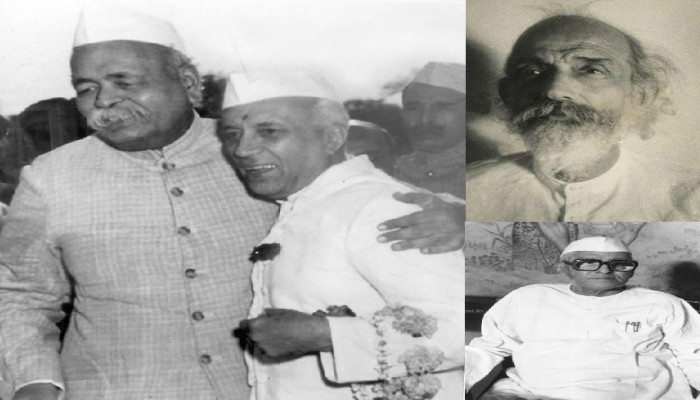
The most instructive episode in Nehru's management of UP leadership is perhaps the forced resignation of Purushottam Das Tandon as Congress President in 1951. Tandon, known as Rajarshi (the saintly king), was a towering figure in the Hindi-speaking belt — a passionate advocate of Hindi as the national language, a deeply religious Hindu, and a Congress stalwart with roots going back to the pre-Gandhi era. His election as Congress President over Nehru's preferred candidate represented a genuine democratic assertion of the party's grassroots sentiment over the high command's preferences.
Nehru found Tandon's cultural and political orientation intolerable. Tandon's Hinduism was not performative but deep and sincere; his commitment to Hindi was not merely linguistic but civilisational; his political style was rooted in a UP tradition of mass mobilisation that owed more to temple, ashram, and akhara than to the drawing rooms of Delhi. These qualities, which made him enormously popular in the Hindi heartland, were precisely what made him threatening to Nehru's vision of a secular, modernising India led by an English-educated elite.
Using his control over the Congress organisation and threatening to resign the Prime Ministership, Nehru forced Tandon out and took over the Congress presidency himself—a remarkable concentration of executive and party power with no precedent in the democratic tradition. The message to Congress leaders in UP was unmistakable: cultural nationalism, strong Hindu identity, and independent political stature were incompatible with survival in the Nehruvian order.
The Chandra Bhanu Gupta Era: Factionalism as Governance
The UP Chief Ministership under Chandra Bhanu Gupta (with several interruptions between 1960 and 1967) illustrated how Nehru's centralisation had transformed UP politics. Gupta was not the most popular or most capable Congress leader in the state, but he was skilled at managing his relationship with the centre. His long tenure — punctuated by the brief Chief Ministerships of rivals — rested less on any positive vision for the state than on his ability to deliver electoral results and keep the Congress organisation loyal to the Nehru high command.
Under Gupta, UP Congress politics became increasingly a zero-sum factional game in which the objective was not governance but the distribution of patronage — government contracts, transfers of district officials, college appointments, liquor licences, and the thousand other instruments by which a ruling party in an Indian state can reward its supporters and punish its opponents. Gupta did not invent this shift from governance to patronage distribution, but he consolidated it over his long tenure.
The cost to the people of UP was incalculable. A state with enormous human and agricultural resources was governed by a political class whose primary concern was its own reproduction. The developmental failures of the 1950s were compounded in the 1960s, and by the time Indira Gandhi completed the destruction of state-level autonomy in the late 1960s and 1970s, UP's political culture was already deeply corrupted.
The Constitutional Dimension: Article 356 as a Political Weapon
Nehru's management of state-level leadership was not conducted purely through political manipulation. It was also facilitated by the Constitution's Article 356, the provision for President's Rule in states, which allowed the central government to dismiss elected state governments on the grounds of constitutional breakdown. While Nehru used this provision far less aggressively than his daughter would, the constitutional architecture it represented gave the centre enormous leverage over state governments — leverage that could be threatened as well as exercised.
The knowledge that the centre could dismiss a recalcitrant state government acted as a permanent constraint on the political autonomy of state leaders. A Chief Minister who was too independent, who challenged central policies too strenuously, or who built too powerful a personal base could always be threatened with central intervention. This threat, real and ever-present, fundamentally altered the calculation of UP's political leaders, pushing them toward subservience as a survival strategy.
The legacy of this centralisation was to produce a political culture in UP characterised by deference to Delhi, factional competition for central patronage, and a chronic underinvestment in the actual challenges of governance. The population of the state, which deserved leaders with the autonomy and accountability necessary to address its massive developmental challenges, instead received managers of a patronage machine ultimately controlled from the capital.
The Limits of Congress Governance and Administrative Faultlines in Post-Independence Uttar Pradesh Part 2
Disclaimer: The opinions expressed within this article are the personal opinions of the author. MyIndMakers is not responsible for the accuracy, completeness, suitability, or validity of any information on this article. All information is provided on an as-is basis. The information, facts or opinions appearing in the article do not reflect the views of MyindMakers and it does not assume any responsibility or liability for the same.



 Loading...please wait
Comments