




Henri Kagan, Kenso Soai win Nobel Prize in Chemistry for solving century-old molecular mystery
- In Reports
- 08:00 PM, Oct 07, 2026
- Myind Staff
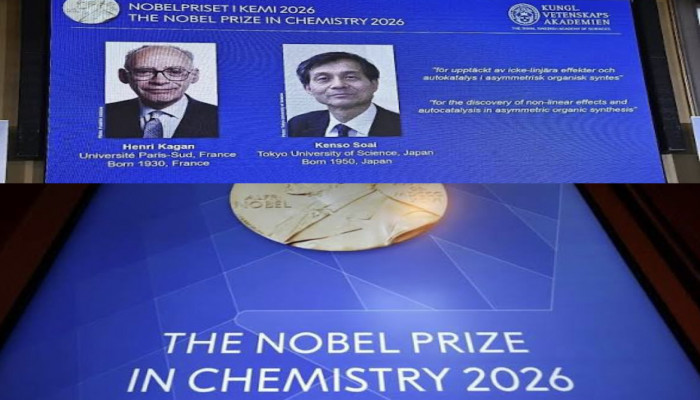
Henri Kagan and Kenso Soai have won the 2026 Nobel Prize in Chemistry for their work on a long-standing mystery in organic chemistry. The Royal Swedish Academy of Sciences announced the award in Stockholm on Wednesday, honouring the two scientists “for the discovery of non-linear effects and autocatalysis in asymmetric organic synthesis.”
Kagan is affiliated with Université Paris-Sud in Orsay, France, while Soai, aged 95, is affiliated with the Tokyo University of Science. Their research has helped scientists understand how chemical reactions can produce one preferred version of a molecule when two mirror-image forms are possible.
Kagan’s research showed that chemical reactions could produce a much greater excess of one mirror image than scientists had previously believed possible. His findings opened new possibilities for controlling chemical reactions during asymmetric organic synthesis. Such work has applications in the development of pharmaceuticals, flavours, fragrances and new materials.
Soai made another breakthrough. He developed the first chemical reaction in which only one of the possible mirror-image forms was produced. The achievement provided an important step towards understanding how chemical systems can develop a single molecular orientation without an external source directing the process.
The Nobel committee described the discovery as a landmark achievement in chemistry. It said, “Other than life itself, no one had ever achieved this feat. The Soai reaction is one of the most spectacular chemical experiments ever conducted,” the Nobel committee stated.
The work by Kagan and Soai addresses the phenomenon of homochirality. It refers to the presence of molecules with the same three-dimensional orientation, a feature widely seen in living systems. Scientists have studied this phenomenon for more than a century while trying to understand how such molecular uniformity could arise naturally.
Heiner Linke, chair of the Nobel Committee for Chemistry, highlighted the importance of the discoveries. He said, “Henri Kagan and Kenso Soai have provided a solution to a chemical mystery that is over a century old: how homochirality can emerge spontaneously. The chemical reactions they have developed are spectacular.”
The award follows last year’s Nobel Prize in Chemistry, which went to three scientists for developing new molecular structures capable of trapping large quantities of gas. Their work created possibilities for technologies that could remove greenhouse gases from the atmosphere and collect moisture from desert environments, the Associated Press reported.
Kagan and Soai’s discoveries have given chemists new ways to control molecular reactions. Their work also provides important insights into how one molecular form can become dominant in chemical systems, a process that remains closely linked to the chemistry of life.



 Loading...please wait
Comments