



Haryana assembly passes bill to increase work duration to 10 hours for shop employees
- In Reports
- 02:19 PM, Dec 23, 2025
- Myind Staff
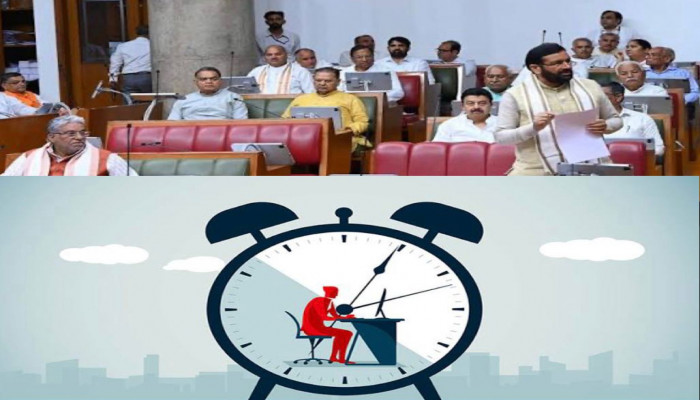
The Haryana Assembly on Monday passed a Bill that increases the daily working hours for employees in shops and private commercial establishments from nine hours to ten hours, while keeping the weekly working limit unchanged at 48 hours. The Bill was cleared on the concluding day of the Winter Session of the Haryana Vidhan Sabha amid sharp differences between the ruling party and the Opposition.
The legislation, titled The Haryana Shops and Commercial Establishments (Amendment) Bill, 2025, amends the Haryana Shops and Commercial Establishments Act, 1958. It introduces several changes related to working hours, overtime limits and registration requirements for establishments.
Labour Minister Anil Vij, who introduced the Bill, said the amendments were aimed at reducing the compliance burden on small establishments and promoting economic growth, while continuing to protect the interests of workers. “The Bill is beneficial for both workers and shopkeepers. It has been framed keeping in mind the interests of employees as well as traders,” Vij told the House.
One of the key provisions of the Bill is the increase in daily working hours from nine to ten hours. At the same time, the maximum weekly working hours remain capped at 48. Vij clarified that the ten-hour daily limit includes rest intervals and is subject to the weekly ceiling.
The Bill also increases the permissible limit of overtime work per quarter from 50 hours to 156 hours. According to the government, this change will help shops and commercial establishments manage peak business demands and emergencies more efficiently. In addition, the maximum period of continuous work without rest has been increased from five hours to six hours.
However, the Congress strongly opposed the Bill. Congress MLA Aditya Surjewala raised concerns over what he described as the impact of the amendments on workers’ lives. He questioned whether the government’s focus was truly on ease of doing business or on “legalising modern-day slavery.”
Surjewala pointed out that the Bill allows daily working hours to rise from nine to ten and significantly increases overtime limits. “If overtime is increased from 50 hours to 156 hours, it works out to nearly two extra hours every day,” he said. “Now, take 10 hours of daily work with two hours of overtime. If a person has to work 12 hours a day for six days a week, what time does it leave for himself or his family?” he asked while addressing the House.
Calling the provisions excessive, Surjewala repeatedly questioned the intent behind the amendments. “Is this ease of doing business or legalising modern-day slavery?” he said.
The Congress MLA also moved an amendment seeking to retain the existing nine-hour daily working limit. The amendment was supported by party legislators but was rejected by the House through a voice vote.
Another major change proposed in the Bill relates to registration requirements. Vij explained that the threshold for mandatory registration has been increased from zero employees to 20 or more employees. Establishments with fewer than 20 workers will no longer be required to obtain a registration certificate. Instead, they will only need to provide an intimation of their business operations. “This change will reduce the compliance burden for smaller businesses, encourage job creation and eliminate the fear of non-compliance,” Vij said. He added that earlier, even shopkeepers with no employees were required to register under the Act.
Vij cited examples from other states to defend the provision. “Even today, in states like Karnataka, shopkeepers are required to register even if they do not have a single worker,” he said, adding that Haryana’s approach aligns with several other states.
Surjewala, however, claimed that the revised threshold would exclude a large number of establishments from the Act. He argued that more than 80 per cent of shops and establishments employ fewer than 20 workers and would therefore fall outside the law’s provisions, potentially weakening worker protections.
Responding to this, Vij said the government had studied labour laws across various states before finalising the Bill. He noted that in Haryana, Maharashtra, Punjab, Andhra Pradesh and Odisha, registration is compulsory only for establishments with 20 or more workers. He also pointed out that daily working hours are set at ten hours in Haryana as well as in Maharashtra, Punjab, Telangana, Andhra Pradesh and Odisha.
The Labour Minister said the increase in daily working hours, while retaining the weekly limit, is intended to boost economic activity and provide flexibility to establishments. “This measure aims to enhance employment opportunities and give establishments the flexibility to handle emergencies, peak demand or staff shortages without disruption,” Vij told the House.
The Bill was one of eight pieces of legislation passed on the final day of the Winter Session. Other Bills approved by the Assembly included the Haryana Private Universities (Amendment) Bill, 2025, the Haryana Abadi Deh (Vesting, Recording and Resolving of Ownership Rights) Bill, 2025, and the Haryana Jan Vishwas (Amendment of Provisions) Bill, 2025.
The Haryana Jan Vishwas (Amendment of Provisions) Bill focuses on decriminalisation and rationalisation of offences to improve trust-based governance. It aims to further ease living and doing business by reducing minor criminal provisions.
According to the government, this Bill seeks to reduce 164 minor criminal provisions across 42 state Acts and 17 departments. It removes obsolete and redundant clauses, introduces civil penalties and administrative actions for minor technical and procedural lapses, and decriminalises minor and technical offences by eliminating penal provisions.
With the passage of these Bills, the Winter Session of the Haryana Vidhan Sabha concluded, marking the approval of several legislative measures aimed at regulatory reform, economic flexibility and administrative simplification.



 Loading...please wait
Comments