




Harnessing India's Youth Power for a Prosperous Viksit Bharat
- In Current Affairs
- 01:11 PM, Jul 27, 2026
- Viren S Doshi
Overview
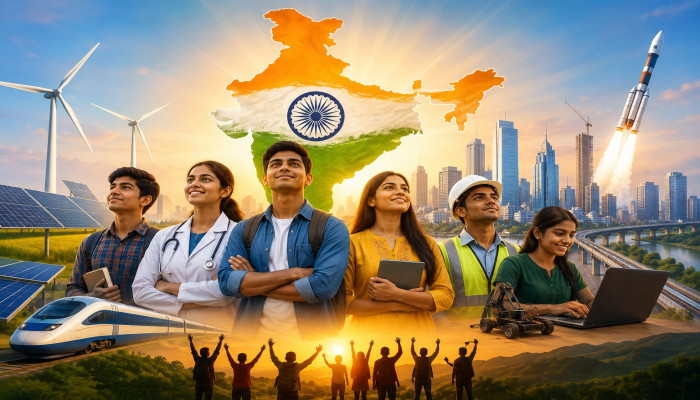
India, the world's largest democracy, possesses the planet's biggest youth population — a demographic dividend that could drive decades of economic growth if channelled effectively. With nearly 255 million people aged 15-24 and around 371 million in broader youth cohorts (per United Nations estimates around 2025-2026), the country stands at a critical juncture. Yet, this advantage risks turning into a liability without productive skilling, meaningful engagement, and pathways to entrepreneurship and stable livelihoods aligned with India's cultural emphasis on family, settlement, and holistic well-being.
The Scale of the Challenge: Degrees Alone Are Not Enough
Every year, India adds roughly 5 million graduates. The total number of graduates in the 20-29 age group has reached 63 million by 2023. However, job creation lags significantly: only around 2.8 million find employment annually, and far fewer secure stable salaried roles. Reports indicate that graduates constitute about 67% of unemployed youth (around 11 million unemployed graduates in the 20-29 cohort as of 2023).
Large corporations increasingly automate, prioritising efficiency and shareholder returns over mass hiring. They have access to interest-free shareholder money for automation.
Traditional "respectable" white-collar jobs cannot absorb the influx.
A plumber, electrician, or skilled entrepreneur often earns respectably but carries less social status and dignity in an era of Instagram benchmarks.
The result: high open unemployment among graduates, underemployment, and delayed family formation and settling in life.
Skill development, not just degrees, is the proven bridge. Only about 4.5% of India’s workforce has formal vocational training, and 88% remain in low-competency jobs.
Schemes like Pradhan Mantri Kaushal Vikas Yojana (PMKVY) have trained over 1.65 crore candidates, with placement rates around 42-43% in earlier phases and measurable gains in employment/self-employment (from ~26.6% pre-training to 45.4% post-training in evaluations). Complementary efforts through Industrial Training Institutes (ITIs, expanded significantly since 2014 to over 13,800), apprenticeships (National Apprenticeship Promotion Scheme or NAPS, over 53 lakhs enrolled), and Jan Shikshan Sansthans expand reach.
The MSME Engine: Micro to Macro Through Entrepreneurship
Micro, Small and Medium Enterprises (MSMEs) are India's employment powerhouse and export backbone. The sector includes over 8.7 crore registered units (Udyam portal as of mid-2026), contributes 31.1% to GDP, 35.4% to manufacturing output, and ~48.58% to exports. It employs around 36-39 crore people, making it the second-largest employer after agriculture.
MSME exports have grown dramatically — tripling in value in recent years to over ₹12 lakh crore in FY 2024-25 reported figures — with the number of exporting MSMEs surging from around 52,849 in 2020-21 to 1,73,350 by 2024-25. Medium enterprises (though only ~0.3% of units) punch above their weight in exports. The sector's "dwarfishness" (dominance of tiny firms) is a challenge, but scaling micro → small → medium → large offers the only realistic path to absorbing millions annually.
Entrepreneurship must be made aspirational. Government initiatives like Prime Minister's Employment Generation Programme (PMEGP, supporting over 10.71 lakh micro enterprises and generating estimated employment for 87 lakh+ persons), Self-Reliant India (SRI) Fund for equity infusion, credit guarantees (enhanced ceilings), and Udyam registration ease formalisation and finance access. Women-owned enterprises (approximately 20-40% in various data) and rural clusters add inclusivity. Khadi and Village Industries (KVIs) sales have crossed Rs 1.27 lakh crore, supporting local employment and cultural crafts.
Dual Levers: Exports Promotion and Imports Substitution
India's domestic market is vast, but global markets are even larger, offering scale for growth.
Export Promotion: Key high-potential sectors for MSMEs include engineering goods and auto components (recent growth of +11-13% year-on-year), electronics and components (+39% inperiods, driven by smartphones, semiconductors, and supply chain shifts), textiles/ apparel/handicrafts, agro-processed foods / marine products/spices (+17% in recent aggregates), pharmaceuticals/chemicals, and emerging areas like defence/aerospace (national target of ₹50,000 crore exports by 2029), renewables, and green technologies. Initiatives such as the Export Promotion Mission (outlay of Rs 25,060 crore for FY26–FY31), district-level export hubs (targeting about 500 districts where MSMEs dominate exports), quality testing laboratories, certifications, logistics subsidies, and FTAs aim to broaden participation beyond current concentrations in under 100 districts.
Import Substitution: India’s merchandise imports reached around $775 billion in FY25-26. An internal government assessment identified imports worth about $398 billion with potential for domestic manufacturing, of which ~$51 billion across roughly 100 critical products are prioritised for immediate action. Focus sectors include electronics components/semiconductors, chemicals, machinery, solar equipment, footwear, textile inputs, fertilisers, pharmaceuticals (Active Pharmaceutical Ingredients), and more. This creates substantial MSME opportunities in manufacturing, components, and value addition while reducing reliance on single suppliers like communist regime-occupied China and enhancing strategic autonomy.
Rural, agro-based, and KVIs add decentralised growth.
Projections to 2047: Jobs, GDP, and Per Capita Income
Scaling MSMEs through skilling, exports, and import substitution is projected to create tens of millions of additional jobs. Optimistic scenarios and alignments with Viksit Bharat @2047 suggest MSMEs could support 15 crore+ additional livelihoods by 2030-2030s, with cumulative potential reaching 20-30 crore or more by 2047 from the current base of around 37 crore, helping absorb the annual influx of graduates and youth entrants.
This expansion could lift manufacturing and MSME GDP contribution toward 35-50% (from current ~31%), supporting overall GDP growth trajectories consistent with developed-nation goals (potentially achieving a $10-30+ trillion economy by 2047 under sustained 7-9%+ growth). Per capita income could rise significantly from current lower-middle income levels toward $10,000–$20,000+ ranges, crossing high-income thresholds with equitable distribution. Successful execution could add 1-2 percentage points to long-term GDP growth via productivity gains, export multipliers, and reduced import dependence, while enabling higher wages in skilled and scaled enterprises.
Pathways Forward: Policy, Mindset, and Execution
Revamp Skilling: Align curricula with industry (via Sector Skill Councils), integrate apprenticeships / on-the-job training, emphasise entrepreneurship modules, and focus on high-growth areas (AI, EVs, green skills, precision manufacturing). PMKVY 4.0, ITI upgrades, and related Budget boosts (e.g., significant allocation increases) are positive steps.
Ease Scaling for MSMEs: Address credit gaps, delayed payments, technology adoption, and regulatory burdens. New classification norms and incentives help firms grow without losing benefits.
Make Entrepreneurship Respectable: Showcase success stories, integrate vocational streams in education, reduce stigma through campaigns, and link skills to cultural values of self-reliance (Atmanirbhar) and family stability.
Market Linkages: Quality labs, certifications, logistics support, overseas warehousing, and e-commerce / global platforms for MSMEs. Focus on clusters and districts.
Financing and Innovation: Expand Trade Receivables Discounting System (TReDS), collateral-free credit, equity funds, and R&D support. Encourage micro businesses in import-substitution and export-oriented manufacturing.
Conclusion: Turning Demographic Dividend into Cultural and Economic Bliss
India cannot create enough traditional jobs for its youth bulge through large firms alone. The solution lies in democratising opportunity: skilling millions for entrepreneurship, nurturing MSMEs from micro to global players, aggressively pursuing exports, and substituting imports. This approach generates not just numbers but dignified, productive work that enables family settlement and aligns with India's ethos of holistic well-being.
With focused execution — combining policy muscle, industry collaboration, and a mindset shift — India's youth can drive Viksit Bharat, transforming potential into widespread prosperity and cultural flourishing. The window is open; the government is working in the right direction, the time for action for all and at all levels is now.
Disclaimer: The opinions expressed within this article are the personal opinions of the author. MyIndMakers is not responsible for the accuracy, completeness, suitability, or validity of any information on this article. All information is provided on an as-is basis. The information, facts or opinions appearing in the article do not reflect the views of MyindMakers and it does not assume any responsibility or liability for the same.


 Loading...please wait
Comments