




Hanuman Ansh – Dharmic Storytelling at its Best
- In Movie Reviews
- 02:04 PM, Aug 13, 2026
- Dr. Nidhi Shendurnikar
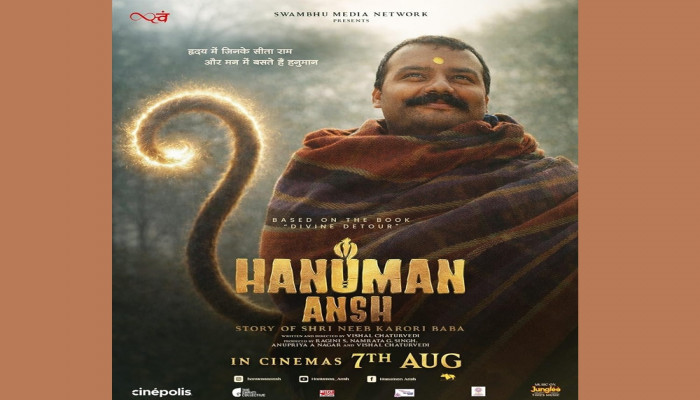
Before I watched ‘Hanuman Ansh’, a film based on the life, experiences and journey of Neem Karoli Baba, I had only passingly heard about this saint from acquaintances and friends. Curiosity about his miracles, his celebrity following and the status he enjoys among his ‘Bhakts’ led me to watch – ‘Hanuman Ansh’ – a film that sincerely attempts to bring Baba’s life and philosophy to the big screen. As the film ended, I left the theatre with mixed feelings – joy in my heart, smile on my face and beaming pride on being part of an ancient civilisation whose timeless values continue to inspire the world. And Neem Karoli Baba’s story exemplifies exactly that! I also left with an enhanced sense of responsibility – to honour our Rishis, Gurus and Sants who have sacrificed immensely for the sustenance of Dharma. I also wondered why are we as a nation, as a civilisation are not making such films on a larger scale? Why is such cinema, so rare? Why is our pop culture and entertainment space full of substandard, intellectually dumbed down content and why have we failed to recognise the rich Dharmic heritage our storytelling traditions offer to narrate stories such as these that matter, stories like ‘Hanuman Ansh’!
Unlike many mainstream films in the past and some big budget projects in the near future where Dharmic Storytelling takes a backseat and what one witnesses instead is pompous sets, larger than life characters, predictable VFX, insipid dialogues and a missing Dharmic core – ‘Hanuman Ansh’ has its heart at the right place. It is a powerful, engaging, genuine attempt drenched in divinity and bliss. Faith can indeed move mountains and nothing portrays this more beautifully and convincingly than Laxmi Narayan Sharma from Akbarpur who transformed to Neem Karoli Baba (Neeb Karori Baba) after intense ‘tapasya’, meditation and a journey through which he discovered devotion to Bajrangbali Hanuman. He is indeed believed to be an ‘ansh’ – an ‘avatar’ of Hanuman ji.
The film traces Baba’s life as a young child who is not enamoured by worldly life and seeks Bhagwan Ram in search for his dead mother – "मुझे राम जी के पास जाना है, मुझे मेरी माँ के पास जाना है" – This young child then, unlike others of his age, spends time in ‘dhyana’, reflection, introspection before deciding to leave his home forever in search for the ultimate knowledge and truth. This in essence is the spirit of Sanatana, kindled in Neem Karoli Baba, right from his childhood. He questions his school teacher as to why one needs to study and attend school when one is not interested in ‘samsara’! The spark of a genuine quest to connect with the divine power leads Laxmi Narayan into forests, along river belts through Mewar, Gujarat, central and southern India before he returns to Braj. His spiritual journey underscores the unity and interconnectedness of Dharma throughout the length and breadth of Bharat. It shows how we as a civilisation, despite diversity and differences in ‘paramparas’ were united in a single thread of Dharmic beliefs and values.
The choice of events from Baba’s lifespan which the director selects to narrate is extremely poignant. These connect with the viewers directly, in a heartwarming manner – showcasing why Neem Karoli Baba was so dearly loved, admired and why he had such a profound impact on the lives of those around him. Through the instances seen in the film, one realises that despite attaining the highest of ‘siddhis’, Baba was one among his ‘Bhakts’ – he understood their lives, was connected to the ground, lived like a commoner, truly caring for those who placed their ‘shraddha’ in his wonders. A carefree, nonchalant individual with a warm and radiant demeanour who didn’t carry sainthood with arrogance or a sense of superiority but who shared his philosophy and teachings in the simplest and most affable of ways. Baba’s connect with those around him, the affinity in their relationships and the way he sensed the pulse of people is written all over the film.
Each episode, every narration connected with Baba is told convincingly with characters that one can easily identify with. His abode in Shree Kainchi Dham, Uttarakhand still draws devotees to an ashram established in the midst of the mountains – a living example of Baba’s presence long after he is gone. Some scenes from the film that are sure to stay with the viewers are those where Neem Karoli Baba proves his mystic powers in an endearing manner – especially the moment where he and his disciples are thrown out of a first-class train compartment by a British officer who objects to Baba’s presence. After being asked to leave the train, Baba isn’t angry – he moves on and meditates at Neeb Karori – a place which earned him this name. The train doesn’t move despite herculean efforts and the British officer is forced to apologise and requests Baba to board the train back! This scene will bring tears to your eyes!
The film is commendable in terms of production quality which is bound to leave a lasting impact on the viewer’s mind. It is visually and aesthetically appealing, each cinematic frame carved carefully, soaked in the pure intent of ‘samarpan’. The cinematography is top-notch, something which young Dharma-oriented film-makers must learn from. It is not enough to simply tell a Dharmic story in a bland, dull, boring, preachy fashion – creators ought to set the highest standards in all aspects of the film craft so that Gen Z is drawn to cinemas to watch such films.
‘Hanuman Ansh’ sets the right example here. The environment metaphors and natural landscape used by the director is soothing to the eye. You feel lively seeing trees, animals, mountains, rivers, flowers on screen. It simply brightens up the cinematic experience and reinforces the sacred value that Sanatan philosophy attaches to ‘Prakriti’. One cannot miss the presence of ‘monkeys’ in the narrative! Director & Writer Dr. Vishal Chaturvedi has rightfully credited – ‘Hanuman ji ke Doot’ – Bandar aur Langoor in the opening credits of the film. Actors Shobhinaw Satyaa, Anil Rastogi, Bhagwan Das Patel and others are simply outstanding – a gifted addition to Indian cinema. The film’s music and songs – presented with authenticity, emphasis on local dialects, and elements of folklore bring the audience closer to experiencing Neem Karoli Baba.
As a cinema enthusiast, craving for such Dharmic stories to be told with confidence and pride – I believe that ‘Hanuman Ansh’ is an experience not be missed. Bharat’s young generation can reconnect with their Dharmic traditions through such films, in a meaningful yet entertaining way. Such Dharmic storytelling can capture Gen Z’s imagination and make them aware of our rich, timeless traditions which have survived many challenges. Such films can also represent Bharat on global platforms in times when Sanatan Dharma is often misunderstood due to gross misrepresentation, stereotyping and vilification in popular cinema. But most importantly, ‘Hanuman Ansh’ is a tribute honouring the arduous journeys of the great men and women of Bharat who stood the test of time, survived trials and tribulations from various inimical forces to preserve and pass on to us today, the ancient wisdom and practices of our great civilisation.
Disclaimer: The opinions expressed within this article are the personal opinions of the author. MyIndMakers is not responsible for the accuracy, completeness, suitability, or validity of any information on this article. All information is provided on an as-is basis. The information, facts or opinions appearing in the article do not reflect the views of MyindMakers and it does not assume any responsibility or liability for the same.



 Loading...please wait
Comments