




Guru Purnima in the Age of AI: Why the Ancient Guru Matters More Than Ever
- In Religion
- 12:22 PM, Jul 29, 2026
- Siddhartha Dave
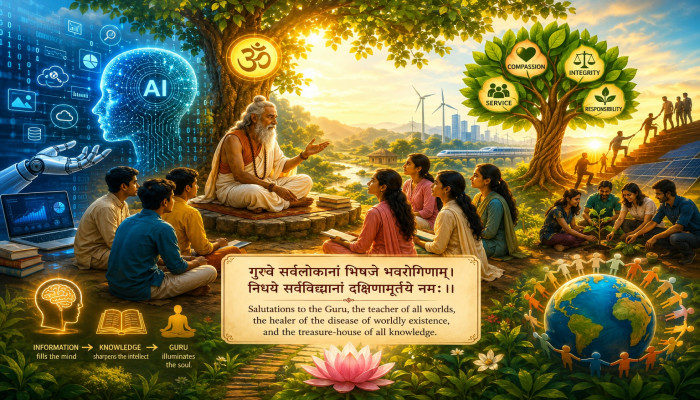
In an age where information is available in seconds, wisdom has become increasingly scarce. A smartphone can answer almost any factual question. Artificial Intelligence can draft essays, solve equations, generate images, and even imitate human conversation. Yet anxiety, loneliness, confusion, and lack of purpose among young people are at unprecedented levels. We know more than any generation before us, yet often understand less about ourselves.
This paradox makes Guru Purnima not merely a Sanatana observance but one of the most relevant civilisational festivals for the twenty-first century.
The Sanskrit word Guru is derived from two syllables—Gu (darkness) and Ru (the remover). A Guru is not simply a teacher who transfers information; a Guru dispels ignorance and awakens discernment. Indian civilisation has always distinguished between information (सूचना), knowledge (ज्ञान) and wisdom (प्रज्ञा). The Guru leads the seeker from the first to the third.
The First Lesson: Seek a Worthy Guru
The Mundaka Upanishad (1.2.12) instructs:
तद्विज्ञानार्थं स गुरुमेवाभिगच्छेत्
समित्पाणिः श्रोत्रियं ब्रह्मनिष्ठम्॥
"To realise the Supreme Truth, one must approach a Guru who is well-versed in the scriptures and established in Brahman."
Notice that the Upanishad does not merely ask us to find an expert. It asks us to find someone who not only knows the truth but lives it.
Today's youth have countless influencers but very few mentors. Social media rewards popularity; Indian philosophy honours authenticity.
The Guru is not measured by followers but by character.
Humility Opens the Door to Learning
The Bhagavad Gita (4.34) provides perhaps the greatest model of learning:
तद्विद्धि प्रणिपातेन परिप्रश्नेन सेवया।
उपदेक्ष्यन्ति ते ज्ञानं ज्ञानिनस्तत्त्वदर्शिनः॥
"Approach the wise with humility, sincere inquiry and service. Those who have realised Truth will impart knowledge to you."
Three qualities are emphasised:
- Pranipāta — humility
- Paripraśna — intelligent questioning
- Sevā — service
Remarkably, the Gita never asks students to stop questioning. Instead, it encourages thoughtful inquiry rooted in respect rather than arrogance.
In today's classrooms, universities, and even online platforms, this balance is desperately needed.
Knowledge Requires Devotion
The Shvetashvatara Upanishad (6.23) declares:
यस्य देवे परा भक्तिः यथा देवे तथा गुरौ।
तस्यैते कथिता ह्यर्थाः प्रकाशन्ते महात्मनः॥
"To one who has supreme devotion to God and equal reverence to the Guru, the truths of the scriptures reveal themselves."
Devotion here does not imply blind obedience.
It means openness of mind.
A closed mind cannot learn.
Honour the Teacher
The Taittiriya Upanishad (1.11) offers one of India's most famous injunctions:
आचार्यदेवो भव।
"Regard your teacher as divine."
This teaching does not deify individuals.
Rather, it recognises the sacred role of one who transforms another human being.
Every successful scientist, entrepreneur, artist, athlete, or leader can usually identify one mentor who changed the direction of life.
Guru Purnima is an opportunity to remember them.
Knowledge Blossoms Through Guidance
The Chandogya Upanishad (6.14.2) states:
आचार्यवान् पुरुषो वेद।
"The one who has a Guru truly knows."
Google can provide answers.
Only a Guru helps us ask the right questions.
The Guru Is the Living Embodiment of Wisdom
The Manusmriti (2.145) proclaims:
आचार्यो ब्रह्मणो मूर्तिः।
"The Guru is the very embodiment of Brahman."
Similarly, the timeless Guru Stotram reminds us:
गुरुर्ब्रह्मा गुरुर्विष्णुः गुरुर्देवो महेश्वरः।
गुरुः साक्षात् परब्रह्म तस्मै श्रीगुरवे नमः॥
This is not personality worship.
Rather, it reminds us that the Guru performs the functions of creation, preservation, transformation, and ultimately leads the disciple towards the Supreme.
Meditation, Knowledge and Liberation
Another celebrated verse from the Guru Gita beautifully summarises the Guru's role:
ध्यानमूलं गुरोर्मूर्तिः
पूजामूलं गुरोः पदम्।
मन्त्रमूलं गुरोर्वाक्यं
मोक्षमूलं गुरोः कृपा॥
"The Guru's form is the basis of meditation, His feet the basis of worship, His words the source of mantra, and His grace the path to liberation."
The Guru teaches not merely what to think but how to think.
Human Birth, Aspiration and a Great Guru
Adi Shankaracharya, in the Vivekachudamani (Verse 3), writes:
दुर्लभं त्रयमेवैतत्...
मनुष्यत्वं मुमुक्षुत्वं महापुरुषसंश्रयः॥
Three things are exceedingly rare:
- Human birth
- Desire for liberation
- Refuge in a great Guru
Many possess intelligence.
Few possess direction.
No Success Without Guidance
The Kularnava Tantra simply states:
गुरुविना न सिद्धिः।
"Without a Guru, there is no accomplishment."
Whether one wishes to master music, medicine, martial arts, science, or spirituality, excellence demands mentorship.
Even Olympic champions have coaches.
The First Guru of Bharat
Guru Purnima is traditionally dedicated to Maharishi Vedavyasa, compiler of the Vedas, author of the Mahabharata, the Brahma Sutras, and the Puranas.
The Mahabharata honours him through the famous invocation:
व्यासाय विष्णुरूपाय
व्यासरूपाय विष्णवे।
नमो वै ब्रह्मनिधये
वासिष्ठाय नमो नमः॥
Without Vyasa, much of India's civilisational memory would have been lost.
Noble Thoughts from Every Direction
The Rig Veda (1.89.1) offers a universal prayer:
आ नो भद्राः क्रतवो यन्तु विश्वतः।
"Let noble thoughts come to us from every direction."
This verse is profoundly relevant today.
Being rooted in one's civilisation never means being closed to the world. True confidence allows one to learn from every source while remaining firmly anchored in one's own values.
The Guru in the Ramayana
The Ramayana repeatedly illustrates how Sage Vashistha shaped the character of Bhagwan Rama—not merely by imparting knowledge but by cultivating righteousness, self-discipline, and compassion.
Education was never limited to acquiring skills.
It was the formation of character.
Why Guru Purnima Matters in the AI Era
Artificial Intelligence can process enormous quantities of data. It cannot replace human wisdom. Algorithms can recommend what we may like. Only a Guru can help us discover what is right. Technology can improve efficiency. Only values can ensure that efficiency serves humanity. The world needs more than skilled professionals. It needs ethical leaders.
That is precisely what the Guru–Shishya tradition seeks to produce.
The Real Meaning of Guru Purnima
Guru Purnima is not only about offering flowers to one's Guru. It is about expressing gratitude to every individual who has shaped our life—parents, teachers, mentors, coaches, spiritual guides, and even those whose example taught us difficult lessons.
As young people navigate an increasingly complex world of rapid technological change, misinformation, and endless distraction, India's timeless Guru tradition offers something the modern world desperately needs: clarity amidst confusion, wisdom amidst information, and purpose amidst success.
On this sacred day, let us remember that the greatest education is not merely learning how to make a living, but learning how to live.
For information may fill the mind.
Knowledge may sharpen the intellect.
But only the Guru illuminates the soul.
गुरवे सर्वलोकानां भिषजे भवरोगिणाम्।
निधये सर्वविद्यानां दक्षिणामूर्तये नमः॥
"Salutations to the Guru, the teacher of all worlds, the healer of the disease of worldly existence, and the treasure-house of all knowledge."
On this Guru Purnima, may we not merely celebrate our Gurus—but strive to become worthy disciples.
Disclaimer: The opinions expressed within this article are the personal opinions of the author. MyIndMakers is not responsible for the accuracy, completeness, suitability, or validity of any information on this article. All information is provided on an as-is basis. The information, facts or opinions appearing in the article do not reflect the views of MyindMakers and it does not assume any responsibility or liability for the same.



 Loading...please wait
Comments