




Gujarat police uncover Rs 802 crore cyber fraud network, 55 arrested in major crackdown
- In Reports
- 07:31 PM, Jul 06, 2026
- Myind Staff
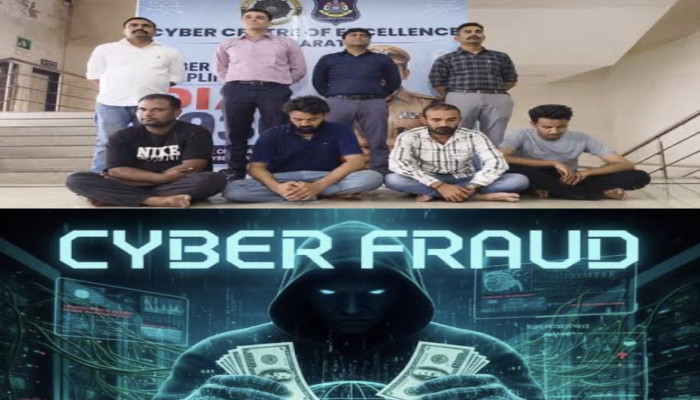
Gujarat Police has exposed one of India's biggest cybercrime networks under Operation Mule Hunt 2.0. The operation uncovered cyber fraud worth more than Rs 802 crore across the country. The investigation revealed fake companies, mule bank accounts and organised cybercrime activities spread across 22 states and Union Territories. Police have arrested 55 people over the past month in connection with the case.
The Cyber Centre of Excellence (CCOE) of Gujarat CID Crime led the operation. In the latest phase, police arrested four more accused from Ahmedabad and Surat. Investigators identified them as key members of different cybercrime networks. The accused allegedly created fake firms, managed mule bank accounts and helped cybercriminals move money collected through online fraud.
One of the main accused is Vishal Sureshbhai Dodiya, a resident of Vastral in Ahmedabad. According to the Gujarat CID Crime, Dodiya registered a fake company named Chamunda Communication. He then opened three bank accounts in the company's name at different banks. Police alleged that he handed these accounts to organised cyber fraud groups. These groups used the accounts to receive, transfer and launder money collected through cyber scams.
Investigators checked the accounts through the National Cyber Crime Reporting Portal (NCCRP). They found links to 253 cybercrime complaints registered across 22 states and Union Territories. These complaints involved fraud worth more than Rs 161 crore. The findings showed the large scale of the network and its reach across several parts of the country.
Police data showed that Maharashtra recorded the highest number of complaints with 56 cases. Karnataka reported 28 complaints, followed by Gujarat with 23. Telangana and Uttar Pradesh each registered 20 complaints. Rajasthan reported 18 cases, Tamil Nadu 16, Delhi 14 and West Bengal 13. Kerala recorded eight complaints, Andhra Pradesh seven, Assam and Punjab five each, Bihar four, Haryana and Jammu and Kashmir three each, Chhattisgarh, Madhya Pradesh, Odisha and Uttarakhand two each, while Arunachal Pradesh and Jharkhand reported one complaint each.
During the same operation, Gujarat Police also arrested Mohammad Khaliq Ghulam Husain and Shoaib Gulabnabi Rana from Surat in connection with the Bhavnagar District Cooperative Bank hacking case. Investigators alleged that hackers illegally entered the bank's servers, database and core banking system. They changed electronic records and created fake account balances. The group then transferred nearly Rs 7.34 crore into several bank accounts. Police alleged that Khaliq Hussain and Rana operated bank accounts that received and transferred the stolen money.
Police also arrested Afzal Pir Mohammad Mansuri from Ahmedabad in another mule account investigation. He was wanted in an earlier case linked to cyber fraud. Investigators found 197 bank accounts during the probe. Out of these, 60 accounts were connected to 132 cybercrime complaints from different parts of India. These complaints involved fraud worth Rs 53.55 crore.
According to investigators, Mansuri managed mule bank accounts and helped move money collected through cyber fraud. He allegedly arranged withdrawals and transferred the funds after other members of the syndicate opened the accounts. Police had already arrested ten accused in this case before Mansuri's arrest.
Investigators explained that a mule account is a bank account that a person knowingly or unknowingly gives to cybercriminals. Criminals use these accounts to receive, transfer or launder money collected through online fraud. They often lure account holders with promises of commissions or quick earnings. Once the account holder shares access to the bank account, ATM card, cheque book, SIM card or internet banking details, the account becomes part of the money transfer chain. Criminals move stolen funds through several accounts, making it difficult for investigators to trace the original source of the fraud.
Gujarat Police identified mule accounts as one of the strongest support systems for cybercrime. The department launched Operation Mule Hunt to trace these accounts, freeze suspicious transactions and break the financial networks that support online fraud. Officials believe that stopping the movement of illegal money can weaken cybercrime networks more effectively.
Operation Mule Hunt 2.0 is a statewide initiative led by the Gujarat Police's Cyber Centre of Excellence. The team is examining intelligence received from the National Cyber Crime Reporting Portal (NCCRP), the Indian Cyber Crime Coordination Centre (I4C), banking records and digital evidence. Investigators are using this information to trace mule accounts and identify organised cybercrime networks operating across India.
Officials believe that targeting the financial infrastructure of cybercrime rather than merely arresting individual fraudsters is proving to be an effective strategy in reducing online financial fraud across India.
Police have registered cases against the accused under relevant provisions of the Bharatiya Nyaya Sanhita (BNS) and Section 66D of the Information Technology Act. The investigation is still underway. Officers are tracing more bank accounts, identifying additional members of the syndicate and examining the complete extent of the nationwide cyber fraud network.
Authorities have also appealed to the public to remain alert while using banking services. They advised people not to share bank account details, ATM cards, cheque books or internet banking credentials with anyone. They warned that even allowing another person to use a bank account can make the account holder part of a cybercrime investigation. The police have urged citizens to stay cautious and report suspicious financial activities to help prevent such fraud.



 Loading...please wait
Comments