




Great Power Games: From Western Decline to Eastern Ascent
- In Book Reviews
- 05:45 PM, Apr 01, 2026
- Ramaharitha Pusarla
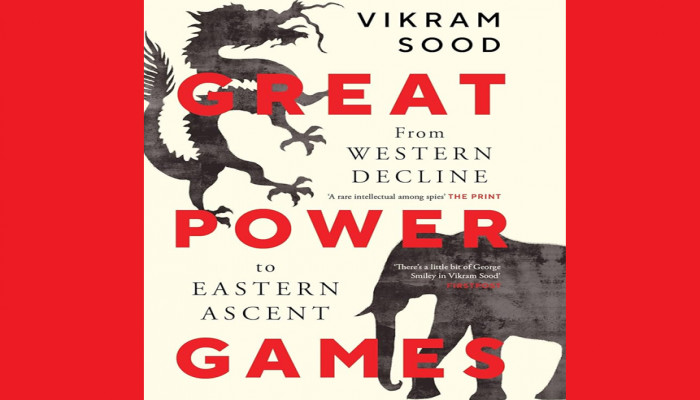
In the present age and time, information is not a scarce resource. However, the ability to knowledgeably interpret is. Drawing from his years of experience, Spymaster, former R&AW Chief, Sri Vikram Sood, in his latest work, “Great Power Games: From Western Decline to Eastern Ascent”, has effortlessly deconstructed the ambitious power play of Superpowers. Connecting the dots incisively, the book seamlessly unravels a panoramic view of global geopolitics.
This fitting trilogy, preceded by The Unending Game (on the intricacies of espionage) and The Ultimate Goal (on narratives), offers fascinating insights into the United States' relentless quest for domination. The pursuit of dominance and the unyielding effort to reassert control have never been benevolent. The structure of the Great Powers' policy has always relied on the pillars of Control and Dominance. The unmatched power accumulated by Superpowers grants them the freedom to walk away from agreements, revoke treaties at will, and violate the rules-based order with impunity. They can abandon allies, disown friends, and hold a free and unchecked reign to push the world into uncertainty. The only certainty about superpowers is their promising ability to plunge the world into instability and global disorder. The slew of executive orders signed hours into President Trump's inauguration, heightening global uncertainty, is proof of absolute power wielded by superpowers.
Control and Dominance rooted in the aspirations for a global title would turn any country into a hegemon. Supercharged with global ambitions and greed, great powers cease to be a Benevolent Global Hegemon. Indeed, a benevolent hegemon is an oxymoron, as the very oxygen for global supremacy is chaos. Any existential threat, or a war in any part of the globe, benefited the military-industrial complex of great powers, as they controlled all the essential resources. War has been a profitable enterprise through which great powers bolstered their dominance. While any country’s power is defined by its economy and military might, with a strangulating grip over the global tech, pharma, agriculture, health, financial system and currency, the United States has steadily positioned itself as a mighty power. War has become an opportunity to consolidate their military, tech and financial dominance and influence. Turbulence anywhere in the globe accrued cumulative benefits to collective capitalist guilds in the United States.
From the Gilded Age, a coalition of capitalists has incrementally monopolised industries, banking systems, energy and the investment ecosystem and reshaped the country's policies to fit their commercial interests. These exclusivist capitalist clubs, elite networks fostering the cohesion of economic and political forces, constituted the “Establishment”, which laid the foundations for the American empire in the 19th and 20th centuries. The “Establishment”, which is the “Deep State” of countries operating under the convenient narrative of democracy, is a complex working together of “military-industrial-pharma-technology-media-philanthropy-intelligence” (p4). This brilliant dissection of the “Deep State”, which wields immense and disproportionate influence in controlling the world, is at the core of the United States power calculus.
The book meticulously dissects the veritable arms of the deep state to help readers understand the “ultimate goal” of domination of Superpowers. The introductory chapters of the book delve into the different cogs of the imperialist Deep State axis and unpack this well-oiled machine that rides roughshod over other countries to retain global control. In the process, the author conclusively and unabashedly exposes the new order philanthropy. Dubbed as “good club”, a team of self-preserving elites backed (perhaps) by the Deep State, aligned with the US foreign policy goals, is creating markets for Western products and colonising the Third World. The early trendsetters of Philanthrocapitalism- Rockefeller and Carnegie established Foundations to keep the hegemony of Western interests intact. The contemporary subscribers to the so-called “Giving Pledge” include the representatives of Big Tech, Big Data, Big Telecom, Big Finance, Big Pharma, Big Ag and Big Media Behemoths. With direct accessibility to the leaders of the countries, these powerful voices, dressed as superheroes to save the world from doom, in reality are the predatory offshoots of the Capitalist World.
The opening three chapters of the book are nothing short of a revelation. With masterful clarity, they lay bare the big picture before plunging into the notion of “American Exceptionalism”, a subset of the broader idea of “American Empire” rooted in imperialistic tendencies. As the author observes, “Empires do not rise or die overnight, or even in a decade. Sometimes it takes generations. The American Empire has been the cleverest of all its predecessors. It ran its empire by remote control.”(p 123)
This trajectory of manifest destiny, traced back to the Renaissance and popularised by American thinkers and philosophers, finds expression in voices like Thomas Paine, who declared, “We have it within our power to begin the World over again”- to Hillary Clinton’s assertion, “ We are called upon to use this power” (p 91). For generations, Americans held to the belief that the rest of the world wanted to be like them but lacked the means. They assumed - “It was, therefore, America’s noble task to create American clones, which would then ensure peace”.
This self-adulation reached its zenith post-Soviet Union collapse. In its unipolar arrogance, the US recklessly used force against countries, ruthlessly ousting regimes and pushing countries into disarray, stating, “Realism demanded that America always be ready to fight wars with the greatest lethality as a way to maintain American exceptionalism” (p 92). Preparing to target Saddam Hussein, in 1998, Madeleine Albright remarked, “But if we have to use force, it is because we are America; we are an indispensable nation. We stand tall, and we see further than other countries into the future”. (p 92). America’s wars were “about American Exceptionalism, American Invincibility and American Righteousness” (p 93).
So, the theme of “America First”, which has become doubly popular since Trump’s second term, stretches back to the 19th century and is politically deployed at challenging times to revive nationalist sentiments. To put this into perspective, the author recalls, the presidential debate remarks of John F Kennedy on 1st October 1960- “I think we have to demonstrate to the people of the world that we’re determined in this free country of ours to be first- not first if, and not first but, and not first when- but first. And when we are strong and when we are first, then freedom gains, then the prospects for peace increase; then the prospects for our society gain” (P93). America First, which bred American Triumphalism and hubris, especially since its 21st-century wars on the Global War on Terror, culminating in needless imbroglio, set the United States on a decline. The Forever Wars and the rising costs of war have dented its global domination. A decline, though not precipitous, is imminent from the rise of new power centres or poles.
The United States has stretched to its limits. With military bases across 36 countries, the estimated maintenance cost per year is $900 billion or 5 per cent of GDP, together with the overt and covert regime change operations, which took a huge toll on the country. Over the last 100 years (1898-1994), the US has successfully led 41 coups in Latin America or an average of a leadership ouster every 28 years. The costly and futile wars in Iraq and Afghanistan have further exacerbated the economic uncertainties. Regardless of power and wealth, what mattered the most are- “Credibility, dependability and intention”. Once these perceptions plunge, a return journey (rise) is difficult.
The 2008 Financial Crisis, the Arab Spring, the COVID pandemic and the 2022 Ukraine war, which the US ended up provoking its old rival, augmented a New World Order. Alongside, the meteoric economic rise of an authoritarian China with its Middle Kingdom ambitions has changed the dynamics of the existing global order. The world is now staring at a second edition of the Cold War, with China steadily expanding its presence and influence, especially among the Global South Countries. Unlike the post–World War II Cold War era, when the US relentlessly stymied the Soviet Union without reprieve, it has adopted a restrained stance toward China despite the evident challenge to its global supremacy. Though China is weakening the American influence in Latin America and Africa, Washington is reluctant to take Beijing head-on due to the deeply integrated American corporate interests in China.
Smashing American illusions of a rising China becoming a liberal country is becoming more centralised and increasingly authoritarian. The multidimensional challenges posed by China are disregarded as Corporate America still thinks of it as a source of inexpensive products and not as an entity that threatens the American way of life. By controlling the global supply chains, China has positioned itself as a challenger to America.
Another important aspect often overlooked by strategic analysts is the Clash of Civilisations. The book offers a deeper insight into the pivotal role played by religion in terms of shaping the Empires. Western Civilisation is synonymous with the Christian civilisation, and Arab Civilisation became synonymous with Muslim Civilisation. Unapologetic about their allegiance towards their faith, all the Abrahamic religions and the respective civilisations proudly flaunt their identity. American Presidents openly flaunting their Christianity have promised faith-based education, healing and law enforcement. The American system is reconfigured on the Graeco-Roman framework. Now Europe is on the brink of being Islamised. The clash of civilisations, as envisaged by Samuel Huntington, is inevitable as both grapple for domination. India, with the second-largest Muslim population, is bound to face the impact of such a clash.
India is on the verge of an economic boom, and its rise is unsettling global players. Amid the shifting power dynamics, India is positioning itself as a key ‘actor’ alongside China and Russia, reinforcing the eastward shift of the global power centre. India’s growing international profile is no longer ignored. However, India’s future faces obstacles—“India has the most irritating problem with Pakistan, the most vexing with China and the most complicated with the US. Then, there is an enemy within” (p 267). While optimistic about India’s progress, the book warns of a dominant Western narrative that deliberately overlooks India’s achievements and blatantly undermines its democratic and pluralistic credentials. By penetrating civil society, co-opting dissenters, through a vast network of NGOs and think-tanks supported by the CIA, all the global indices are creating a negative perception about India. This unhinged propaganda is an unvarnished attempt to install an amenable “friendly regime” that safeguards Western interests in the region. “The idea now is to shift the narrative away from China and target India. The reason being that China is far too powerful now, and there are too many deep Western financial and trade entanglements with China, so any harsh action against it could rebound on Western corporate interests”. (p 276)
Overtly, India and the US have a comfortable relationship anchored in shared values. But the self-proclaimed friends of India are working against India’s interests. National interests rather than shared values should be the guiding principle for India. “A superpower has only its interests in sight; no one else’s interests matter” (p302). Living next door to a hegemonic neighbour that expects nothing short of subservience, India has to tackle the Dragon across the mountains. It is also worth recalling that Empires may have allies but no friends and prefer vassal states. Laying bare the dynamics of the power calculus in an unobtrusive way, Sri Vikram Sood ingeniously sets the reader to analyse, think and prudently assess the ruthless foreign policies of the Great Powers determined to retain their global supremacy.
Prudence lies in identifying obstacles and insidious narratives widely amplified by the Big Media Behemoths and being prepared for them. He states, “It is never a bad idea to try and turn an enemy into a friend, but whatever action a strategist must take, a country should not become a naïve victim. It must be armed with prudence, the ability to detect the enemy within and never ever lower one’s guard, not even for friends” (p8).
Structured into ten chapters, the book provides a comprehensive perspective of international affairs. Enriched with real-world insights into covert operations, proxy wars, the “Deep State,” and its entrenched, clandestine networks, the book serves as a definitive guide to understanding Great Powers’ pursuit of dominance. The perspectives in the volume built on the solid foundation of years of working on national security must be internalised. Beyond urging strategists and the dispensation to recognise the importance of developing indigenous social media platforms to present our viewpoint to the world, the book underscores the critical integration of military, economic and civilisational foundations as essential for building a strong and self-reliant nation.
Sri Vikram Sood’s latest work is an indispensable treatise to ruminate on for strategist analysts, policy makers, foreign policy experts, scholars on international relations and citizens who closely monitor geopolitics.
Disclaimer: The opinions expressed within this article are the personal opinions of the author. MyIndMakers is not responsible for the accuracy, completeness, suitability, or validity of any information on this article. All information is provided on an as-is basis. The information, facts or opinions appearing in the article do not reflect the views of MyindMakers and it does not assume any responsibility or liability for the same.



 Loading...please wait
Comments