




Graham’s 100% Tariff Act: A Senate Split and a Blow to the Communist–Jihadi Axis
- In Current Affairs
- 07:04 PM, Sep 19, 2026
- Viren S Doshi
Lindsey O. Graham Sanctioning Russia and Iran Act of 2026 (H.R. 5334)
Being the biggest importer and sitting on global trade currency, and strategically weaponising US import-dominant foreign trade, US President Donald Trump signed the Lindsey O. Graham Sanctioning Russia and Iran Act of 2026 (H.R. 5334) into law on Friday, September 18, 2026. The powers (including the discretionary tariffs of up to 100% on the five largest purchasers of Russian oil/gas and facilitators of sanctions evasion, plus expanded Russia sanctions and the five-year extension of the Iran Sanctions Act of 1996 through 2031) are now available to the President to implement. Implementation of specific tariffs or additional sanctions remains at the President’s discretion (with the statutory timelines and waiver provisions applying).
The law does not automatically apply 100% tariffs to any specific country the moment it is signed. It is to be determined whether a country was among the five largest importers, by total volume, of crude oil or natural gas originating in Russia during the most recent 12-month period preceding the date of enactment, and whether a country knowingly makes new purchases of Russian-origin crude oil or natural gas on or after 30 days after the enactment. There is also a parallel “top 5” category for countries that facilitate Russian oil sanctions evasion (e.g., via the shadow fleet). Understandably, the list can not be static. The U.S. Trade Representative (in consultation with the Secretaries of State and Energy) must assess, reassess and update which countries meet the “five largest” criteria every 180 days based on the most recent data.
Why media reports mention five specific countries
Analysts, media, and some lawmakers have publicly projected the likely top five based on current trade data (China and India as the clear top two for crude, followed by others such as Turkey, Slovakia, Hungary, Azerbaijan, etc., depending on whether one looks at oil, gas, or combined volumes). These are informed estimates. An amendment that would have explicitly named a longer list of countries was proposed in the House but was not adopted. The final text that passed both chambers keeps the neutral, volume-based “five largest” standard.
As of now, Communist Regime-ruled China remains the largest buyer of Russian crude (often around 47–50% of exports, plus substantial pipeline gas and other fuels), generating higher revenues for Moscow.
India ranks second (typically 36–38%, though monthly seaborne figures have sometimes fluctuated due to discounts and logistics). Some Indian commentary has portrayed the Act as anti-India because of New Delhi’s pragmatic purchases of discounted Russian crude to secure affordable energy for 1.4 billion people.
In reality, the quantitative and strategic weight falls more heavily on Communist China due to larger absolute volumes, deeper strategic alignment with Russia, and greater resistance to Western pressure.
India’s publicly stated diversification plans and market-driven sourcing provide clearer grounds for potential waivers if the Russian share declines.
The President has significant discretion: Whether to impose the tariffs at all. At what rate, on which country (anywhere from a positive rate up to 100%). Whether to grant waivers (the law explicitly allows national-security or other waivers). How and when to act.
Executive Orders / Presidential Actions
The President will almost certainly issue one or more executive orders, proclamations, or directives to implement the law anytime now, as soon as he has the required authentic information on his table. There is no legal requirement that he must issue a separate executive order for each country. He can act on multiple countries in a single instrument or handle them case-by-case. We need to watch for the first presidential determination or executive action to see exactly how he chooses to apply it.
Ayatollah Regime-ruled Iran-related portion of the Act
That part amends the existing Iran Sanctions Act of 1996 (Public Law 104-172) by extending the expiration year from “2026” to “2031,” giving a five-year extension. This preserves the President’s authority to impose sanctions on persons involved in Iran’s energy sector or certain weapons-related activities.
The Act will lead to many implications, but in its passing, it has already dented the leftist Democratic Party.
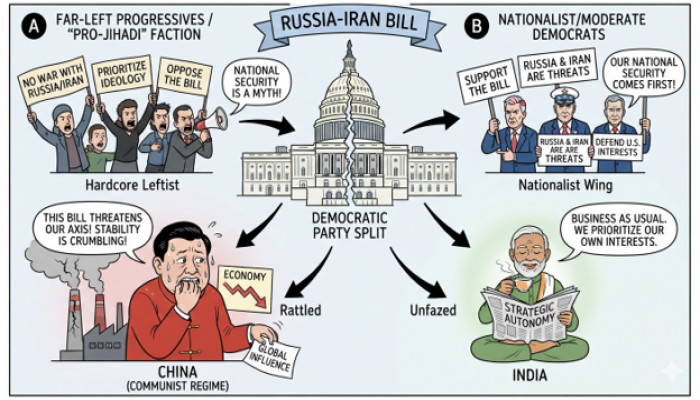
Act split the Leftist Democratic Party almost vertically
On September 16, 2026, the U.S. House of Representatives passed “the Lindsey O. Graham Sanctioning Russia and Iran Act of 2026 (H.R. 5334)” bill by a 262-159 vote (Roll Call 308). The Senate had approved it 86-11 in August. Named after the late South Carolina Republican Senator who championed tougher pressure on Moscow until his death in July, the 61-page legislation divided the leftist Democrats and consolidated the nationalist Republicans.
The Split, Vote Polarisation: Far Leftist versus Centrist Democrats, Indian-American Lawmakers, and a Handful of Republicans
The catch-22 left the leftists divided. Leftist Opposition centered primarily on the breadth of new tariff authority granted to the President, of course not on defending Russian energy sales.
Far left Democrats—including Democrat leaders like “Hakeem” Jeffries—voted against the final amended version, warning it ceded broad tariff and trade powers.
House “Nay” votes:
House Democratic opposition (152 “nays” overall): Hakeem Jeffries (D-NY), Katherine Clark (D-MA), Pete Aguilar (D-CA), Gregory Meeks (D-NY), and Richard Neal (D-MA) opposed the measure.
Indian-American Far Left Democrats Ro Khanna (D-CA), Shri Thanedar (D-MI), Ami Bera (D-CA), Suhas Subramanyam (D-VA) and Pramila Jayapal (D-WA) voted against the bill along with Ilhan Omar (D-MN) and Rashida Tlaib (D-MI).
In contrast, 58 Democrats (including some defence hawks and institutionalists) joined most Republicans in support. Lone Centrist Indian American Congressman Raja Krishnamoorthi (D-IL) voted yes. This decision carries particular resonance in light of RSS chief Dr Mohan Bhagwat’s clear statement that Indian (or Hindu) Americans must remain loyal to their Karmabhoomi—the land of their work and life. Krishnamoorthi’s support for the bill, which prioritises U.S. national-security interests and pressure on the war machine, can be read as an affirmation of that principle: loyalty to the United States as the primary arena of civic duty and contribution, even while maintaining value-based cultural and familial ties to India. From both a U.S. nationalist perspective (backing tools against adversaries funding a major conflict) and Indian diaspora perspective aligned with Bhagwat’s guidance, the vote was consistent and appropriate. It differentiated him from his far-left colleagues who prioritised leftism and communism on executive tariff power.
House Republican “Nay” votes (the seven):
Thomas Massie (R-KY), Andy Harris (R-MD), Ralph Norman (R-SC), Keith Self (R-TX), Tom McClintock (R-CA), Chip Roy (R-TX), and Warren Davidson (R-OH). These members generally come from the more libertarian or limited-government wing sceptical of expanded executive powers.
Senate “Nay” votes (11 total on final passage):
Lisa Blunt Rochester (D-DE), Maggie “Hassan” (D-NH), Mazie Hirono (D-HI), Ed Markey (D-MA), Jon Ossoff (D-GA), Alex Padilla (D-CA), Elizabeth Warren (D-MA), Peter Welch (D-VT), Ron Wyden (D-OR), Bernie Sanders (I-VT).
Rand Paul (R-KY—the sole Republican; a consistent non-interventionist critic of broad sanctions and tariff delegations).
Senate Minority Leader Chuck Schumer (D-NY) supported the bill.
So even before it became an act, the statute left the leftist Democrats horribly divided.
Pressure on Ayatollah Regime
On Iran, the five-year extension of the Iran Sanctions Act sustains and strengthens longstanding restrictions on entities investing in Iran’s energy sector. It limits funding for the regime’s weapons activities, military cooperation with Russia, and terrorism sponsorship. The extension does not invent entirely new authorities but reinforces the existing architecture constraining the Ayatollah regime’s revenues and international partnerships. This is a dent in the Communist Jihadi Axis.
India, China and other countries
U.S. goods imports from India recently totalled roughly $100–104 billion annually, with two-way goods-and-services trade around $240 billion. A full 100% tariff (if applied) would disrupt Indian exporters in affected categories, though the authority is discretionary and India can mitigate through diversification, negotiation, or demonstrated reduction in Russian purchases. India is already on to this, and it is an important strategic partner too.
U.S.-China goods trade is substantially larger, so equivalent tariffs would carry greater absolute impact and systemic risk.
India’s Ministry of External Affairs has monitored the legislation closely through its stages. Following House passage, the MEA reaffirmed that India remains “firmly committed to ensuring energy security for its 1.4 billion people” through diversified sourcing based on evolving market dynamics. It noted high-level discussions with U.S. interlocutors on the implications for bilateral ties and the international energy market, while emphasising determination to protect India’s trade and economic interests and coordination with industry. Earlier briefings stressed that oil purchases serve national and global priorities rather than any single supplier.
Last Word
The Graham Act illustrates the complicated collision of leftist Ukraine support, domestic U.S. politics, executive trade powers and energy geopolitics. Navigating it to its goals would require tactful steering by the stakeholders, including natural democratic allies.
While leftist Democrats fell divided on home turf, the Act’s practical design and data place heavier pressure on Communist China’s larger Russian energy purchases.
Indian-American lawmakers Ro Khanna, Shri Thanedar, Ami Bera, and Suhas Subramanyam joined the “nay” side on the final amended package, while Raja Krishnamoorthi’s “yes” vote aligned with both U.S. security priorities and the principle of loyalty to Karmabhoomi.
Outcomes will hinge on how—or whether—the president deploys the new discretionary authorities, with potential waivers remaining available for nations demonstrating credible reasons and plans for diversification.
Disclaimer: The opinions expressed within this article are the personal opinions of the author. MyIndMakers is not responsible for the accuracy, completeness, suitability, or validity of any information on this article. All information is provided on an as-is basis. The information, facts or opinions appearing in the article do not reflect the views of MyindMakers and it does not assume any responsibility or liability for the same.



 Loading...please wait
Comments