




Governor dissolves Bengal assembly, Mamata Banerjee removed as Chief Minister
- In Reports
- 04:16 PM, May 08, 2026
- Myind Staff
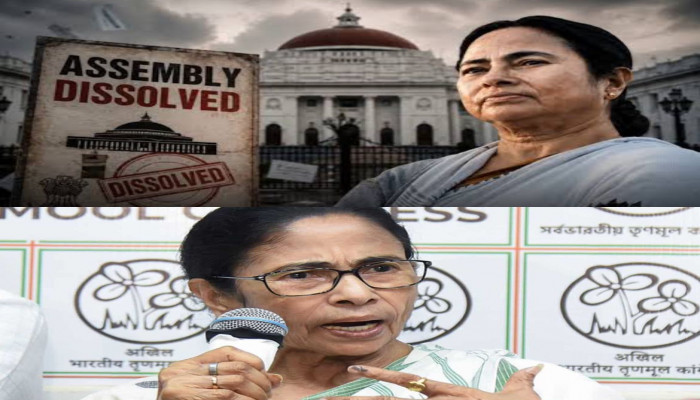
Mamata Banerjee is no longer the Chief Minister of West Bengal after Governor RN Ravi dissolved the state assembly on Thursday. The move officially brought an end to the All India Trinamool Congress government in the state.
The governor exercised the constitutional powers granted to him under Article 174 (2)(b) of the Constitution of India. In the official notice, RN Ravi stated, "I hereby dissolve the Legislative Assembly of West Bengal with effect from 7th May, 2026."
The development came after Mamata Banerjee continued to hold on to the Chief Minister’s post despite the end of her government’s term. The 71-year-old leader remained firm in her stand and repeatedly alleged that the Bharatiya Janata Party secured its breakthrough victory in the state through unfair means. She accused the opposition of vote looting and electronic voting machine tampering during the elections.
Banerjee also claimed that the Election Commission of India worked in favour of the BJP to remove her party from power. According to her, the BJP had won the election “immorally”. Despite mounting pressure and constitutional concerns, she did not step down from the post after the expiry of the government’s term.
The term of the Bengal government ended a day before the assembly was dissolved. Former Government of India Secretary Jawhar Sircar explained that until a new Chief Minister takes oath, the governor is expected to take interim charge of the state administration.
The political atmosphere in West Bengal has remained tense since the election results were announced. The Trinamool Congress alleged that votes were looted in nearly 100 seats where its candidates had initially maintained leads during counting. The party raised concerns over the fairness of the election process and questioned the final outcome.
To maintain law and order during polling, hundreds of central security personnel were deployed across the state. However, violence erupted in several areas after the results were declared. The post-poll clashes have already claimed multiple lives. More than five people have reportedly died in the violence so far.
Among those killed was Chandranath Rath, an aide of BJP Chief Ministerial frontrunner Suvendu Adhikari. Rath was allegedly shot dead at point-blank range in Madhyamgram during the unrest. The incident further escalated political tensions in the state.
Meanwhile, the BJP has not yet announced its Chief Ministerial candidate for West Bengal. The party is expected to make a decision soon. A meeting of BJP MLAs has been scheduled for tomorrow to elect the leader of the legislative party. The elected leader is likely to become the next Chief Minister of the state.
The dissolution of the assembly has also drawn attention to Article 174 (2)(b) of the Constitution of India, which gives governors certain powers regarding state legislatures. Article 174, Clause 2 states, "The governor may from time to time — (a) prorogue the House or either House; (b) dissolve the legislative assembly."
The Article gives the governor two important powers. Under sub-clause (a), the governor can prorogue the House, which means ending a session of the state legislature without dissolving it. In such a case, the legislature can be called again for another session later.
Sub-clause (b), however, allows the governor to dissolve the legislative assembly completely. Once the assembly is dissolved, the process for fresh elections begins. This constitutional provision is generally used when the government’s term has ended or when the government can no longer continue legally.
Earlier, constitutional experts had also spoken about the situation and explained why it would be unconstitutional for Mamata Banerjee to continue as Chief Minister after losing the polls and after the completion of the government’s five-year term. According to them, if she refused to resign, the governor would have no option but to dissolve the assembly because a government cannot continue beyond its constitutional term limit.
With the assembly now dissolved, West Bengal enters a transition phase until a new government is formally formed and sworn in.



 Loading...please wait
Comments