




Government doesn’t want to control temples, Centre tells Supreme Court
- In Reports
- 07:32 PM, Apr 22, 2026
- Myind Staff
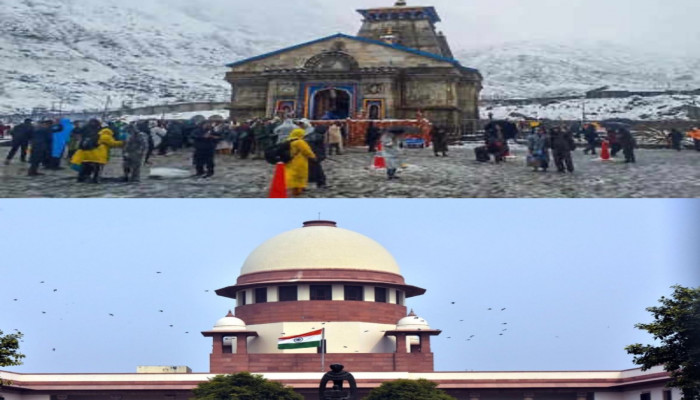
The Centre on Tuesday informed the Supreme Court that it does not support government control over temples, even as several religious institutions across India continue to be managed by state-supervised bodies. The clarification came during an ongoing debate on faith and fundamental rights before a nine-judge bench led by Chief Justice of India Surya Kant.
The Centre stated that its position was based on its interpretation of constitutional provisions. It emphasised that while the Constitution allows the state to regulate certain aspects of religious institutions, this should not be seen as an intention to take control of temples. The discussion mainly revolved around Articles 25 and 26, which deal with religious freedom and the management of religious affairs.
Senior advocate Gopal Sankaranarayanan argued during the hearing that Solicitor General Tushar Mehta, representing the Centre, and senior advocate A M Singhvi, appearing for the Travancore Devaswom Board, had presented an interpretation suggesting that the government aimed to control temples. The Travancore Devaswom Board manages the Sabarimala Ayyappa Temple.
In response, Mehta sought permission from the bench to clarify his position. He said, “Government does not want to control the temples at all and what he mentioned was purely a constitutional interpretation of Article 25(1)(a), which empowers the state to manage economic, political and secular activities of any religion.” He stressed that his arguments were limited to explaining constitutional provisions and not advocating state control over religious institutions.
During the proceedings, Justice Amanullah questioned whether Mehta’s argument that the government should not control temples applied only to Hindu religious institutions. This raised the issue of whether the Centre’s stance was specific to one religion or applied universally. In reply, the Solicitor General said that constitutional interpretation should not be viewed through the lens of any particular religion. He stated that discussions in court must remain neutral and should not be seen as favouring or targeting any specific faith.
Justice Bagchi added that constitutional interpretation must be approached from the perspective of a citizen rather than a religious identity. Responding to this, Mehta said he had already presented a broad overview of the diversity present in different religions, including Hinduism, Islam, Christianity, Buddhism, and other denominations. His argument aimed to underline that constitutional principles apply equally to all.
The issue gains importance in the context of how temples are currently managed in several states. In Kerala, multiple state-supervised Devaswom Boards such as Travancore, Cochin, Malabar, Guruvayur, and Koodalmanikyam oversee around 3,000 temples. Similarly, in Tamil Nadu, the Hindu Religious and Charitable Endowments Department manages more than 30,000 temples. In Andhra Pradesh, the Tirumala Tirupati Devasthanam Trust Board is responsible for the administration of the Tirupati Balaji temple. Karnataka also has a department dedicated to managing Hindu religious institutions and charitable endowments. In Uttarakhand, the Chardham Devasthanam Board looks after major shrines like Badrinath and Kedarnath.
The Centre’s statement comes at a time when questions are being raised about the extent of state involvement in religious institutions and whether such control aligns with constitutional principles. By clarifying its position, the government has attempted to distance itself from the idea of directly controlling temples, while maintaining that the Constitution does allow regulation of their secular aspects.
The hearing reflects a broader debate on the balance between religious freedom and state oversight. The Supreme Court is currently examining how constitutional provisions should be interpreted in this context. The outcome of this discussion is likely to have significant implications for the management of religious institutions across the country.



 Loading...please wait
Comments