




Global Recognition for Bhojpuri Heritage: 105-Year-Old Folk Singer Jang Bahadur Singh Receives ‘Son of Siwan, Pride of Bihar’ Award
- In History & Culture
- 10:34 AM, Mar 04, 2026
- Rudra Dubey
Bhojpuri is far more than a language—it is a vibrant cultural civilisation shaped by centuries of tradition, literature, music, and collective memory. Spoken by more than 200 million people worldwide, Bhojpuri represents one of the most dynamic cultural identities of the Indian subcontinent. From the villages of Bihar and eastern Uttar Pradesh to diaspora communities in Mauritius, Fiji, Suriname, and the Caribbean, Bhojpuri culture has travelled across oceans while preserving its deep-rooted traditions.
The richness of Bhojpuri culture is reflected through its folk traditions, devotional singing, classical influences, literature, theatre, and cinema. Generations of artists—often unsung—have nurtured this heritage through their voices and creative expression. Leaders, including PM Narendra Modi, have acknowledged Bhojpuri culture as an important part of India’s cultural diversity and its global diaspora identity.
Bhojpuri Music: A Cultural Lifeline and in Bhojpuri DNA
Music is the heartbeat of Bhojpuri culture. From birth to marriage, from harvest celebrations to migration journeys, songs accompany every stage of life.
Traditional Bhojpuri musical forms include Sohar (songs celebrating childbirth), Kajri (monsoon songs of longing), Chaita (springtime folk singing), Biraha (songs of separation and migration), and Bidesia, a theatrical musical form that reflects the emotional struggles of migrant labourers.
These traditions are more than artistic expressions—they are living archives of social history, reflecting the aspirations, struggles, devotion, and resilience of the people.
Bhojpuri music has also drawn inspiration from classical Indian traditions. Folk performers often incorporate classical ragas such as Bhairavi, while the Vyas style of Ramayan recitation blends devotional storytelling with musical narration. These traditions have created a unique cultural bridge between classical and folk music.
Bhojpuri Culture Beyond Borders
The Bhojpuri cultural journey expanded globally during the 19th century when thousands of people from the Bhojpuri-speaking regions migrated overseas. With them travelled their language, songs, instruments, and traditions.
Today, Bhojpuri culture continues to flourish in countries like Mauritius, where it is recognised as a key part of national heritage. Similar cultural continuity exists in Fiji, Suriname, and Trinidad & Tobago, where Bhojpuri music and festivals remain vibrant expressions of identity.
A deeply moving tribute to this cultural legacy took place on February 28, 2026, at Jiradei, the birthplace of Rajendra Prasad, India’s first President.
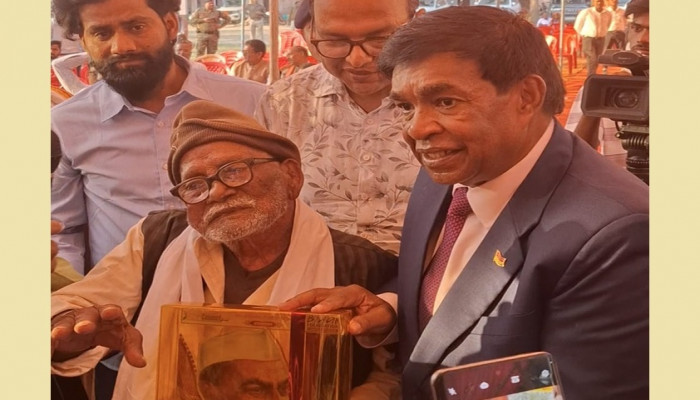
On the occasion of Dr Rajendra Prasad’s death anniversary, a ceremony organised by Bihari Connect in collaboration with the Bihar Foundation honoured one of Bhojpuri culture’s living legends—Jang Bahadur Singh.
At the age of 105, the veteran folk singer and freedom fighter was conferred the “Son of Siwan, Pride of Bihar” award.
The award was presented by Prithvirajsing Roopun, the former President of Mauritius. In a rare and deeply symbolic gesture of respect, he stepped down from the stage to personally honour the elderly artist—an act that resonated deeply with the audience and reflected the reverence for Bhojpuri cultural heritage.
Speaking at the ceremony, Dr Udeshwar Singh, President of Bihari Connect, remarked that honouring Jang Bahadur Singh is not merely recognition of an individual but a celebration of the entire tradition of Bhojpuri folk music and its contribution to India’s cultural heritage.
Born on December 10, 1920, in Kausar village under Raghunathpur block of Siwan district, Jang Bahadur Singh grew up in an era when music often served as a medium of resistance and awakening.
During the Indian Independence Movement, particularly between 1942 and 1947, he travelled from village to village singing patriotic Bhojpuri songs that awakened the spirit of freedom among rural communities.
For his patriotic activities, he endured persecution under British rule and even imprisonment. Yet his voice remained unwavering in its dedication to the cause of independence.
Later, while working at the Sen Raleigh Cycle Factory in Asansol in West Bengal, he continued spreading Bhojpuri musical traditions. Through the Vyas style of singing, he gained recognition across regions including Jharia, Dhanbad, Durgapur, Sambalpur, and Ranchi.
His voice was legendary—people often recalled that his singing could carry across large distances without a microphone, drawing crowds wherever he performed.
By the 1960s, he had reached the pinnacle of Bhojpuri music. For nearly two decades, his performances elevated Bihar’s cultural prestige across eastern India.
A Legacy That Built Bhojpuri Music
Renowned Bhojpuri singer Bharat Sharma Vyas once remarked that Jang Bahadur Singh laid the foundation upon which modern Bhojpuri music later flourished. Similarly, celebrated singer Munna Singh Vyas advocated that he deserved national recognition, such as the Padma Shri, recalling a time when his influence in dugola singing competitions was unmatched.
Beyond music, Jang Bahadur Singh was also a skilled wrestler who earned distinction in traditional dangals in the coal belt region.
Today, at the remarkable age of 105, Jang Bahadur Singh lives a quiet life away from the spotlight. Yet the honour bestowed upon him in Jiradei stands as a powerful reminder of the countless artists who have preserved Bhojpuri culture through dedication and passion.
The “Son of Siwan, Pride of Bihar” award is therefore more than a personal accolade—it is a tribute to the enduring spirit of Bhojpuri music and the cultural legacy carried by generations of artists.
As Bhojpuri culture continues to flourish across the world, the voice and legacy of pioneers like Jang Bahadur Singh will remain forever etched in the cultural history of India.



 Loading...please wait
Comments