




Glasgow 2026: The Bharat Behind the Medals
- In LifeStyle & Sports
- 02:57 PM, Aug 18, 2026
- Dr Nikhilesh Pathak
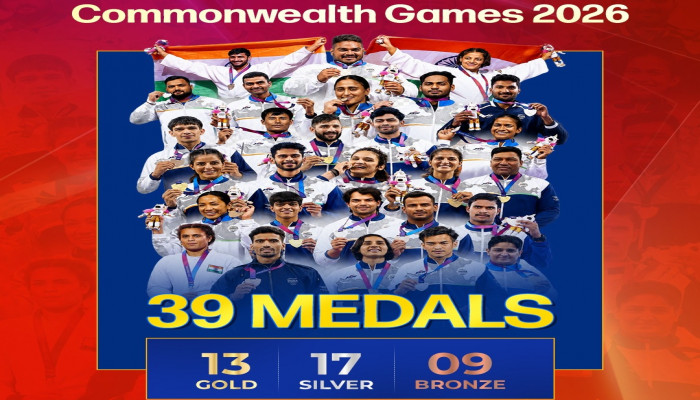
India’s Commonwealth Games 2026 campaign in Glasgow has produced 39 medals along with a few records and historic firsts. But behind the podium finishes lies a story far more powerful than Bharat – ‘jugaad’ in adversity, family sacrifice, respect for the Guru, courage in service, humility and the refusal to give up.
Consider the triumphs of Sharmila Dhankar, Seema Kaliramna, and Asmita Dey. They represent far more than athletic milestones, reflecting a powerful narrative of resilience, responsibility, and the multidimensional strength of Bharatiya Nari Shakti. Their achievements showcase how modern athletes honour family values and tradition while forging their own paths to excellence, leading the country to glory.
There is a reason Indian tradition has preserved stories of women such as Savitri, who confronted fate itself with extraordinary determination, and Durga, whose strength is invoked when adversity demands courage. These stories have endured not simply because their protagonists were powerful, but because they represented a deeper idea of womanhood – strength that can coexist with compassion, responsibility, tradition and sacrifice.
Sharmila Dhankar’s shot-put gold is a testament to victory over profound personal trauma. After enduring years of domestic abuse and being forced out of her home with two young daughters, she rebuilt her life with unwavering support from her parents. Her journey highlights the Indian family structure as a vital sanctuary that grants women the confidence to rise again. Twelve years after the darkest chapter of her life, the 40-year-old made history as India’s first Commonwealth Games para-athletics gold medallist with a 9.81m throw. Like Savitri, Sharmila refused to let adversity dictate her ending, proving that her medal was a result of self-respect, motherhood, and unwavering courage and that she did not have to give up on her role as a mother for professional pursuits. Indian women have perfected the art of balancing the home front with their career aspirations. Family and tradition do not come in the way, rather act as a support system propelling them to heights of success.
On the other hand, Seema Kaliramna exemplifies a seamless synthesis of intellect, motherhood and elite sport. A mother, PhD researcher, and bronze-medallist thrower (58.65m), Seema returned to competition after motherhood without compromising her academic or domestic obligations. A balance of rigorous training, scholarship, and family responsibilities draws on the intellectual legacy of ancient women sages and scholars like Gargi and Maitreyi. Seema demonstrated that an accomplished woman need not sacrifice one identity for another; she can be a devoted mother, a scholar, and a champion simultaneously, leaving an enduring legacy for her young son.
Asmita Dey’s judo gold carries profound values of memory, care for parents, and community. The daughter of a bicycle mechanic from Tripura, Asmita stepped onto the mat just months after her father’s death. Rather than letting grief derail her, she transformed her pain into purpose, offering her victory as a tribute to the parent who guided her journey. In true alignment with Indian tradition, her success was not a solitary conquest, but a shared offering that brought immense pride to her family, village, and nation. There is also something distinctly Indian about the way such victories are understood and celebrated in the country – not simply as individual accomplishments, but as offerings to those who stood behind the athlete. Individual achievements become a source of pride for the village, the community, the nation.
Para-athlete Dilip Gavit’s 100m T47 gold is a testament to India’s timeless Guru-Shishya Parampara, demonstrating how a mentor’s guidance can unlock extraordinary human potential. After losing his right forearm as a child, Gavit ran on dusty village roads until Coach Vaijnath Kale recognised his innate talent and took him under his wing. A reflection of the sacred bond between the teacher and the student in Indian tradition – Chanakya and Chandragupta Maurya, Krishna and Arjuna, Guru Dronacharya and Arjuna, Guru Vashishtha and Bhagwan Rama, Satyakama and Sage Haridrumata Gautama, Ramakrishna Paramahamsa and Swami Vivekananda – where a master shapes courage into strategic greatness – Kale provided much more than athletic training. He offered Gavit food, shelter, equipment, and the unshakeable belief required to overcome immense adversity. Kale did not run the race for Gavit; he prepared him to conquer his own battles on the world stage. By dedicating his historic medal as Guru Dakshina, Gavit honoured a profound cultural truth: true mastery is a gift of the Guru’s vision, transforming physical limitation into world-class triumph.
Soman Rana’s shot-put gold embodies service, resilience, and the essence of Karmayoga. A Gorkha Rifles soldier who lost his leg in a 2006 landmine blast, Rana refused to let tragedy define his fate. His story parallels Arjuna’s journey in the Mahabharata, where acceptance was not surrender, but the prelude to duty. Supported by the Artificial Limb Centre in Pune, Rana embraced his new reality with military discipline, transforming adversity into purposeful action. Rana’s triumph reflects an enduring truth: true strength lies in accepting what cannot be changed while relentlessly pursuing what can be done. His victory is a testament to performing one’s duty with unyielding courage, regardless of the battlefield, a message found in the Indian tradition through the teachings of the Bhagavad Gita.
Similarly, Tejaswin Shankar’s journey exemplifies resilience, continuous learning, and selflessness. After a chronic knee injury derailed his high jump aspirations, he adapted courageously to win India’s first-ever Commonwealth Games medal in the gruelling decathlon. Beyond athletics, Shankar embodies the pursuit of knowledge. Possessing bachelor’s and master’s degrees in accounting, he views education as a lifelong endeavour. His selflessness shines through his actions off the podium: after his own disappointment, he remained behind to coach teammate Sarvesh Kushare to a silver medal, proving that uplifting others never diminishes personal success. Shankar’s story transcends sport, providing important life lessons: accept setbacks with resilience, train both body and mind, generously share knowledge, and remain humble enough to keep learning. These are the core values of Bharat’s ancient knowledge system.
Sakshi Chaudhary and Priya Ghanghas embody the dynamic ambition of India’s new generation of female boxers, while highlighting a powerful cultural value: cross-sport solidarity. Inspired to pursue boxing by Vijender Singh, Sakshi later received crucial financial backing from cricketer Virat Kohli. Kohli’s gesture proves that aiding a fellow Indian transcends the boundaries of one's own sporting career. This story beautifully illustrates unity in diversity within the nation's sporting ecosystem. A celebrated cricketer empowering a young boxer demonstrates how one sport can nurture another, ensuring that success is passed down through generations. Ultimately, Sakshi’s journey completes a circle of inspiration—moving from Vijender's achievements to Kohli's generosity. It underscores a timeless truth in Indian sports: though the playing fields and rings may differ, every athlete ultimately competes with a hope to lift the Tricolour.
The Glasgow medals may carry individual names, but the stories behind them reflect the values that define India—perseverance, duty, respect, knowledge, resilience, humility and collective support. From the Guru-Shishya tradition to the strength of Indian women, from service to selflessness, these champions show that sporting excellence is rooted in values nurtured beyond the field. The medals may belong to the athletes, but the values they embody belong to India and its glorious civilisation which can inspire the next generation of sporting accomplishments.
Disclaimer: The opinions expressed within this article are the personal opinions of the author. MyIndMakers is not responsible for the accuracy, completeness, suitability, or validity of any information on this article. All information is provided on an as-is basis. The information, facts or opinions appearing in the article do not reflect the views of MyindMakers and it does not assume any responsibility or liability for the same.


 Loading...please wait
Comments