



German investments in China at four-year high amid US trade wars: Report
- In Reports
- 08:02 PM, Jan 27, 2026
- Myind Staff
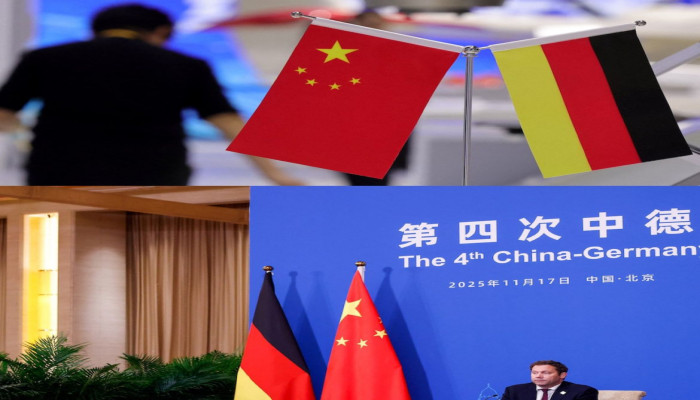
German companies significantly increased their investments in China in 2025, reaching a four-year high, according to data compiled for Reuters. This rise highlights how U.S. President Donald Trump’s trade policies are pushing businesses and governments to strengthen economic ties with other countries, especially China.
Data from the IW German Economic Institute, which had not been previously reported, shows that German investments in China rose to more than 7 billion euros between January and November 2025. This marks an increase of 55.5% compared to € 4.5 billion recorded in both 2024 and 2023. The figures indicate that companies in Germany, Europe’s largest economy, are increasingly turning towards China as an alternative market amid tensions caused by U.S. tariffs.
The shift is happening alongside similar moves by other countries. Britain’s government is visiting China this week with a delegation aiming to secure new business deals in sectors such as automobiles and pharmaceuticals. At the same time, the European Union is nearing a trade deal with South America, while Canada is trying to expand trade agreements with China and India.
Germany has been trying to maintain a delicate balance in its relationship with China. On one hand, Berlin has toughened its stance on Beijing over trade and security concerns. On the other hand, it is trying to avoid damaging its fundamental relationship with China, which remains its top trading partner.
“German companies are continuing to expand their activities in China – and at an accelerated pace,” said Juergen Matthes, head of international economic policy at the IW institute. He pointed out that companies are increasingly strengthening their local supply chains in China.
Reuters had earlier reported that German companies nearly halved their investments in the United States during the first year of Trump’s second term. This further shows how trade tensions are influencing corporate investment decisions.
China regained its position as Germany’s top trading partner in 2025, after being overtaken by the United States in 2024. This shift was driven by rising imports from China, the world’s second-largest economy.
Concerns about global political instability have also played a role in the changing investment pattern. Matthes explained that fears of “geopolitical conflicts” are encouraging companies to expand their operations in China so that they can operate more independently in case of major trade disruptions.
“Many companies say: ‘if I’m only producing in China for China, I’m reducing my risk of being affected by possible tariffs and export restrictions’,” he said.
Several major German companies remain strongly dependent on the Chinese market. These include BASF, Volkswagen, Infineon, and Mercedes-Benz. China is a key market for these firms, especially in industries such as automobiles and chemicals, where a large share of global demand exists.
Volkswagen stated that both the Chinese and U.S. markets are strategically important for the company. The automaker said investments in both markets are being made “independently of one another” in line with local strategies.
The company also highlighted the growing global relevance of its China-based innovations. It said that technologies and products developed in China are now being used more widely in other regions, including Southeast Asia, the Middle East, South America, and Africa.
“China is thus helping to further strengthen the Group’s global presence and competitiveness,” a Volkswagen spokesperson said.
German Economy Minister Katherina Reiche also addressed the issue on Tuesday, stressing the importance of building new alliances as traditional relationships become more fragile.
Other German firms are also expanding their footprint in China. The German fan and motor manufacturer ebm-papst said it invested 30 million euros in expanding its Chinese operations in 2025. This investment accounted for more than one-fifth of the company’s total investments for the year. The company said it made this move to produce more products closer to its customers.
“This model has proven to be an important anchor of stability, especially in times of tariffs and geopolitical tensions,” ebm-papst said in a statement. The company also added that it plans to expand its business in the United States this year.
The overall investment figure for 2025 is also higher than the long-term average. According to the IW report, which is based on data from Germany’s Bundesbank, German investments in China averaged around 6 billion euros per year between 2010 and 2024. The 2025 figure, therefore, exceeds this average, reflecting the growing importance of China in German corporate strategy.
Overall, the data shows that German companies are reshaping their global investment patterns in response to changing trade policies and geopolitical uncertainties. As trade tensions with the United States continue, China is increasingly becoming a central pillar of Germany’s international business strategy.



 Loading...please wait
Comments