




Garo Hills Unrest: Demographic Change and Native Insecurity
- In Current Affairs
- 12:39 PM, Mar 23, 2026
- Ankita Dutta
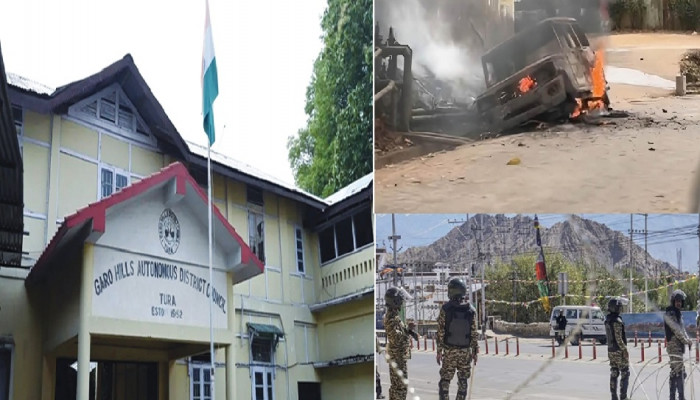
The recent unrest in Meghalaya’s West Garo Hills District began when clashes broke out between local Garo people and Bangladeshi-origin Muslims on March 10 during the nomination process for the Garo Hills Autonomous District Council (GHADC) elections, leaving two persons dead in police firing and several properties damaged. Incidents of arson, vandalism and looting were reported in parts of Chibinang and Tura town bordering Assam and Bangladesh. An indefinite curfew was imposed. The Army was deployed along with the State Police and Paramilitary Forces to prevent further escalation. An Internet ban also came into force. It may be recalled that on February 17 this year, a notification issued by the Chief Executive Member of the GHADC declared that the Council’s Executive Committee had resolved that its members should “possess demonstrable status” as members of Scheduled Tribe (ST) communities recognised in Meghalaya.[1] It stated that this is required for “effective administration of tribal affairs and preservation of customary laws” since the GHADC has been constituted under the Sixth Schedule of the Constitution of India. Accordingly, candidates for election to the GHADC had to produce a valid ST certificate.
It may be mentioned here that the GHADC, constituted in 1952, is one of the three Autonomous District Councils in Meghalaya exercising jurisdiction over the districts of East Garo Hills, West Garo Hills, South Garo Hills, and North Garo Hills. Late Capt. Williamson A. Sangma was its first Chief Executive Member. Power was vested in the Council under the Sixth Schedule of the Indian Constitution to administer and legislate on matters relating to the allotment, occupation, and use or settling of land. It is based in Tura, the headquarters of the West Garo Hills. The Council comprises of 30 members, and elections are held for 29. Two of its current members are Bangladeshi-origin Muslims. The recent unrest erupted after the Meghalaya High Court struck down the GHADC’s order making an ST certificate mandatory for contesting elections, a decision that triggered protests and heightened tensions in the Garo Hills. For a long time, local Garo groups such as the Achik State People’s Front had been voicing opposition against the ever-expanding presence of Bangladeshi-origin Muslims in different districts of Meghalaya. The tensions began during a nomination rally in Tura on March 9.
The plain belt areas of the district, such as Phulbari, Rajabala, and Chibinang were the most affected in the violence. Since these areas are situated adjacent to the border with Bangladesh, Muslims are concentrated here in large numbers. Following the violence and the deteriorating law-and-order situation, Meghalaya Chief Minister Conrad K Sangma announced the postponement of the elections, which had earlier been scheduled to be held on April 10. A viral video soon surfaced on social media showing local Garo people vandalising the Tura Jama Masjid, alleging that the mosque has been the focal point of all illegal activities in the region. Security was beefed up in Tura town immediately after the incident. Subsequently, many media reports began portraying the situation unfolding in Meghalaya as a ‘Garo vs. non-Garo’ one. Earlier in January this year, ISIS posters printed in English were reportedly found near Tura Law College and other public spots, threatening the indigenous Garos to vacate their ancestral lands in the border villages of Phulbari, Rajabala, Tikrikilla, Selsella, Garobadha, and Turisori in the Garo Hills region of Meghalaya by 2027, thereby provoking tensions and trying to create conflicts in not just Meghalaya but across the entire North-East.[2]

Picture Credits: https://referenceworks.brill.com/display/entries/BERO/COM-032268.xml
The posters that read as – ‘Vacate your plots before 2027, or face consequences’, prompted swift police action amid increasing fears of expansion of the Jihadi network in Meghalaya. Around the same time, on January 20, the West Jaintia Hills Police had apprehended 18 Bangladeshi nationals and two Indian touts during a coordinated operation.[3] Multiple vehicles transporting undocumented foreign nationals near the India-Bangladesh border were intercepted. Therefore, many important questions arise here – is it truly a ‘Garo vs. non-Garo’ conflict? Or, does it involve other factors such as threats and intimidation against the indigenous people, or the role of illegal cross-border immigration, especially in the context of Bangladesh’s current political scenario? The infiltration of Bangladeshi Muslims into Meghalaya over the past several years has played a major role in fuelling the recent unrest in the Garo Hills. Infiltrators have attempted to expand their political footprint by contesting polls meant exclusively for the local tribes. In many tribal belts of the North-East, including the Garo Hills, Bangladeshi Muslims have a long history of duping local tribal women into marrying them, only to later divorce them and separate. Children born out of such wedlock are invariably Muslim.
The idea behind the strategy is to obtain certificates of eligibility through fraudulent means so that they can contest elections and deprive the indigenous tribal community of their rights, including land ownership, political representation, and governance. The increasing presence of these infiltrators has vastly altered the demography of the North-East. In recent times, infiltration from Bangladesh through the hill areas of Meghalaya has increased drastically. It is evident in some incidents that Bangladeshi Muslims are illegally entering Bharat via smuggling rackets that are active along both sides of the international border. The entire region of the Garo Hills and Jaintia Hills is a hotspot of drugs and cattle smuggling, besides human trafficking gangs. These gangs assist the concerned agents responsible for facilitating illegal infiltration from Bangladesh.
The BSF in Meghalaya has previously intercepted Bangladeshi Muslim infiltrators attempting illegal border crossing along the Bangladesh border.[4] After entering India illegally, many of them are engaged as domestic workers and daily-wage labourers in different cities such as Delhi-NCR, Mumbai, and Bengaluru. Many attempt to return to Bangladesh through unauthorised border routes after spending several months here.
A Brief Introduction of the Garo Hills
The present-day region of the Garo Hills was a part of the erstwhile state of Assam till April 2, 1970, when it was constituted as an autonomous state. Meghalaya was formed on January 21, 1972, by carving out two districts from Assam – the Garo Hills and the United Khasi and Jaintia Hills. Till 1976, the Garo Hills was only a small district with headquarters at Tura. The total area of the district is approximately 8,167 sq. km. Situated on the sensitive Indo-Bangladesh international border, it is divided into the five administrative districts of North, East, West, and South, and South-West Garo Hills, with headquarters at Resubelpara, Williamnagar, Tura, Baghmara, and Ampati, respectively. The entire district of Garo Hills is densely forested, and people here are largely dependent upon agriculture for their livelihood. The practice of slash-and-burn agriculture or jhum cultivation has contributed to soil degradation over the years. The situation has been further aggravated by the influx of Bangladeshi-origin Muslims who began earning their livelihood mostly by cutting off trees, including rare plants such as orchids and pitchers, bamboos and firewood, and later sold them at exorbitant prices.[5]
Meghalaya has an area of 22,429 sq. km with a population of 29.66 lakh, as per the 2011 Census. It shares a 443-km-long border with Bangladesh in the south. The Brahmaputra forms a natural border with Assam’s extremely porous border district of Goalpara towards the north. The tribal population of Meghalaya constitutes the majority, with the Khasis being the largest group, followed by the Garos and the Jainitias. Other smaller groups include Biate, Maram, Koch-Rajbongshi, Hajong, Rabha, Bodo, and Kuki, among others. As the area is contiguous, so is the population structure.
In other words, the same communities with similar traditions and dialects live on the other side of the international border in different proportions in terms of their population, e.g. Garo, Koch-Rajbongshi, Hajong, Rabha, Dalu, etc. They are known to frequently cross over the border and take refuge in the Garo Hills with their own kindred during conflicts in Bangladesh. Some of them directly move into their relatives’ homes without even informing Bangladeshi authorities. It is precisely for this reason that the exact number of immigrants/infiltrators in the Garo Hills is still not clearly known, since it is never clearly reflected in the official entries.
Almost 90 per cent of the Garos and 80 per cent of the Khasis follow Christianity, the predominant religion practised by almost 70 per cent of the state’s population. The Garos are predominantly settled in Western Meghalaya’s Garo Hills. They are also scattered across Assam and Bangladesh’s Mymensingh district. On the other hand, the Khasis are concentrated in Central Meghalaya, and the Jaintias in Eastern Meghalaya. Although Garos are the majority inhabitants of the Garo Hills, many other minority communities, such as Rabha, Hajong, Koch-Rajbongshi, Mech, Bodo and Kachari, etc., have migrated and settled in the surrounding plain areas of the district. All these communities have a fierce history of resistance against the Muslim invaders and the British. In fact, the present-day Garo Hills region became the epicentre of bloodshed, murder and raids during the colonial rule. Noteworthy of mentioning here is that Meghalaya recorded the highest decadal growth of population among all the North-Eastern states, with a growth rate of 27.9 per cent for the decade 2001-11 against the national average of 17.64 per cent.[6] The district of South Garo Hills recorded a growth rate of 40.95 per cent, followed by Ri Bhoi district at 34.26 per cent.
Bangladeshi Infiltration into the Garo Hills – History and Consequences
Meghalaya has witnessed a high population growth rate since 1971, averaging over 30 per cent.[7] This cannot be attributed to natural causes alone. The history of Bangladeshi infiltration in the state, especially the Garo Hills region, is a long and tenuous one, dating back to the pre-Partition days. Since the Partition of Bharat in 1947, the cross-border movement of people from erstwhile East Pakistan (Bangladesh) into the Garo Hills has been a frequent occurrence. Many Garo villages along the border came under the control of East Pakistan after 1947. Those who lived along the borders of Mymensingh district struggled for the amalgamation of their lands with India and the Garos played a leading role in this movement. During the 1960s and the 1970s, a large number of people fled East Pakistan to seek refuge in the adjoining areas of India. The years 1964 and 1971 are considered as the two major periods of mass exodus of people from across the border. In the influx of January, 1964 caused by massive anti-Hindu riots in East Pakistan, the distressed refugees were not only Garos but also people from other minority communities like Hindu Bengali, Bihari, Koch, Dalu, Hajong, Koch-Rajbongshi, etc., who the East Pakistani authorities considered as Communists and anti-Pakistani.
Socio-political turmoil in neighbouring East Pakistan right after the Partition led to increasing persecution and harassment of non-Muslim minorities, especially their women and girls. Non-Muslims of the border areas, including the Garos, incurred huge losses. Cases of frequent rioting, looting and burning of both movable and immovable properties, destruction of paddy, cattle theft, robbery, forcible conversions to Islam, abductions, rape and kidnappings of young girls at night, etc., had become very common.
Garo villages and homes were set on fire by Muslim mobs with the help of the East Pakistan Rifles. If they protested, they were killed or brutally assaulted. They were asked to leave and even threatened that if they did not vacate their lands, they would be killed. The police and the judiciary, too, repeatedly ignored their appeals, although lawful complaints were filed, i.e. no legal action was taken by the authorities against the culprits. It caused deep apprehension and anxiety among the minorities, and that was the reason why many of them left their home and country, panic-stricken. They arrived in streams from Sylhet and North Mymensingh districts and eventually settled in the Easternmost tip of India, particularly in the states of Assam, Tripura, Mizoram, and Meghalaya.
They all had harrowing tales of persecution and inhuman atrocities to narrate. Towards the end of 1964, more than 10,000 such refugees returned to East Pakistan, but more than 75,000 Garo refugees still stayed back in the Garo Hills[8] and some interior pockets of Assam’s Goalpara, Bongaigaon, and Dhubri. The task of rehabilitating them was indeed a humongous one. The Government had to face a sudden and enormous problem of providing food, shelter, clothing and medicines to these people. Naturally, many development programmes had to be postponed. Upon the request of the Government of India, the GHADC, under the active leadership of the then Chief Executive Member, Capt. Williamson A. Sangma played an important role in coping with the grave situation.[9] As per an agreement between the Council and the Government of Assam, the Garos would be settled in the plain Mouzas of the Garo Hills, such as Garobadha, Jigabari, Singimari, Nidanpur, Tikrikilla, Balachanda, Phulbari, etc., provided unoccupied land was available.
Out of compassion and on humanitarian grounds, many of them were rehabilitated along the plain belt of the North-Western Garo Hills during the period from 1964 to 1966, under various schemes of the Government of India and implemented through the Council. The aim was to reduce the Muslims of the plains to a minority, who supported the Congress Party. And it did happen over time. The Council provided land and forest materials to construct relief camps at different places. The refugees mostly worked as barbers, cobblers, sweepers, fishermen, and small-time traders. At present, they are spread all over the Garo Hills District. On the other hand, it is said that Muslim refugees from Bihar were brought during the night and settled in the lands and homesteads abandoned by the minority communities in Sylhet and Mymensingh.[10] As per available official records, there were no Muslims in the Garo Hills till 1964. Till at least 1971, the greater percentages of refugees from Bangladesh who fled into the Garo Hills were Garos and Hajongs. However, during the Bangladesh Liberation War of 1971, many refugees took shelter along the Indo-Bangladesh border of the Garo Hills.
The entire region of the Garo Hills became one of the major fronts of the war and a gateway for displaced persons/refugees and infiltrators from the Muslim community. There was a continuous flow of hundreds and thousands of people into the region since March 1971 till at least December, 1971. The majority of the Muslim infiltrators dispersed along the Assam border, which was then mostly inhabited by people belonging to different tribal groups and communities. The Department of Relief and Rehabilitation, Government of India, provided relief camps for the Bangladeshi and local evacuees. For this purpose, huge amounts of money had been sanctioned under different schemes by the then Congress Government at the Centre. Since the GHADC is a constitutional body with authority over land in the district, this time too, it undertook the responsibility of rehabilitating the immigrants/infiltrators from the newly-created nation of Bangladesh, despite the scarcity of suitable lands. School buildings and marketplaces were used to provide temporary accommodation and carry out relief works. As a result, the normal functioning of schools and markets was affected in the border areas. The collection of tolls from the border markets was disrupted, causing loss to the Council.
The people who came from Bangladesh were granted reclaimed lands for agriculture to settle down. Families were allotted farmland, a pair of bullocks, homestead plots, and other provisions under different schemes and grants. Those who did not receive agricultural land were provided with business loans.[11] Since the Council provided land and forest materials to construct relief camps at different places along the Indo-Bangladesh border in the Garo Hills, a huge number of valuable trees such as sal and bamboo, were being indiscriminately cut down not only for the construction of camps and houses but also for the collection of firewood. Over time, there was a massive reduction in the forested area of the Garo Hills, leading to incalculable environmental damage and aggravating the already existing problem of large-scale deforestation. Noteworthy of mentioning here is that thousands of the Muslim infiltrators who entered the Garo Hills at this time were suffering from deadly infectious diseases such as cholera, dysentery, leprosy, small-pox, measles, etc. While many of them died, those who survived were not willing to stay in places far from the border.
They thus forcibly trespassed into the homes and homesteads, private vegetable gardens and jhum fields of the local Garos and robbed whatever fruits and vegetables they could. The paddy fields and other crops and gardens along the hill slopes of Baghmara and the neighbouring border villages were trampled upon by the immigrants, causing massive economic loss to the inhabitants.[12] Prior to the arrival of the Bangladeshi-origin Muslims into the Garo Hills, instances of stealing, looting or robbery were rare. It was after their arrival and subsequent rehabilitation that every such criminal incident had their involvement. They had absolutely no sense of basic hygiene and sanitation, jeopardising the health of the local residents of the Garo Hills. They disposed of their dead carelessly at places close to human habitation, sometimes even dumping the corpses, almost half-exposing them. Available literature on the subject throws light on the fact that these Muslim immigrants had imposed a ban on the sale of jackfruits, mangoes, fresh fish, dried fish, and pork at the Baghmara weekly market,[13] leading to a serious economic setback for the indigenous people of the border villages who now had to move to the interior regions.
Since the locals could no longer cultivate their land properly, they were unable to pay their land revenue and other taxes to the Council on time due to poor yield. Meanwhile, the Muslim immigrants cleared the forests for agriculture and rice cultivation. They initially worked as farmers and labourers for their livelihood. Agricultural production in the Garo Hills registered a sharp increase thereafter. They were skilled and very well-trained in construction activities, tailoring, hair-cutting, carpentry, leather works, etc. Later, they ventured into petty business establishments such as tea stalls in the border villages and opened vegetable shops at every available space, even on the busy footpaths of the roadsides of towns such as Tura, Williamnagar, Baghmara, Najing Bazar, and in other pockets of the Garo Hills. They used to purchase all kinds of foodstuffs from the local people, and then resold them at exorbitant rates. Those who could not find any alternative means to sustain themselves engaged in the cutting of firewood, bamboo, and trees for selling in the local market. Even today, many are engaged in illegal felling of trees. The indiscriminate felling of trees for agriculture, housing, domestic fuel, etc., had adversely impacted the ecological balance of the region.
In short, the Muslim immigrants captured all sorts of existing menial jobs in the Garo Hills, making the cost of labour exceedingly cheap. As a result, the poor daily-wage workers of the local area were rendered jobless; so much so that their family members were almost on the brink of starvation. Pushed into a state of extreme distress, it took an emotional and psychological toll on them. They had never faced such unprecedented hardship earlier. To sustain themselves, they gradually began venturing into small enterprises like selling of various locally produced vegetables in towns such as Williamnagar, where the locals were not accustomed to selling these produce.[14] The Bangladeshi-origin Muslim immigrants had inundated the local population in the Garo Hills by their sheer numbers and also taken control of the local economy, thereby increasing the problem of unemployment for both the educated and the uneducated lot. And why not? Unlike the Hindu immigrants, the Muslims made no attempt whatsoever to assimilate themselves with the culture of the host society. Although they absorbed themselves into the Garo society very fast, but in this process, they also clung to their own cultural values very tenaciously.
Since they could speak fluent Bengali, they did not face any language barrier in carrying out their businesses with the non-tribals of the area. Having understood the importance of education quite early, many of them continued pursuing their studies after coming to the Garo Hills, with some even becoming high-ranking officers like magistrates, doctors, and engineers. Many Government jobs and those in the private sector, too, are today occupied by them. Unfortunately, only a few were repatriated or deported by the Government of India when the situation returned to normalcy. Many continued to overstay. By the mid-1970s, the number of Muslims in the region had far exceeded the number of Hindu and Christian refugees. With time, it aggravated the rapid growth of the population in Meghalaya and led to a considerable change in the demography and political scenario of the Garo Hills District. The Census Reports of the district have shown a consistent increase in population in every decade since 1901.[15] While the density of population is increasing rapidly, the per capita income of people here is declining, reflected in the low rate of capital formation and low savings. This has adversely impacted the economic conditions of the people in the Garo Hills.
Prominent political parties like the Indian National Congress (INC) made the utmost use of the Muslim immigrants to win elections. In fact, it became the solid vote bank of the Congress Party in the elections to both the Assam and Meghalaya State Legislative Assemblies. The indigenous people of the Garo Hills were gradually being dominated by them. The first sign of the growing unrest against the presence of Bangladeshis in the region began when organisations such as the Federation of Khasis-Jaintias and Garo People (FKJGP) started issuing diktats to non-tribals to close down their businesses and leave the state immediately.[16] Organisations like the Khasi Students’ Union (KSU) insisted that the electoral rolls of the state needed to be revised, settling on 1951 as the cut-off date for immigrants. To a large extent, the rise of Garo insurgent outfits can be attributed to the emergence of this discord to protect the interests of the indigenous population. However, this led to a brutal phase of Hindu genocide in the entire Meghalaya. Temples were destroyed and many Hindu shops and establishments were attacked. The first major incident of religious intolerance occurred in 1979 when some Khasi youth desecrated a murti of Ma Kali.[17]
Almost 20 thousand Hindu Bengalis were believed to have been displaced from the state following attacks by local Khasi Christians. From then, Khasi Christian vigilantes, backed by the Church and with state-granted immunity, started targeting the Dkhars (pejorative name for non-tribals) or minority Hindus from different communities, bordering on ethnic cleansing. Youth organisations like the KSU that are notoriously anti-Dhkar are often known to give calls for ousting Bangladeshi infiltrators, a signal to launch attacks on Hindus and Hindu Bengalis in particular, who are treated as ‘Bangladeshis’ or outsiders. Muslims are rarely targeted. This same pattern was visible in Assam too, during the 1990s and early 2000s, at the peak of the ULFA Movement. Precisely because of this reason, a large number of Hindus have been forced to leave Meghalaya over the past few decades.
In March 2020, the Hynniewtrep National Liberation Council (HNLC), a banned Christian terrorist group from Meghalaya, had threatened ‘mass bloodshed’ if Hindu-Bengalis in the Ichamati and Majai areas of East Khasi Hills District did not leave the state within a month.[18] The HNLC has been accused of involvement in the circulation of fake currency in the state, at the behest of Pakistan’s ISI.
Over time, such a state of affairs has indirectly facilitated the way for Islamic-Jihadi networks to secure their foothold in the state. Security reports have identified Meghalaya, specifically the Garo Hills region, as a "safe corridor" for jihadis from Bangladesh moving into India, often as an alternative to the Karimganj (Sribhumi) route in Assam. Personnel of the Bangladesh Rifles (BDR) have been known to assist illegal Muslim immigrants cross the border by curtailing any checks on their movements – proof that fencing alone cannot be a foolproof security mechanism to prevent illegal immigration.
While Islamic militant groups like the Muslim United Liberation Tigers of Assam (MULTA) have operated in the North East, their presence in Meghalaya has been characterised more as "sleeper cells" or support networks rather than widespread violence. Following the dismantling of several jihadi modules in different districts of Assam in 2022, Meghalaya Police had issued a high alert regarding the potential movement of jihadis along the Bangladesh border.[19] During the recent violence in West Garo Hills, Bangladeshi-origin Muslims had staged a protest at Chibinang against the administration, chanting "Allahu Akbar".
Simultaneously, the video of a Garo leader declaring "This is not your land brother, no Allahu Akbar in Meghalaya" had gone viral on social media.[20] The leaders appealed for unity among the Khasis, Garos, and Jaintias to protect indigenous land, rights and identity. However, several pertinent questions arise here – who are to be held responsible for creating such a state of affairs in the first place in Christian-majority Meghalaya? Who paved the way for Islamists to gain influence in the state by compelling Hindus to leave? Why did Hindus leave and not Muslims? It’s high time the locals introspect. The guarding of the extremely porous, long and open border of Bangladesh already poses a serious challenge to the security forces. In view of this, if the locals themselves and their insurgent groups have a history of both directly and indirectly facilitating the safe settlement of Muslim infiltrators in their own state, then who is really to be blamed for the consequences that are unfolding today? Interestingly, why is this pattern visible across other states of the North-East too, such as Assam? Wherever Muslims settle down, they always create problems for the locals, whether in Assam, Meghalaya or any other part of the world. Albeit late, Meghalaya seems to have understood this now.
[1] Tension in Meghalaya: Why Garo Hills council elections have triggered 2 deaths and a curfew, The Indian Express, March 10, 2026. https://indianexpress.com/article/india/tension-meghalaya-why-garo-hills-council-elections-deaths-curfew-10575101/
[2] Meghalaya: Clashes between local Garos and Miya Muslims in West Garo Hills led to imposition of curfew, ban on internet, Organiser, March 12, 2026. https://organiser.org/2026/03/12/343725/bharat/meghalaya-clashes-between-local-garos-and-miya-muslims-in-west-garo-hills-led-to-imposition-of-curfew-ban-on-internet/
[3] Meghalaya police intercept 18 Bangladeshi nationals in major border operation near Dawki, India Today NE, January 21, 2026. https://www.indiatodayne.in/meghalaya/story/meghalaya-police-intercept-18-bangladeshi-nationals-in-major-border-operation-near-dawki-1334354-2026-01-21
[4] Meghalaya: BSF detains six Bangladeshi Muslim infiltrators, Hindu Post, January 23, 2025. https://hindupost.in/defence/meghalaya-bsf-detains-six-bangladeshi-muslim-infiltrators/
[5] Sengjrang N. Sangma. (2005). Bangladeshi Immigrants in Meghalaya: Causes of Human Movement and Impact on Garo Hills. Anshah Publishing House: Delhi, p. 13.
[6] Ashwani Gupta. (2019). Changing Demographics in India’s Northeast and Its Impact on Security. KW Publishers Pvt. Ltd.: New Delhi, p. 11.
[7] Ibid.
[8] Interview of Grohonshing A. Marak, cited by Sengjrang N. Sangma, 2005, p. 65.
[9] Sangma, 2005, pp. 64-65.
[10] Sangma, 2005, p. 42.
[11] Ibid, p. 39.
[12] P.C. Kar. (1982). Glimpses of the Garos. Das S.K. Hawakhana: Tura, p. 55.
[13] D.S. Rongmuthu’s complaint letter, dated Baghmara, June 3, 1971.
[14] Interview of Bilsing Ch. Marak from Danakgre (son of Najing Sangma), cited in Sengjrang N. Sangma, 2005, p, 91.
[15] Provisional Census Hand Book, 2001, Meghalaya.
[16] Gupta, 2019, p. 52.
[17] Banned Christian tribal terror group asks Hindu-Bengalis to leave, warns of bloodshed in Meghalaya, Hindu Post, March 4, 2020. https://hindupost.in/news/banned-christian-tribal-terror-group-asks-hindu-bengalis-to-leave-warns-of-bloodshed-in-meghalaya/
[18] Meghalaya: HNLC issues ‘leave Ichamati, Majai’ notice to Hindu-Bengalis, NE NOW NEWS, March 1, 2020. https://nenow.in/north-east-news/meghalaya/meghalaya-hnlc-issues-leave-ichamati-majai-notice-to-hindu-bengalis.html
[19] https://www.facebook.com/MizoramNewsletter/posts/meghalaya-on-alert-after-multiple-jihadi-modules-busted-in-assamshillong-aug-5-m/165027369372472/
[20] https://www.instagram.com/reel/DVx_ayaE2RE/
Disclaimer: The opinions expressed within this article are the personal opinions of the author. MyIndMakers is not responsible for the accuracy, completeness, suitability, or validity of any information on this article. All information is provided on an as-is basis. The information, facts or opinions appearing in the article do not reflect the views of MyindMakers and it does not assume any responsibility or liability for the same.



 Loading...please wait
Comments