



G RAM G bill replacing MGNREGA passed amid protests, Opposition stages overnight demonstration
- In Current Affairs
- 01:42 PM, Dec 19, 2025
- Myind Staff
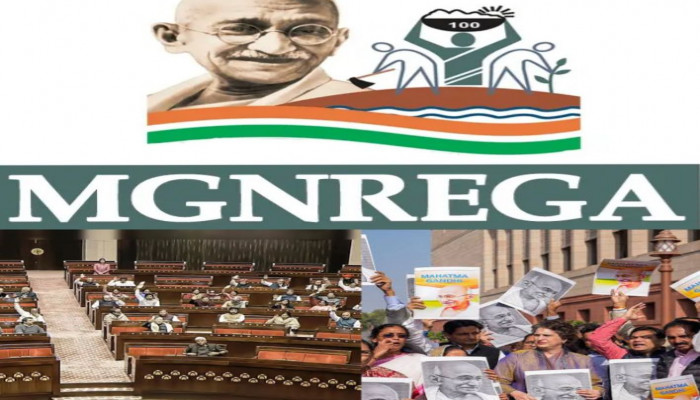
Parliament on Thursday passed the Viksit Bharat Guarantee for Employment and Livelihood Mission (Rural) Bill, commonly referred to as the G RAM G Bill, amid intense protests, walkouts, and overnight demonstrations by the Opposition. The new law is intended to replace the Mahatma Gandhi National Rural Employment Guarantee Act (MGNREGA), one of the United Progressive Alliance (UPA) government’s most significant social welfare programmes.
The bill was cleared by both Houses of Parliament within two days, despite strong resistance from Opposition parties who accused the government of undermining the spirit of MGNREGA and erasing Mahatma Gandhi’s legacy from a flagship welfare scheme.
The G RAM G Bill was passed by the Lok Sabha on Thursday afternoon despite repeated protests, sloganeering, and walkouts by Opposition members. Later the same day, the debate in the Rajya Sabha stretched beyond midnight. Voting began around 12:15 am, and the bill was eventually passed by a voice vote, with Opposition members absent after staging a walkout. Following the passage of the bill, Members of Parliament from the Trinamool Congress (TMC) and other Opposition parties sat on a dharna inside Parliament, protesting both the content of the legislation and the manner in which it was passed.
Although Opposition parties expressed strong outrage, the government’s numerical strength ensured the bill’s clearance. The Opposition had first demanded that the bill be referred to a Standing Committee for detailed scrutiny. When this demand was rejected, they called for the complete withdrawal of the bill. Eventually, they walked out, allowing the ruling alliance to pass the legislation in both Houses.
The Viksit Bharat Guarantee for Employment and Livelihood Mission (Rural) Bill, dubbed G RAM G is projected by the government as an updated and modernised version of the 20-year-old MGNREGA.
MGNREGA, enacted in 2005, legally guaranteed 100 days of wage employment every year to rural households. It also provided for an unemployment allowance if work was not given within a stipulated time after demand.
Under the new G RAM G law:
- The guaranteed days of employment are increased from 100 to 125.
- The unemployment allowance and wage payment provisions remain unchanged.
- Employment generation will be based on pre-approved plans, rather than direct demand raised by workers at the gram panchayat level.
The government has argued that these changes are necessary to address loopholes, improve efficiency, and align the programme with contemporary development needs.
The Opposition’s strongest objection has been to the change in name, replacing Mahatma Gandhi’s name with G RAM G. Congress leaders have alleged that this move reflects the government’s intent to remove Mahatma Gandhi’s legacy from public life.
Beyond the name, Opposition parties have raised concerns about the structure and philosophy of the new law. They argue that G RAM G weakens the rights-based framework of MGNREGA and converts it into a government-driven investment programme rather than a demand-driven employment guarantee.
During the heated debate in the Rajya Sabha, Congress President Mallikarjun Kharge launched an attack on the government and the proposed law. He warned that the new programme would harm the rural poor and urged the government to withdraw the bill.
Using strong language, Kharge said: “Don't have ‘Ram’ on your lips and a dagger in your hand! You keep saying ‘Ram Ram’ for the poor, but you have a dagger hidden behind your back.”
Addressing Union Minister for Rural Development Shivraj Singh Chouhan, who piloted the bill through Parliament, Kharge appealed for reconsideration: “Chauhan ji, think again. There is still time to withdraw the law. There is still time.”
Kharge reminded the House that the government had previously rolled back controversial laws without political damage. Referring to the repeal of the three farm laws, he said, “Many laws have been withdrawn by the government. Did the government suffer any setback? You withdrew three black laws related to agriculture. If you withdraw this law, you will become a hero. You will become ‘Mama-ji’ instead of just ‘Mama’.”
In an emotional conclusion, the 83-year-old leader made a personal appeal, saying, “My mother passed away in my childhood when I was 6–7 years old. I swear on her—this law is not good for the poor. I swear on my mother, I swear on Mother India, this law is not good for the poor.”
Leaders from other Opposition parties also strongly criticised the bill. TMC MP Derek O’Brien highlighted developments in West Bengal to underline what he described as the immediate impact of the government’s move.
He told the House, “At 1:07 pm today, you passed the G RAM G Bill in Lok Sabha. At 1:11 pm today, something happened. This government stopped the MGNREGA scheme in West Bengal.”
O’Brien explained that the West Bengal government had introduced its own employment scheme, Karmashree, to provide work to job card holders. “This year, every job card holder got 75 days of work. Next year it will be 100 days of work,” he said.
He added that on the same day, Chief Minister Mamata Banerjee renamed the scheme Mahatmashree, stating, “Today at 1:09 pm, the Chief Minister of West Bengal changed the name of her Karmashree scheme and named it the Mahatmashree Scheme.”
When Rural Development Minister Shivraj Singh Chouhan rose to respond to the debate, Opposition members began shouting slogans of “Withdraw the black bill”. As the disruption continued, the Opposition walked out of the House.
A visibly angry Chouhan criticised the walkout, saying, “I listened carefully to all the Opposition MPs. But to speak, make accusations, and then run away—this is also a betrayal of Bapu’s ideals. Not allowing a response is also violence.”
Taking a swipe at the Congress leadership, he added, “I expected Kharge to speak with some seriousness today. Who will work with them? The Congress sinks whoever it associates with.”
Defending the G RAM G Bill, Chouhan rejected allegations that the government was disrespecting Mahatma Gandhi. He accused the Congress of misusing Gandhi’s name and ideals. He said, “Bapu is our ideal, our inspiration. We have tried to incorporate Mahatma Gandhi’s social ideas.” Chouhan also pointed out that Mahatma Gandhi’s name was not part of the scheme when it was first introduced.
“The Congress had not included Mahatma Gandhi’s name in NREGA initially. Only when the elections came in 2009 did they add Mahatma Gandhi’s name,” he said. The minister further claimed
That MGNREGA had become a “tool of corruption” and that the new law was framed after discussions with various stakeholders to ensure better outcomes. The government has consistently argued that an update was necessary to fix flaws in the existing scheme and make it relevant to current economic and developmental needs.
How G RAM G Differs from MGNREGA
Under MGNREGA:
- Work was demand-driven.
- Rural workers could approach the gram panchayats and demand employment.
- Panchayats had the flexibility to decide work based on local needs.
Under G RAM G:
- Employment will be generated through pre-approved government plans.
- Workers will get jobs only if such plans exist.
- Work has been categorised into four areas: Water security, Core rural infrastructure, Livelihood-related assets, Climate resilience
The Samyukt Kisan Morcha (SKM) issued a strong statement condemning the repeal of MGNREGA. It alleged that the new law converts a people-centric employment scheme into a corporate-driven investment model.
SKM said, “All of this has been given short shrift by making it a government investment-driven programme linked to the needs of big corporations.” The group warned that women, who form a large share of MGNREGA workers, would be severely affected. It also said Dalits and Adivasis would lose employment opportunities and that the role of local self-government institutions would be weakened.
SKM demanded amendments to ensure:
- 200 days of work
- Minimum wages of at least Rs 700 per day
- Stronger links between employment schemes and agriculture to address rural distress, migration, and farmer suicides.
- Federalism and Financial Concerns
Critics have also linked the G RAM G Bill to other recent legislations such as the Seeds Bill, Electricity Bill, and four Labour Codes, claiming these weaken fiscal federalism. According to them, states already facing financial stress after the GST reforms will now be required to bear 40% of employment costs, amounting to thousands of crores, which many states cannot afford.
Despite widespread protests and strong objections from the Opposition, the G RAM G Bill has now cleared Parliament. The government maintains that the law modernises rural employment and strengthens development outcomes, while critics insist it dismantles the rights-based foundation of MGNREGA. As Opposition parties continue their protests and civil society groups mobilise resistance, the political and social impact of replacing MGNREGA with G RAM G is likely to remain a major point of debate in the months ahead.
Disclaimer: The opinions expressed within this article are the personal opinions of the author. MyIndMakers is not responsible for the accuracy, completeness, suitability, or validity of any information on this article. All information is provided on an as-is basis. The information, facts or opinions appearing in the article do not reflect the views of MyindMakers and it does not assume any responsibility or liability for the same.



 Loading...please wait
Comments