



From Rift to Renewal: PM Carney’s Quiet Reset
- In Foreign Policy
- 12:04 PM, Mar 05, 2026
- Ramaharitha Pusarla
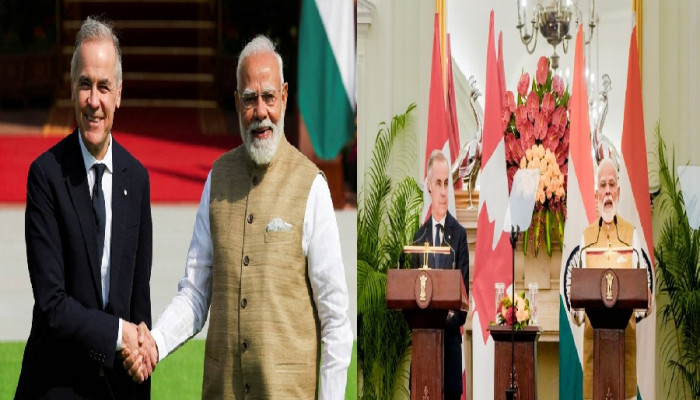
Canada’s swift foreign policy recalibration amid Trump’s incessant tariff and sovereignty threats hasn’t escaped global attention. In his scintillating remarks on the ongoing powershift and dwindling multilateralism, at the World Economic Forum (WEF), Jan 2026, Canadian Prime Minister Mark Carney has outlined the role of Middle Powers like Canada to build a new order – “build a new order that encompasses our values, such as respect for human rights, sustainable development, solidarity, sovereignty and territorial integrity of the various states”. Earlier in Nov 2025, he elucidated Canada’s “Variable Geometry”- a concept in an opEd titled “The Americas in 2026” for The Economist. The concept implied pursuing “different coalitions for different issues based on common values and interests”.
Challenges
Assuming the charge as Premier at a time when Trump repeatedly threatened Canada to turn it into the 51st state, Carney resisted the bullying and adopted a ‘pragmatic’ approach. Trump’s rhetoric on trade and sovereignty had jolted Canadian politics, which has been inherently libertarian. Ottawa’s left-leaning approach towards free speech, facile interpretations of the Khalistan ideology, and pandering to the minority vote bank had been at the heart of the diplomatic breakdown with New Delhi. Justin Trudeau’s reckless snapping of diplomatic ties with the largest democracy on “credible allegations” had been a travesty of statecraft seeped in liberalism. The relationship barely hung by a thread after countries expelled High Commissioners in October 2024 and reduced diplomatic presence to a minimal level.
Silent Stabilisation of Ties
In the wake of Trump’s ad hoc policies and constant threats, Carney, elected into power in March 2025, adopted a ‘pragmatic’ and ‘centrist’ foreign policy. Hosting the 51st G7 Summit, he swiftly engaged with World leaders. Signalling a thaw, Carney extended an invitation to Prime Minister Modi, an honour New Delhi coveted for over a decade. In June 2025, along the margins of the G7 Summit at Kananaskis, Alberta, leaders of India and Canada held forward-looking discussions “to take calibrated and constructive steps to restore stability in the relationship”.
By September, High Commissioners of both countries returned. Rebuilding trust and expanding cooperation, NSAs held the first round of talks. In October 2025, Canadian Foreign Minister Anita Anand, on her visit, renewed the roadmap for bilateral engagement. Injecting new momentum into the bilateral partnership, leaders met along the sidelines of the Johannesburg G20 Summit in November 2025. They reviewed the ties and launched negotiations for the Comprehensive Economic Partnership Agreement (CEPA) to reach USD 50 billion by 2030. This engagement at the highest levels revived Ministerial and Official-level mechanisms. Subsequently, Foreign Office Consultations, security dialogues and sector-specific working groups were back on track.
Critically, the second round of NSA’s meeting in Feb 2026, ahead of PM Carney’s scheduled State visit, streamlined issues of major concern like law enforcement issues, extraditions, illegal drug flows, immigration fraud, immigration enforcement, cybersecurity, transnational criminal networks and set the stage for leadership talks. PM Carney arrived in Mumbai on Feb 28 for a four-day bilateral visit. After extensive business engagements and an investment push in Mumbai, the actual bilateral talks commenced in Delhi on Mar 2. The visit at the invitation of PM Modi is PM Carney’s first visit to India as the Prime Minister. The last Canadian bilateral visit to India was in 2018.
The Pivot
In a generational shift, PM Carney, leveraging “the Middle Power moment”, is expanding defence, security and economic ties with countries in the Indo-Pacific region and Looking South. This steady shift is evident in PM Carney accelerating defence cooperation with the Philippines, Japan and South Korea. In November 2025, Canada signed the Status of Visiting Forces agreement with the Philippines. In January 2026, delicately balancing ties, Carney, on his Beijing visit, carved a “new strategic partnership” and inked a preliminary trade agreement with China to ease tariffs. In the same month, Canada sealed a defence collaboration Equipment and Technology Transfer Agreement (ETTA) agreement with Japan. The two strategic rivals.
Expanding its Indo-Pacific strategy, Canada is finalising an FTA with Indonesia, elevating its partnership with Vietnam and ASEAN and seeking to increase military presence through Operation Horizon. As the resident power of Indo-Pacific with fourth largest economy, Canada now understands the significance of building pragmatic ties with India. For long, the India-Canada relations have been a victim of misreading of contrasting narratives. However, under mounting Trumpian economic and diplomatic pressure, Canada has embraced strategic diversification and multi-alignment.
Ambitiously working to build the political trust, in the run-up to PM Carney’s visit, Federal officials indicated that India is no longer linked to violent criminal activities in Canada and moved to revoke the citizenship of Tahawwur Rana, accused in 26/11 for alleged misrepresentation in his citizenship application. By easing the tensions, Canada has set the stage for pragmatic cooperation.
The Reset
Having established diplomatic relations for 79 years, both countries structured a roadmap aligning with New Delhi’s Viksit Bharat and Ottawa’s Build Canada Strong Agenda. Addressing the Canada-India Growth Forum, PM Carney described his visit as “the beginning of a renewed Canada-India partnership”. In an interaction, recognising India’s rising global influence, PM Carney said, “I wouldn’t call India a ‘middle power’. I’m happy for Canada to be called a middle power. But India’s trajectory and ambition is totally different”. This strategic shift in the Canadian approach is firmly mirrored in his intent to decisively take forward the partnership from normalisation of ties to a structured expansion.
The diplomatic row over Nijjar ruptured the partnership. To rebuild strategic trust, leaders have structured a vision for the partnership anchored in the guiding principles of ‘Vasudaiva Kutumbakam’ (One World One Family One Future), providing a framework for political, economic, technological and strategic engagement.
Outcomes
The wide-ranging bilateral talks yielded several concrete outcomes. Notable among them are signing of Terms of Reference (ToR) for CEPA. India is Canada’s seventh-largest goods and services trading partner, with bilateral trade at USD 8.66 billion. Setting a target of USD 50 billion in bilateral trade by 2030, the countries plan to conclude the trade agreement by the end of 2026.
Countries signed MoUs in Critical Minerals Cooperation, Renewable Energy, Global Research, Cultural cooperation and declaration of Intent to establish the Joint Pulse Protein Centre of Excellence at the National Institute of Food Technology, Entrepreneurship (NIFTE) at Kundli. Canada announced fully-funded internships for up to 300 eligible Indian students annually for three years.
Nearly 24 MoUs/partnerships have been signed between universities/institutions in areas such as Artificial Intelligence, healthcare, agriculture, and innovation. The scale and diversity of the commercial agreements signalled normalisation of ties.
Along the sidelines of the G20 Summit, Prime Ministers of Australia, Canada and India launched the Australia-Canada-India Technology and Innovation Partnership (ACITI), leveraging the complementary strengths of Australia’s critical minerals, Canada’s AI expertise and India’s digital talent with an emphasis on green energy innovation, building resilient supply chains, including for critical minerals. Taking it forward, all three countries held meetings during the AI Impact Summit in New Delhi, and now the Sides have inked an MoU on cooperation in Technology and Innovation.
Resetting ties, India and Canada reached a landmark agreement for the sale of $1.9 billion of uranium (10,000 tonnes) to India for its civil nuclear programme over 10 years. This will facilitate India’s clean energy transition and help reach the goal of 100 GW nuclear capacity by 2047. Canada is second largest producer of Uranium. One of the foundational pillars of the India-Canada partnership has been nuclear collaboration on CANDU (Canada Deuterium Uranium Technology) reactor design. Soon, India developed its own Pressurised Heavy Water Reactors (PHWRs) based on Canadian technology. India’s second nuclear reactor, CIRUS (Canada India Reactor Utility Service) and Rajasthan Atomic Power Station were built with Canadian assistance. Nuclear cooperation stalled post-1974 and 1998 tests. Sanctions were imposed on the sale of Uranium. The US-India nuclear deal of 2008 restored trust. In 2015, Canada agreed to sell Uranium. However, marred by misgivings and shifting relations, nuclear cooperation took a hit.
Renewing Relationship
Advancing India-Canada strategic energy partnership, the countries relaunched the Ministerial Energy Dialogue to finalise a joint plan of action to promote collaboration in clean energy, conventional energy and renewable energy. To broaden energy cooperation, Canada is joining the Global Biofuels Alliance and the International Solar Alliance. Given the Gulf crisis and concerns about the security of maritime trade routes, India is keen to source energy supplies through alternative routes. For stable energy security, India intends to buy LNG from Canada along with heavy oil. India is simultaneously working towards concluding a long-term LPG supply agreement with Canada.
Countries are elevating the 30-year space cooperation agreement between the Indian Space Research Organisation (ISRO) and the Canadian Space Agency (CSA), signed in 1996. India has supported Canada joining the Indian Ocean Rim Association (IORA) as a Dialogue Partner.
Countries are relaunching and elevating the existing mechanisms, joint working groups to the ministerial level, to institutionalise cooperation and strengthen the relationship. To structure student mobility, an important domain of the bilateral ties, countries launched a new Canada-India Joint Talent and Innovation Strategy. 400,000 Indian students study in Canada, twice the number in the US and four times the number in the UK. Owing to Canada’s stricter immigration norms amid housing crises, PM Modi welcomed reputed Canadian Universities to set up their campuses in India. India has also proposed twinning degree programmes.
Trump’s ‘America First Agenda’, has critically weakened the institutionalised defence and security mechanisms. To align with NATO’s new targets, Canada is increasing defence expenditure and plans to spend about $500 billion over the next decade. Diversifying defence partnerships, Canada is now reviewing the F-35 acquisition, reversing the decision to purchase 88 of them. Carney is diversifying defence partnerships with Japan, South Korea, the EU and Indo-Pacific countries and identifying partners for defence collaboration. This can open up ample opportunities for Indian defence companies for co-development and coproduction. Given the convergence on Indo-Pacific, Canada, seeking to expand military cooperation with India, is institutionalising the India-Canada Defence Dialogue.
The post-World War II institutional architecture is on the brink of collapse. New regional and global security arrangements are shaping up. As a middle power, positioning the partnership toward long-term expansion, Canada is seeking to widen cooperation. Committing to ironing out the structural differences stemming from the misinterpretation of liberal values, Canada is now valuing Indian partnership. PM Carney described the partnerships in the famous words of Swami Vivekananda- “arise, awake, and stop not till the goal is reached”.
Canada wants to work with India for its own reasons. India is cognisant of its conciliatory approach and appreciative of PM Carney’s attempt to anchor the relationship in “mutual respect, sovereignty, and democratic values”.
References
- Davos 2026: Special address by Mark Carney, PM of Canada | World Economic Forum
- The world is in a new age of variable geometry, says Mark Carney
- List of Outcomes: Visit of Prime Minister of Canada to India (February 27 – March 02, 2026)
- India-Canada Joint Leaders’ Statement (March 02, 2026)
- Transcript of Special Media Briefing by MEA on the Official Visit of Prime Minister of Canada to India (March 02, 2026)
- Prime Minister meets Prime Minister Mark Carney on the sidelines of the G7 Summit
- Visit of NSA Shri Ajit Doval to Ottawa, Canada (06- 07 February 2026)
- Joint statement by the Government of India, the Government of Australia and the Government of Canada (November 22, 2025)
- 'Arise, Awake, And Stop Not…': What Carney Said About Swami Vivekananda's Time In Canada | World News - News18



 Loading...please wait
Comments