




From Partition to Operation Sindoor: Lessons for a Strong, United New India at 80
- In Current Affairs
- 11:08 AM, Aug 18, 2026
- Viren S Doshi
Overview
History does not merely repeat itself. It stutters. It limps. And sometimes it returns in a new mask, carrying the same old wound with more severity.
For South Asia, that wound is the question of how a state deals with political violence that seeks to break it from within.
In 1947, the answer was hesitation, compromise, and finally, vivisection.
In 2026, the answer being tested is different: clarity, continuity, and the refusal to be blackmailed.
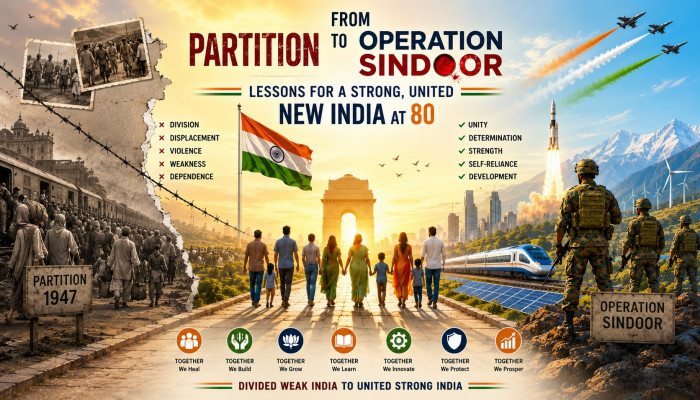
This is the contrast between the Tragedy of Partition and the Saga of Operation Sindoor.
One represents a weak India that chose to divide to avoid a fight. The other represents a United Strong India that chose to fight to avoid another division.
The lesson for the New India is stark: peace is not the absence of conflict. Peace is order enforced by a state that is not afraid to use power when reason fails.
1947: A Catastrophe Sold as Inevitability
We are told, with rehearsed solemnity every August 15th, that Partition was a historical accident. A sudden act of mercurial violence. As if 90 years of politics from 1857 to 1947 had nothing to do with it.
That is not true. Partition was a meek choice made lately, and a failure made early.
The Chemistry of the "Muslim Problem" as it was framed then
The All-India Muslim League was founded in 1906 in Dhaka. The Indian National Congress was founded in 1885. That 21-year head start mattered. The Congress built a mass movement. The League built a typical Muslim forte based on violence and falsehoods packaged under the label of Jihad.
By the 1930s and 40s, politics had hardened into a transactional logic: concede territory to buy (the mirage of) peace. The colonial state, eager to exit, encouraged separate electorates; separate electorates became separate states.
The chronology is brutal:
1921 Moplah Rebellion, Malabar: Agrarian unrest that quickly turned communal. Thousands dead. And this was repeated all across right up to the Jihadi Direct Action.
1946 Direct Action Day, Kolkata, August 16: Called by the Muslim League. What began as a political hartal became four days of street killing. Estimates range from 4,000 to 10,000 dead.
1947: Punjab and Bengal burned for months before and after August 15.
Every riot was followed by a concession. Every concession was framed as "statesmanship." In reality, it was fear of a larger civil war. So, the leadership chose a smaller, formalised civil war called Partition instead. But this was not what it seemed to their short-sighted vision.
Non-violence claimed more lives than violence.
Horrendous Partition claimed more lives than any of the shadows of any civil war could ever would or could. Bloodshed was the bloodiest of any event in the recorded 20th century of global history.
The Arithmetic of Failure
Result: 15 million displaced. One to two million dead by most scholarly estimates. Trains arriving full of corpses. Women abducted. Property worth billions abandoned.
And the cruellest irony: non-violence as state policy, when it becomes an excuse for not protecting citizens, produces more violence than a short, decisive war to uphold the law would ever have.
The Paradox: 1905 vs 1947
Here is the bitter paradox that haunts Indian political memory.
In 1905, Lord Curzon partitioned Bengal. The response was immediate and furious. Swadeshi, boycott, agitation. Within 6 years, in 1911, the British rescinded it. Popular will reversed an imperial colonial decree rooted in the politics of “divide and rule”, steeped in Jihadi Islamic violence on one hand and Ahimsa as the cardinal principle of Hindu Dharma on the other. But Bharat fought together and foiled the vicious conspiracy.
Thirty-six years later, the same political class, now in power, could not reverse a far greater partition. Why?
Because in 1905 the demand was "keep India united." In 1947, the demand from a section of leadership was "give us a separate nation or we will make the country ungovernable." And the response was to negotiate the price of ungovernability instead of paying the price to enforce governability.
Sardar Vallabhbhai Patel, as Home Minister, later showed what administrative firmness looked like in Junagadh and Hyderabad. The counterfactual many historians ask: had that firmness been national policy in 1946, would the calculus of 1947 have changed? The question is pregnant with many lessons.
The Lincoln Contrast: You Do Not Partition a House to Appease the Arsonist
Abraham Lincoln faced a similar test in 1861. Seven states seceded. The argument was "let them go, to preserve peace." Lincoln’s answer was no. A house divided against itself cannot stand, and you do not reward secession with legitimacy.
He fought a four-year war. 600,000 dead. But the Union was preserved. And because the Union was preserved, the United States could become a continental power instead of two squabbling neighbours.
Compare that to 1947. Partition did not solve the Muslim communal question. It exported it across a border and added an army, a flag, and nuclear weapons to it. Look at the map today.
- Pakistan: a garrison state with repeated coups, debt crises, and radicalisation.
- India: a democracy that spent 40 years in strategic restraint.
- Kashmir: a fault line that became a bleeding sore.
The partition of land did not partition the ideology of hate. It gave it a state.
The Nuclear Bluff: Three Decades of Paralysis
After 1947 came 1998. India and Pakistan tested nuclear weapons.
For the next 20 years, Indian policy was shaped by what strategists call "nuclear blackmail." The logic: any conventional retaliation to terror would risk escalation; therefore, do nothing beyond dossiers and diplomatic protests.
This created a perverse incentive. Proxy war became cost-free. Bomb a market in Mumbai, attack a parliament, strike a military base, and then hide behind the mushroom cloud.
The state told its citizens: "We are strong, but we are restrained." The adversary heard: "They are afraid."
That was the psychological condition of "Divided Weak India" — militarily strong, politically hesitant. Strong enough to absorb blows, not strong enough to change the rules of the game.
The Breakthrough Rupture: The Idea Behind Operation Sindoor
Something changed in the last decade. The political establishment made a different calculation.
The calculation was: the cost of not acting is higher than the cost of acting.
Operation Sindoor is the public name given to that shift. It is not one strike. It is a doctrine. A sustained campaign to do three things:
Dismantle: Training camps, launch pads, financing, and logistics across the border. Use precision weapons, intelligence, and time.
Deter: Create certainty that any attack will invite a response, so that the incentive to attack disappears.
Denounce the Bluff: Prove that nuclear weapons are for deterrence, not for giving a free pass to sub-conventional war.
The name "Sindoor" itself is deliberate. In Indian culture, Sindoor is about protection of the home. The operation says: we will protect the home, and we will go to the source of the threat to do it.
Militarily, this meant integration of BrahMos supersonic cruise missiles, drones, satellite surveillance, and special forces. Politically, it meant absorbing international criticism and continuing anyway.
Strategically, it meant one Sanskrit idea made operational:
अग्रत: चतुरो वेदा: पृष्ठत: सशरं धनु:।
इदं ब्राह्मं इदं क्षात्रं शापादपि शरादपि।।
Before these are the Vedas, behind them is the charged bow. We can argue, and if argument fails, we can act.
That is the difference. A state that has both “Dharma” and “Dand”.
Why This is in the Interest of Common Muslims of the Subcontinent
This is the most important point, and the most deliberately confused.
Who are the biggest victims of the groups targeted by Operation Sindoor?
Data from SATP, UN, and Pakistan’s own interior ministry reports are clear: Muslims have died in far greater numbers from terrorism in Pakistan, Afghanistan, and Bangladesh than anyone else. Mosque blasts. Shia processions. Sufi shrines. School children in Peshawar.
The terror economy does not respect borders. The same financier who funds a cell in Kashmir funds one in Karachi. The same recruiter who radicalizes in South Punjab recruits in Bihar.
Therefore, a campaign that breaks the infrastructure of terror helps:
- A shopkeeper in Lahore who wants his market to be safe.
- A teacher in Dhaka who does not want his students recruited online.
- A farmer in Gujarat who wants trade, not tension.
When India degrades these networks, it is not "anti-Muslim." It is anti-terror. Conflating the two is exactly what the terror groups want, because it gives them cover.
The common Muslim of the subcontinent has no interest in perpetual war. He has interest in jobs, schools, and dignity. Operation Sindoor, by removing the veto power of violence, creates space for that.
The Psychology: Calling the Bluff
The real victory of Operation Sindoor so far has been psychological.
For 30 years, the message from across the border was: "We can bleed you with a thousand cuts and you cannot respond because of nukes."
Operation Sindoor’s message back: "We can respond below your nuclear threshold, and we will keep responding until you dismantle the machine."
That changes calculations. Deterrence is restored not by having bigger bombs, but by showing willingness to use proportionate force consistently.
It also changes domestic psychology. Citizens no longer feel that the state will absorb the next attack and issue a statement. They see action. That matters for national morale.
Lessons for the New India: From Divided Weak to United Strong
What are the concrete lessons drawn from 1947 and applied in 2026?
Lesson 1: Do not negotiate with the threat of chaos.
In 1946, the threat of civil war was used to extract Partition. In 2026, the threat of escalation is used to demand restraint. The answer cannot be surrender. The answer must be: we will enforce the law.
Lesson 2: Unity is not a slogan; it is a capability.
A "United Strong India" means a state that can mobilise intelligence, diplomacy, economy, and military together for years. Not for one news cycle. Operation Sindoor continues because problems that took decades to build will take years to dismantle.
Lesson 3: Moral authority without power is empty.
The Congress of 1947 had moral authority but outsourced power to mobs. The New India is trying to fuse both: moral argument at the UN, and hard power on the ground.
Lesson 4: Protect minorities by protecting the state.
A weak state cannot protect anyone. A strong state can protect Hindus, Muslims, Sikhs, Christians equally because it is not afraid. Weakness invites predators. Strength creates space for normal life.
The Road Ahead
Operation Sindoor is continuing. It will continue until the "devilish bull" — the infrastructure of cross-border terror — is decimated completely.
That means three verifiable benchmarks:
1. No training camps operating with impunity.
2. No financing networks moving money through hawala and crypto.
3. Legal action against planners, not just foot soldiers.
This will take time. It will invite criticism. It will require patience from the public.
But the alternative is clear. Pause now, and in 5 years we will be back to dossiers and candlelight vigils. Continue, and we create a new normal where violence is not a tool of policy.
Conclusion: Jai Hind
The tragedy of Partition was that India tried to buy peace by giving away land. It got neither peace nor land.
The saga of Operation Sindoor is that India is trying to buy peace by enforcing order. It may be costly, but it is the only purchase that has ever worked in history.
To the cynics who ask "is this endless war?" the answer is no. This is how you end an endless war. By making the cost of starting it too high.
To those who ask, "Is this against Muslims?" the answer is no. This is for every citizen of the subcontinent who is tired of living under the shadow of violence.
There should not be an iota of doubt on this.
The bow must remain strung until the threat is gone. And when it is gone, the Vedas can be read and lived in peace.
Jai Hind.
Disclaimer: The opinions expressed within this article are the personal opinions of the author. MyIndMakers is not responsible for the accuracy, completeness, suitability, or validity of any information on this article. All information is provided on an as-is basis. The information, facts or opinions appearing in the article do not reflect the views of MyindMakers and it does not assume any responsibility or liability for the same.


 Loading...please wait
Comments