



From Oceans to Consciousness, from Instinct to Civilisation, the Dashavatars aren’t Just Tales—They’re Symbolic Milestones of Life’s Unfolding
- In Religion
- 11:09 AM, Sep 23, 2025
- Pranitha Prakash
When Navaratri Meets Darwin: Dashavatar and the Story of Evolution
Yesterday, I had just finished a test on Evolution. My brain was buzzing with Darwin’s ideas, fossils, and missing links when I came home to find my family unpacking dolls for Navaratri. As the little figurines were unwrapped and placed carefully on the steps, a thought struck me: what if these avatars weren’t just stories? What if they were poetic, symbolic ways of explaining truths that not everyone could grasp directly—the shifts in life, in consciousness, in the very fabric of existence?
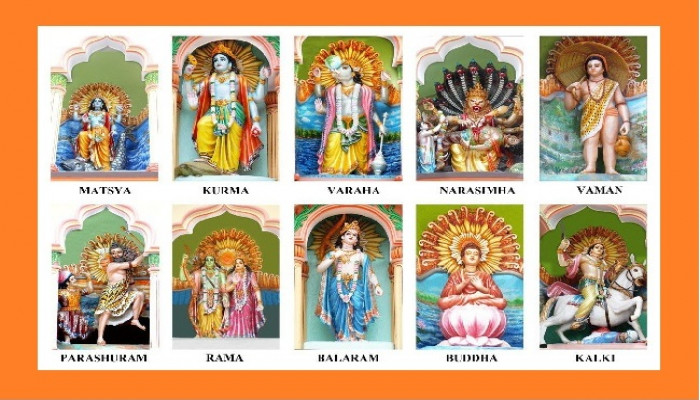
The sequence of Vishnu’s Dashavatar begins, fittingly, in water. Matsya, the fish, represents life’s origin in the oceans.
Biology too confirms this: the earliest organisms arose in aquatic environments. Whether you view Matsya as a cosmic rescuer or an evolutionary symbol, the overlap is striking—life always begins where water flows.
From the fish, the story moves to Kurma, the tortoise, a creature of both land and sea. This duality mirrors evolution’s great transition: amphibians leaving the safety of water to test the uncertain terrain of land. The tortoise, slow but steady, is the perfect emblem of that hesitant but decisive step forward.
Next comes Varaha, the boar, and here the imagery becomes astonishing. Varaha lifts the earth from the depths, carrying it on his tusks. Ancient storytellers depicted the planet not as flat but as a sphere—suspended, supported, and saved. In the 21st century, we take the roundness of the earth as obvious, but the Varaha image suggests an intuitive, almost startlingly accurate perception of cosmic reality long before telescopes and satellites. At the same time, the boar as an avatar symbolises mammals, firmly rooted in the earth, thriving in forests and fields. Life is no longer tentative; it dominates.
But evolution is never just about biology—it is also about the tension between instinct and intellect. This is where Narasimha, the half-man, half-lion, takes his place. Half-beast and half-human, Narasimha embodies the liminal moment when raw animal power gives way to self-awareness. In evolutionary terms, it evokes the transition from primordial creatures to primates with budding intelligence. The figure is not comfortable; it is hybrid, unsettling. Yet it marks the very point where humanity begins to separate itself from the rest of the animal kingdom.
With Vamana, the dwarf, we encounter early humanity—small, fragile, yet upright and ambitious. Vamana’s three great strides across the cosmos can be read as humanity’s first steps, modest in form but infinite in consequence. From here, Parashurama signals a new stage: humans with tools and weapons, shaping their world not merely by instinct but by technology. The axe in his hands is the symbol of the Stone and Bronze Ages, of survival aided by invention.
Then comes Rama, the “perfect man,” who represents not just an individual but a society built on law, morality, and order.
With Rama, evolution has moved beyond survival and reached civilisation. The human project now includes ethics, governance, and the pursuit of justice. Krishna develops this further: he is complex, witty, philosophical, and strategic. His stories capture the subtleties of diplomacy, emotional intelligence, and spiritual inquiry. Evolution here is no longer physical but cultural—the refinement of human thought and relationships.
The ninth avatar, Buddha, shifts the axis again, this time inward. Evolution now transcends biology and society to embrace consciousness itself. Compassion, detachment, and awareness mark a new stage in human becoming. In Darwin’s framework, there is no “final stage,” but in cultural evolution, Buddha stands as a symbol of the highest flowering of inner life.
Finally, there is Kalki, the avatar yet to come. If the earlier nine encapsulate stages we can trace in biology and history, Kalki gestures toward the future—toward whatever humanity will become next. Perhaps it is a warning of collapse and renewal, or perhaps a vision of transformation, whether through technology, cosmic understanding, or spiritual reawakening.
Evolution, after all, never ends.
Seen this way, the Dashavatars are not “just stories.” They are narratives encoded with knowledge, simplified for human minds that might struggle with abstract concepts like energy forms and cosmic processes. They are pedagogy through narrative, teaching through symbol. As I placed the dolls on the steps this Navaratri, I felt I wasn’t merely arranging deities; I was setting out a timeline of life, from ocean to earth, from beast to man, from instinct to consciousness.
Science provides us with mechanisms, evidence, and details. Stories give us meaning, coherence, and memory. In the Dashavatars, I see not a contradiction but a synthesis: an ancient recognition that life evolves, changes, and ascends—told in a language as eternal as faith and as practical as teaching a child.
Disclaimer: The opinions expressed within this article are the personal opinions of the author. MyIndMakers is not responsible for the accuracy, completeness, suitability, or validity of any information on this article. All information is provided on an as-is basis. The information, facts or opinions appearing in the article do not reflect the views of MyindMakers and it does not assume any responsibility or liability for the same.



 Loading...please wait
Comments