




From Obedience to Inquiry: The Dharma of Questioning in a Gen Z World
- In Current Affairs
- 01:38 PM, Jul 27, 2026
- Siddhartha Dave
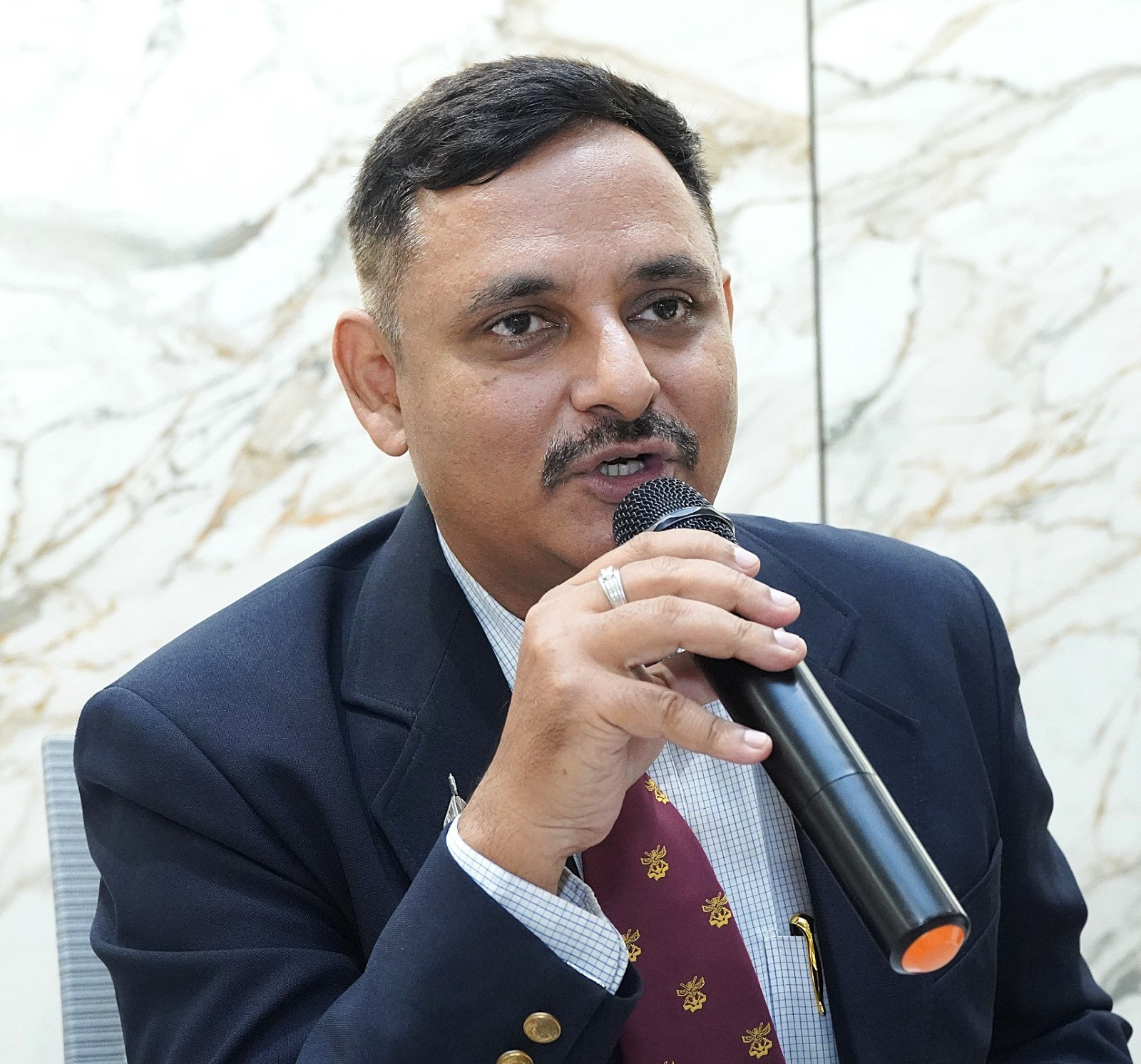
"The era of obedience is over." With this simple yet profound observation, RSS Sarsanghchalak Dr Mohan Bhagwat may have captured one of the defining characteristics of contemporary Bharat. Speaking at a recent programme in New Delhi, Dr Bhagwat remarked that today's youth no longer accept authority unquestioningly. They ask questions. They expect reasons. They deserve affection, time and dialogue. Communication, he cautioned, is increasingly absent not only from public life but even within families.
His remarks have naturally resonated amidst the ongoing debates surrounding the NEET controversy, the rise of digitally mobilised Gen Z activism, and even the emergence of meme-driven political expressions such as the so-called "Cockroach Janta Party."
But Dr Bhagwat's observation raises a far deeper question.
If the era of unquestioning obedience is indeed over, what replaces it?
Is it perpetual outrage? Is it rebellion against every institution? Or is it something far more profound—a return to the civilisational ideal of responsible inquiry?
The answer, perhaps surprisingly, lies not in modern political theory but in the timeless wisdom of Sanatan Dharma.
Blind Obedience Was Never the Sanatan Ideal
Many assume that questioning authority is a modern, Western or post-Enlightenment idea. In reality, Bharat institutionalised inquiry long before Europe discovered dialectics.
Prime Minister Narendra Modi has repeatedly urged the nation to free itself from ghulami ki mansikta—the colonial mindset. While often understood politically, the phrase also carries intellectual significance. Colonial rule did not merely occupy territory; it conditioned minds. The educational framework introduced by Thomas Macaulay was designed to produce efficient administrators who obeyed instructions rather than citizens who questioned assumptions.
Blind obedience thus became more than a social habit. It became an instrument of governance.
Yet this culture of unquestioning compliance was fundamentally alien to Bharat's civilisational ethos.
Sanatan Dharma never celebrated blind obedience.
It celebrated enlightened inquiry.
The Dharma of the Questioner
However, there is an equally important truth that is often forgotten.
Sanatan tradition never celebrated questioning for its own sake. It celebrated responsible questioning.
This distinction is crucial.
In today's public discourse, questioning is often equated with disruption. Volume is mistaken for conviction, and outrage is confused with courage. Social media frequently rewards provocation over reflection. But Sanatan civilisation drew a clear distinction between argument and inquiry.
Its heroes questioned—but they questioned with humility, discipline and an unwavering commitment to discovering truth.
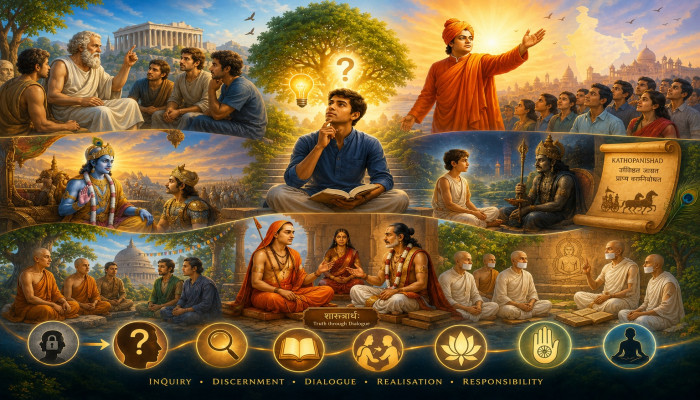
Arjuna questioned Krishna. But before asking, he acknowledged his own confusion.
"कार्पण्यदोषोपहतस्वभावः..."
He admitted that he did not know the right course of action. He accepted Krishna as his guide. Then he listened—patiently—through eighteen chapters of dialogue before making his decision.
His questions were not intended to defeat Krishna. They were intended to understand Dharma.
Young Nachiketa, in the Kathopanishad, questioned Yama, the Lord of Death. Yet he did so with extraordinary restraint. He waited patiently for three nights without complaint. He refused wealth, power and worldly pleasures when they were offered in place of knowledge. His inquiry was driven neither by ego nor by spectacle, but by an earnest desire to know the truth about life and death.
Likewise, the celebrated Shastrartha between Adi Shankaracharya and Mandana Mishra remains one of the greatest intellectual encounters in world history. It was a debate governed by mutually accepted rules, evidence, logic and civility. The objective was not the humiliation of an opponent but the illumination of truth. The debate itself was adjudicated by the learned Ubhaya Bharati, symbolising that reason—not power—was the final arbiter.
Centuries before Socrates wandered through Athens employing what is now celebrated as the Socratic Method, Bharat had already developed an even richer tradition of philosophical dialogue through Shastrartha. If Socrates taught the West to ask questions, the rishis of Bharat taught humanity how to ask them responsibly.
As Dr Sarvepalli Radhakrishnan observed while interpreting the Upanishads, these texts are not collections of commandments. They are records of conversations. They preserve dialogues between seeker and teacher, king and sage, husband and wife, father and son. Knowledge emerges not through coercion but through inquiry.
This dialogic tradition is the very heartbeat of Sanatan civilisation.
Krishna's Formula for Inquiry
Perhaps nowhere is this philosophy expressed more beautifully than in the Bhagavad Gita.
तद्विद्धि प्रणिपातेन परिप्रश्नेन सेवया ।
उपदेक्ष्यन्ति ते ज्ञानं ज्ञानिनस्तत्त्वदर्शिनः ॥
—Bhagavad Gita 4.34
"Approach the wise with humility, through sincere inquiry and through service. Those who have realised the Truth will impart knowledge to you."
This verse is often quoted, but rarely unpacked. Its sequence is remarkably significant.
Krishna does not begin with questioning. He begins with Pranipata—humility.
A seeker must first acknowledge that there is something worth learning.
Only then comes Pariprashna.
Notice that Krishna does not merely use the word Prashna (question). He uses Pariprashna—deep, thoughtful, persistent, analytical and sincere inquiry.
Questions are not asked to embarrass. They are asked to illuminate.
Finally comes Seva.
Knowledge is incomplete unless it culminates in responsible action. The Gita therefore presents a complete pedagogy for civilisation.
Humility. Inquiry. Responsibility.
The teacher has a duty to explain. The seeker has a duty to seek sincerely.
Reading Generation Z Through a Civilisational Lens
Seen through this framework, Generation Z becomes far easier to understand.
This generation has grown up in an age where every claim can be verified, every authority questioned and every institution scrutinised within seconds. Their instinct is not obedience but verification.
That is not necessarily a weakness. Indeed, it may well represent a return to India's original intellectual temperament.
The recent NEET protests reflect this impulse. Young citizens demanded transparency, fairness and accountability in a system that determines millions of futures. Democracies become stronger—not weaker—when institutions are questioned honestly.
Likewise, meme-driven political expressions such as the so-called "Cockroach Janta Party" illustrate how digital natives participate in public life through satire, humour and online communities rather than conventional political platforms. Their methods may be new. Their instinct to question is not.
Rights Must Be Accompanied by Responsibility
Yet, just as institutions have responsibilities, so too do citizens.
The constitutional right to protest is sacred. But constitutional rights also impose constitutional duties.
When legitimate dissent degenerates into vandalism, intimidation or attacks on public property—as witnessed during certain demonstrations in and around Jantar Mantar and Parliament—the moral force of the movement diminishes. Violence does not strengthen an argument that reason itself has not already won.
Public property is not the property of the government. It belongs to the people. Destroying it weakens the very society one seeks to reform. Generation Z therefore faces an equally important challenge. Not merely to ask questions. But to ask the right questions. To ask them for the right reasons.
To remain open to answers—even when those answers challenge deeply held assumptions.
To distinguish activism from anarchy. To distinguish courage from performative outrage.
To remember that truth is rarely discovered by shouting louder than one's opponent. It is discovered by listening more carefully.
That is the Dharma of the questioner.
The Responsibility of Institutions
Dr. Bhagwat's remarks are therefore directed not only at young people but equally at those who lead them.
Parents can no longer expect obedience simply because they are parents. They must explain.
Teachers can no longer rely solely upon authority. They must reason.
Governments cannot merely issue directives. They must communicate with transparency and accountability.
Religious leaders cannot ask for faith without understanding. They must engage intellectually.
Educational institutions cannot fear scrutiny. They must welcome it as the path to continuous improvement.
Authority in the twenty-first century will increasingly derive not from hierarchy but from credibility.
Trust must replace command. Dialogue must replace monologue.
Returning to Bharat's Civilisational Genius
India need not search abroad for a model of engaging young minds. Our civilisation perfected it thousands of years ago.
From the Upanishads to the Bhagavad Gita, from Buddhist councils to Jain philosophical debates, from Mimamsa scholars to Adi Shankaracharya's Shastrarthas, Bharat's intellectual tradition flourished because it welcomed inquiry instead of fearing it.
Swami Vivekananda repeatedly urged young Indians never to accept an idea merely because it was ancient or because someone in authority proclaimed it. Test it through reason. Experience it. Realise it. Faith strengthened by inquiry becomes conviction; faith demanded without understanding becomes dogma.
Perhaps that is why Dr. Bhagwat's observation is so significant. The era of blind obedience is indeed over.
But Sanatan Dharma never asked for blind obedience. It asked for something far more demanding.
प्रणिपात—the humility to learn.
परिप्रश्न—the courage to question with sincerity.
सेवा—the responsibility to act for the larger good.
That timeless triad offers a blueprint not only for raising children or educating students but also for nurturing citizens in a democratic Bharat.
The future belongs neither to unquestioning obedience nor to unthinking rebellion.
It belongs to a generation that has the courage to ask, the patience to listen, and the wisdom to act.
If institutions answer with honesty and transparency, and if Generation Z questions with humility, discipline and integrity, then the dialogue between Krishna and Arjuna will continue—not merely as sacred scripture, but as the living method of Bharat's civilisation.
Far from departing from Sanatan Dharma, today's questioning youth may, in fact, be rediscovering its deepest essence.
The age of obedience may be over.
May the age of responsible inquiry now begin.
PS: This article first appeared at https://newdelhipost.co.in/author/siddharthadave1/
Disclaimer: The opinions expressed within this article are the personal opinions of the author. MyIndMakers is not responsible for the accuracy, completeness, suitability, or validity of any information on this article. All information is provided on an as-is basis. The information, facts or opinions appearing in the article do not reflect the views of MyindMakers and it does not assume any responsibility or liability for the same.


 Loading...please wait
Comments