




From Box Office to the Ballot Box: Decoding Vijay’s Disruptive Entry into the Dravidian Binary
- In Politics
- 08:08 PM, Feb 01, 2026
- Digital Nomad
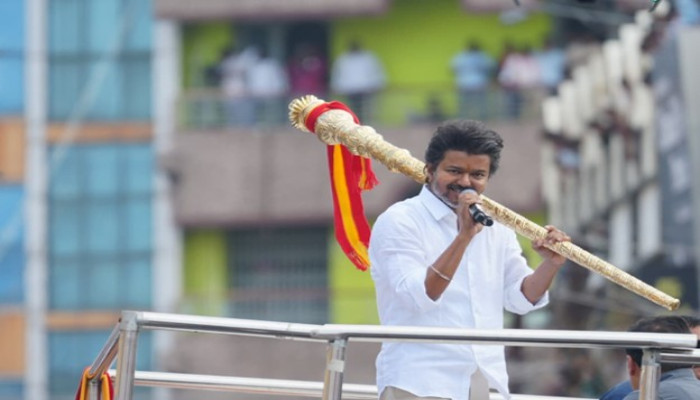
The lead-up to the 2026 Tamil Nadu Legislative Assembly election is witnessing a high-octane transformation as the state shifts from its traditional bipolar contest between the DMK and AIADMK toward a more complex, multi-polar landscape. Central to this shift is the "big bang" entry of actor Vijay and his party, Tamilaga Vettri Kazhagam (TVK), which initially triggered a massive wave of hype through strategic state-wide tours.
In September 2025, Vijay embarked on his maiden political campaign from Trichy, a city traditionally chosen by political icons like C.N. Annadurai and M.G. Ramachandran to launch their electoral journeys. Thousands of supporters thronged the streets, bringing traffic to a standstill as his custom-built campaign vehicle crawled through the city, projecting him as a principal challenger to the Dravidian status quo. This momentum continued with major conferences in Vikravandi and Madurai, where packed crowds of youth and first-time voters seemingly validated his position as a serious third pole. However, this period of intense enthusiasm soon met a sobering reality.

The tragedy in Karur, where a stampede during a Tamilaga Vettri Kazhagam outreach program claimed forty-one lives and left more than sixty injured, has significantly altered the political landscape for Vijay and perhaps even Tamil Nadu. Critics and political opponents have seized upon the event to place him in the dock, citing a lack of administrative oversight and poor crowd management. While the state government initiated a judicial inquiry, the Supreme Court ordered a Central Bureau of Investigation (CBI) probe, which has seen Vijay interrogated for six hours across multiple rounds in early 2026.
Officials have questioned him on his decision-making regarding the rally, the reasons for his seven-hour delay, and his knowledge of the ongoing chaos during the event. The narrative being built by the Dravidian majors is that of an amateur leader who is out of his depth. However, this clinical focus on a single tragedy overlooks the broader structural resilience that Vijay has demonstrated throughout his career.
Beyond the administrative failure in Karur, there is a growing perception that Vijay lacks the groundedness required for the rough and tumble of Tamil politics. His detached leadership style, characterised by a refusal to engage frequently with the media and a preference for communicating through controlled social media posts, has been widely criticised. Critics point to his use of private jets for campaign travel and the heavy presence of bouncers as evidence of a leader who is physically and emotionally isolated from the common citizen. This perceived elitism, combined with his decision to flee the scene in Karur without addressing the public or the press, has led many to question whether he can ever transition from a celluloid superstar to a leader of the masses.

The prevailing consensus among the intelligentsia and a/c room pundits in Chennai is that Vijay is merely a vote-cutter, a transient phenomenon destined to meet the same fate as Sivaji Ganesan or Kamal Haasan. They point to his choice of less experienced advisors as evidence of a perceived lack of ideological or organisational depth. This scepticism has deepened with his recent weakness in handling the release delay of his final film Jananayagan, which has been stalled by the Central Board of Film Certification over alleged objections to religious harmony. Despite his attractive power-sharing offer intended to disrupt existing blocs, his inability to attract any major secular parties to form an alliance has been seen as a significant political failure. Both the Congress and Viduthalai Chiruthaigal Katchi (VCK) have remained cautious, viewing his overtures as old goods or mere film shooting, leaving his party TVK increasingly isolated in a solo run.
To understand why this is a flawed premise, one must first examine the sheer tenacity of his ascent in the film industry. Vijay did not become a superstar overnight; his career is a masterclass in the long game. Starting as a child artist in the early eighties, he transitioned to lead roles in the nineties to a chorus of derision regarding his appearance and acting ability. During this survival phase, he did not have the luxury of being choosy; he hung in there by doing odd roles and soft romantic dramas, at times appearing in content that bordered on the B-grade aesthetic of that era. He persisted through this gruelling decade, slowly pivoting from a soft romantic hero to an action mass star, outmanoeuvring contemporaries who perhaps had more raw talent but less grit. He is a lambi race ka ghoda who has already proven he can withstand decades of mockery to emerge as the highest paid star in the state.

Transitioning from this personal history to the electoral reality, we must look at the cold arithmetic of the 2021 results. The DMK led the pack with roughly thirty-eight per cent, while the AIADMK secured around thirty-three per cent. The gap is narrow, and the vacuum left by the collapse of a singular towering opposition leader is palpable. While the pundits calculate seat shares based on existing caste blocks, they miss the underlying chemistry of his political entry. Vijay understands that in politics, as in cinema, you start humbly, you make rookie mistakes, and you endure the labels of being soft until the organisational work behind the scenes begins to reflect at the booth level.
His foray into politics follows a distinct SWOT profile. His strength lies in a massive, disciplined fan base that has been groomed for over a decade through his Makkal Iyakkam. His weakness is a lack of political administrative experience, which the Karur tragedy has painfully exposed. However, his opportunity is the significant chunk of neutral voters and disillusioned youth looking for a home, a demographic that is increasingly bored of the DMK AIADMK binary. His threat is the established machinery of the Dravidian majors, who will continue to use legal and political levers to stymie his growth. Like MGR, who was often dismissed by the elite as a mere entertainer, Vijay understands that in Tamil Nadu, the path to the fort is paved with emotional resonance and persistence.
He will be ridiculed for his silence and his perceived lack of aggression, but as history shows, those who underestimate the underdog often find themselves outmanoeuvred. The strategic verdict is clear: Vijay is not here to play a cameo. To replicate the MGR magic, he does not need to win a majority in his first outing. He only needs to breach the fifteen per cent threshold to become the kingmaker or the primary challenger in a state tired of the old guard. The Karur incident and the Jananayagan delay may have put him in the dock for now, but those who write him off are ignoring the very tenacity that defined his rise. He will learn, he will adapt, and eventually, he will prevail.



 Loading...please wait
Comments