



Fresh military escalation as US and Israel strike Iran, explosions reported in Tehran
- In Reports
- 02:21 PM, Feb 28, 2026
- Myind Staff
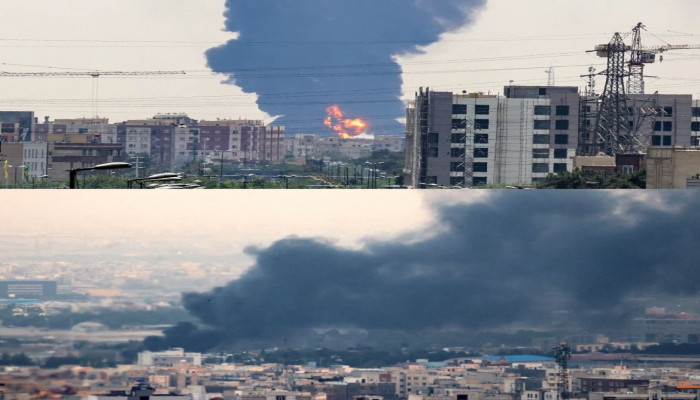
The United States and Israel on Saturday carried out what they described as a preventive missile strike against Iran, leading to massive explosions across Tehran. The attack has sharply increased tensions in the region and raised fears of another major military confrontation in the Middle East. The strikes took place even as diplomatic talks were ongoing between Tehran and Washington in an effort to reduce tensions and avoid a wider conflict.
According to reports, several powerful explosions were heard in different parts of Tehran soon after the operation began. Among the reported targets was the presidential building complex. Following the strike, Iran’s Supreme Leader, Ayatollah Ali Khamenei, was moved to a safer and undisclosed location as a precautionary measure. Iranian authorities also cut mobile phone services in the eastern and western parts of Tehran. In addition, the country closed its airspace in response to the attack, signalling concerns about further military action.
In a statement after the launch of the operation, Israeli Defence Minister Israel Katz explained the purpose of the strike. He said the mission was intended to remove threats posed by Iran. “The State of Israel launched a pre-emptive attack against Iran to remove threats to the State of Israel,” he said. Israeli defence officials confirmed that the operation had been coordinated with the United States. They described it as a necessary step in response to what they consider growing dangers from Iran’s military capabilities.
Israel also prepared for possible retaliation from Iran. The country declared a state of emergency soon after the strike was carried out. Air raid sirens were sounded in several areas to alert citizens and prepare them for the possibility of incoming missiles. The Israeli military said it had sounded protective air raid sirens across parts of the country “to prepare the public for the possibility of missiles being launched toward Israel” in retaliation. Authorities also announced a “prohibition on educational activities, gatherings, and workplaces” across the country, although essential services were allowed to continue functioning.
The latest strike comes months after Israel and Iran were involved in a 12-day aerial conflict in June. That confrontation marked one of the most direct and intense exchanges between the two long-time rivals. Although the earlier conflict had ended, tensions between the two countries have remained high. Israel and the United States have repeatedly warned that military action could resume if Iran continued advancing its nuclear and ballistic missile programmes.
At the same time, diplomatic efforts had been underway. Washington and Tehran resumed negotiations in February in an attempt to resolve their long-standing dispute through dialogue. The goal of the talks was to prevent a broader regional war and find a solution to disagreements over Iran’s nuclear activities. However, Israel has consistently argued that any agreement must go beyond limiting uranium enrichment. It has insisted that there must be a complete dismantling of Iran’s nuclear infrastructure. Israel has also demanded that restrictions on Iran’s missile programme be included in any future deal.
Iran, on its part, has expressed willingness to discuss limits on its nuclear activities if sanctions are lifted. However, it has firmly rejected the idea of negotiating over its missile programme. Iranian officials have also issued warnings to neighbouring countries that host American military forces. They have said that these countries could become targets if US bases on their soil are used to launch attacks against Iran.
The situation has once again placed the Middle East on edge, with fears that the conflict could spread beyond the immediate parties involved. With airspace closed, communications restricted, and emergency measures in place, the region faces renewed uncertainty. While both military action and diplomatic talks continue to shape the crisis, the risk of further escalation remains high.



 Loading...please wait
Comments