




France sends aircraft carrier to Red Sea amid push for Hormuz security mission
- In Reports
- 01:05 PM, May 07, 2026
- Myind Staff
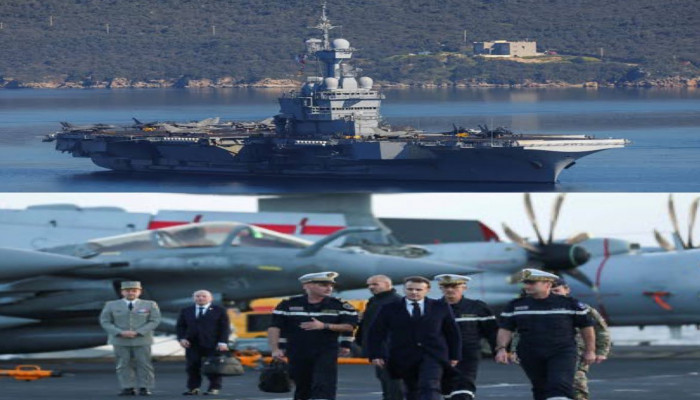
France has deployed its carrier strike group to the Red Sea as tensions continue around the Strait of Hormuz, a key global trade and energy route. The move comes as Paris increases efforts to support a possible international mission aimed at securing safe passage through the strait amid the ongoing confrontation between the United States and Iran.
The deployment was announced on Wednesday as France urged both the United States and Iran to consider a proposal that could help ease tensions in the region. French officials stressed that the continuing blockade and instability around the Strait of Hormuz are creating serious economic consequences across the world.
Fresh exchanges of fire earlier this week highlighted how fragile the situation remains. The recent confrontation between the U.S. and Iran over control of the narrow maritime passage has raised fears of a wider conflict. The Strait of Hormuz is one of the world’s most important shipping routes, carrying major oil and trade supplies. Continued instability has affected shipping movement and raised concerns over rising energy prices.
"The reason why we must make a renewed effort today is simply that the blockade of Hormuz continues, the damage to the world's economy is therefore becoming more and more pronounced, and the risk of a prolongation of hostilities is too serious for us to accept it," a French presidency official told reporters in a briefing after the army announced the strike group's deployment.
France and the United Kingdom have reportedly been working together for several weeks on a proposal designed to prepare the ground for secure maritime movement through the Strait of Hormuz once tensions reduce or the conflict comes to an end. The proposal would require coordination with Iran, and several countries have already shown interest in participating in the mission.
According to the French military, the aircraft carrier group led by the Charles de Gaulle is currently heading toward the southern Red Sea. The strike group is accompanied by Italian and Dutch warships as part of the broader deployment.
The French army stated that the operation aims to study the regional security environment and improve crisis-management options in the area. The mission is also intended to strengthen maritime security, support coordination with partner countries, and reassure global trade operators affected by instability in the region. French officials said the deployment follows a defensive framework that remains in line with international law.
France also outlined the broader diplomatic idea behind the proposal. "What we are proposing is that Iran gains passage for its ships through the Strait and in return commits to negotiating with the Americans on issues of nuclear materials, missiles, and the region, and we propose that the Americans, for their part, lift their blockade of the Strait of Hormuz and, in return, obtain Iran's commitment to negotiations," the French presidency official said.
The official further explained how the multinational effort could function if both sides agree to the arrangement. "Under these conditions we could deploy the multinational force to secure the convoys crossing the Strait of Hormuz and this obviously requires that the Iranians not fire on the ships."
Despite the proposal, questions remain over whether Iran would agree to such a plan. Tehran’s control and influence over the Strait of Hormuz have long been viewed as a major source of leverage in its discussions with Washington, especially during periods of heightened tension.
Still, France said the deployment sends a clear signal about Europe’s readiness to act. "We collectively want to send the signal that not only are we ready to secure the Strait of Hormuz, but that we are also capable of doing so," the French official said.
"The question now will be to obtain Iranian consent, American consent."
So far, European countries have mostly remained observers in the broader conflict involving the U.S., Israel, and Iran. However, growing disruption to Middle Eastern shipping routes and fluctuating oil prices, which are hovering near $100 a barrel, have increased pressure on European governments to protect their economic and strategic interests.
European powers have also faced criticism from U.S. President Donald Trump for not fully supporting Washington’s blockade measures. Trump has accused several countries of failing to align with U.S.-led actions in the region. The decision to send military assets to the Red Sea may also be aimed at easing those concerns while demonstrating Europe’s willingness to contribute to regional security efforts.
The situation around the Strait of Hormuz remains tense, with diplomacy and military positioning continuing at the same time. France’s latest deployment highlights growing international concern over the impact of the crisis on global trade, energy markets, and regional stability.



 Loading...please wait
Comments