




Forgotten Heroes: U Kiang Nangbah of Meghalaya (Part-3)
- In History & Culture
- 02:10 PM, Jan 06, 2021
- Ankita Dutta
Imposition of Taxes
With the passage of time, certain regulations pertaining to taxation, e.g. house tax, etc. that were already operative in the fully-administered areas, were introduced by the British. It was in the year 1853 that A.J.M. Mills who was the judge of the Sadar Diwani Adalat, on deputation to the Khasi and Jaintia hills, advocated for the imposition of a house tax. He further suggested that a thana (police station) was to be immediately set up so that strict vigilance on the “unruly conduct” of some of the people in the area could be maintained. The public pronouncement of the imposition of house tax by the British was made by Manik Pakyntein, a former Doloi of Jowai, in a Dorbar held at Minkoi Pirdi in 1859. The Pnars were never accustomed to paying any money tax in the past, but annually used to send one male goat and a few seers of parched rice from each village as homage to the king in Jaintiapur, who derived a greater portion of his income from the plains. They thus felt that this was an attempt to make them “submissive to authority” and “acknowledge the supremacy of the British government.” But the colonial masters were of the opinion that they were within their rights to impose taxes on their subjects and hence instructed all the Dolois to start the process of tax collection.
The people of the Jaintia hills had already made it clear that they would not pay any form of taxes imposed by the foreigners. When U Kiang Nangbah came to know of the announcement of the house tax, he declared that this was an extremely absurd idea! The fresh changes introduced by the British provoked widespread discontentment beginning in March-April 1860, in which raids were carried out by the Jaintias well into the neighbouring Sylhet district. British writers such as Hunter, Buckland, and Alexander Mackenzie devoted considerable space in their works to the delineation of the events leading to this rebellion. Alexander Mackenzie’s comments in this regard make for an interesting reading. He wrote, “In 1860, the house tax was imposed and within a few months, the people rose in open rebellion. The incident was considered important because virtually all the Jaintia chiefs called Dolois took up arms against the government. Fortunately, a large force of troops was at hand and before the revolt could make any head further, it was stamped out and the villagers were cowed into ‘apparent submission’.” It is believed that the Syndai caves in the Jaintia hills were used as hideouts by the Jaintia Rajas in times of war.
The unrest was quelled in due course of time as a result of the active coordination of the authorities at Sylhet with those at Sohra and Dacca. Three British police stations were destroyed by an angry mob, who became extremely agitated at the ongoing state of affairs and protested violently. During the insurrection, information was gathered that the raids conducted in the plain areas were intended to capture Raja Rajendra and place him on the throne. Suspicions gained ground and the Government, therefore, ordered that Rajendra should be kept under close watch. It was later proposed that he should be pensioned off and removed from Sylhet as soon as possible, for his presence could have continually sustained the rebels. Raja Rajendra spent the rest of his lifetime in exile and passed away on April 29, 1862 in confinement. Kiang Nangbah was keeping a close track of the events, which gradually helped awaken the nationalistic sentiments of the patriot inside him. He could foresee in advance a series of changes which would eventually be disastrous to the Jaintias’ social systems, laws and customs, and institutions.
The decree passed by the government declared that taxes should be paid by everyone, and anyone who failed to do so would be dealt with severely by the government. An organised exploitation of the land-based resources of the Pnars by the British further worsened the situation.
When the British officials attempted to collect tax from one Lakhi Pyrding, a poor Jaintia farming woman, she refused to pay the tax. Humiliated by this refusal, they entered and ransacked the house of the woman, and looted all her valuables too. Upon hearing about the incident, Nangbah became furious. He immediately arrived at the spot and fought against the armed officials almost single-handedly. He always stood for the rights of the weaker and downtrodden sections of the society, particularly women. The lessons learnt from these troubles had apparently not been heeded to by the Empire. In 1861, the British administration considered the imposition of income tax on the local population which would be increased further every year. This was completely insensitive. But, by now, the people had become much more violent and non-compromising. The foreigners had to be shown that they could not impose their authority on the natives without their consent, and if they did so, their authority would be challenged.
Another apprehension which was doing the rounds in the air was that taxes could be levied on betel leaves and betel-nut as well, the two most important and essential items in Jaintia religious ceremonies. Such arbitrary policies of the colonial administration during the 1850s and the 1860s infuriated the Jaintias, eventually compelling them to openly rebel and rise up in arms with the sole objective of protecting their lands, customs, and religion.
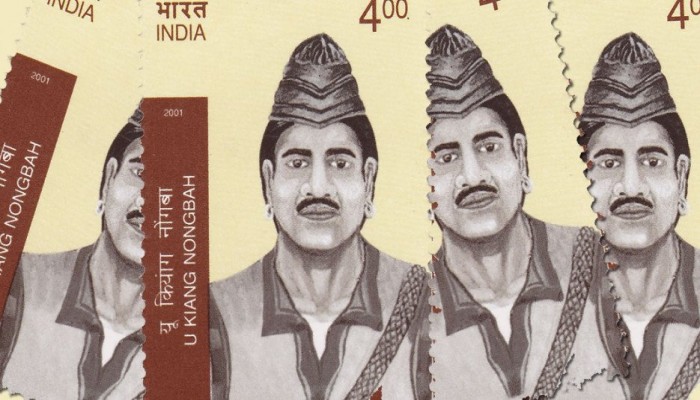
It was at this juncture that U Kiang Nangbah had signalled the beginning of a revolt against the brutal authoritarianism of the colonial state. It gradually took the form of a mass movement which vigorously exploded to engulf the entire Jaintia hills in due course of time. Led by visionaries like Nangbah, U Bang Doloi, and U Myllon Doloi, the Pnars declared complete independence and withdrawal of the British from the Jaintia hills. The war waged by them against the Government signalled a return to their pre-colonial past by reinstating their Raja on the throne. They were assisted by the Khasis and the Garos alike by blocking lines of communication, laying ambushes and creating havocs on the Sohra-Jaintiapur and Jowai roads. Nangbah was a commoner who was supported by the Dolois and other social and community heads. He openly declared that his people were not entitled to pay any form of taxes imposed by a foreign ruling power and that they should be exempted from any forms of taxation. He even snatched the government order from the Doloi and tore it into pieces. He argued that the aliens had no right to demand any form of tax from an indigenous settler. In fact, it was the foreigner who ought to pay tax to the local rulers and not vice-versa.
While many gave in to the might of the colonial rulers, Kiang Nangbah considered it as outrageous to be taxed by foreigners. He displayed exemplary courage by confronting the Doloi even when everybody in the Dorbar chose to stay silent. He felt that injustice had been done to his people as they were not even consulted or made aware about the order to levy tax on them. This went against the Khasi-Pnar democratic tradition. Kiang Nangbah openly refused to recognise and honour the British power and its control over the Jaintia Kingdom, because of the way the latter was deceitfully acceded to the Empire and the king was unceremoniously removed from his throne by the British. He lived and fought his epic struggle against the British during the First War of Independence (1857) and after. Opportunity chanced upon his way when he was unanimously elected as the leader of a group of headmen of a cluster of villages situated in the Jaintia hills. Kiang Nangbah rose to this position not because of any family inheritance, but chiefly because of his convictions and actions which inspired people from both near and far. Subsequently, he went on to lead the war of liberation of the Jaintias against the administrative, land revenue and religious policies of the colonial state.
The Church Begins Its Proselytisation Mission
A police station and a Christian missionary school were established at Jowai in 1855 with the objective of establishing “Government authority” over the hills. Since the police outpost was set up near the cremation ground of the Dkhar clan of the Pnars, it was looked upon as a symbol of intrusion. Previously, in the year 1842, the Bible had been preached for the first time in Jowai by Rev. Thomas Jones. During the initial stages, the coming of the Welsh missionaries into the hills was not at all liked by the Jaintias who were the ardent followers of their indigenous religion Niam Tre. Several restrictions were placed on them by the Church, e.g. the newly converted Christians among the Pnars were strictly debarred from attending any of their traditional festivals. As a penalty to those who refused to comply with the directions, the Church had the right to excommunicate them from its congregations. The Christian converts were given much material assistance, e.g. they were settled in ‘Mission Compounds’, which were places especially meant to keep them away from the “heathens” or non-believers.
The Welsh Presbyterian Mission used to give stipends to students who were likely to return to their villages for Church works as school teachers. This created a deep wedge among the people whereby those who lived in these special compounds came to consider themselves as Skurs, meaning, school-going people and who were more advanced and literate than those residing in the original areas, who were known as Shnongs, meaning “heathens”.
By pouring scorn on their traditional beliefs and customs, it created a sense of inferiority among those who refused to convert. Hence, the Jaintias severely resented, which fuelled popular resistance against the British. Consequently, the Government took several additional measures to control them and assert its power further. E.g. the Deputy Commissioner issued an order directing the people to not burn their dead bodies near the military outpost. This was one of the major incidents that seriously enraged Nangbah who actively fought for the protection of indigenous traditions against the religious conversion agenda of the Christian missionaries. It was a completely unnecessary and uncalled for intervention by the British to abolish the traditional Pnar ritual of cremating the dead bodies in their traditional cremation sites. This action of the Government during the cremation of a woman from the Sumer clan, meant defiling of an ages-old ritual, which deeply wounded the religious sentiments of the Jaintias. They took it as a humiliation of their tradition and an unpardonable offence.
Nangbah rightly felt that the foreigners had no right to disrupt their ways of living, and prevent them from performing their cultural and religious obligations as had been practised so far. He therefore chose to revolt against the British occupiers who had very little or almost no regard for the religion, customs and traditions of the Jaintias and their way of life.
Music was a passion for Kiang Nangbah. He was very much fond of songs and different musical instruments, his favourite being the flute. Oral traditions of the region on Kiang Nangbah tell us that he was an excellent flutist who would always carry his flute with him at work, and also during his exploratory walks along the rivers and streams, hills and valleys. He preferred to relax himself by playing on his flute, and it was said that the beautiful hills and valleys of the region resonated closely to the tunes of his flute. Being a music lover himself, the British high-handedness was explicitly visible to Nangbah when the swords, shields, and other musical instruments such as the Ksein Kynring (a special drum made from the wood of a tree worshipped by the Pnars of Shangpung) which are accorded a ‘sacred’ status by the Jaintias, were forcibly confiscated, desecrated and burnt by the local police led by the Naib Darogah of the Jowai police station. This particular incident of religious intolerance took place at Jalong village during the performance of the Jaintia traditional warrior dance called Ka Pastieh Kaiksoo. The celebration was abruptly interrupted by the police before a large number of people who had gathered to witness the dance performance.
The Jaintias considered it as a sacrilege and thus decided to fight the British to save the honour of their religion. It proved to be the last straw in the already strained relationship between the Jaintias and the British.
Religious places of the Jaintias were destroyed by the British in order to facilitate the entry of the Protestant missionaries. Moreover, in the year 1860, a police constable shot dead a monkey in the nearby sacred forests of the Jaintia Kingdom. The Jaintias had always lived in a profound communion with nature since times immemorial. Their traditional rituals and religious activities played a prominent role in the conservation of nature, with many villages dedicating a part of the forest as sacred groves (known as Khlaw U Blei or Khloo Blai/Khloo Langdoh in Jaintia), which prohibited the extraction of any kind of forest produce. Ryngkew, Basa, and Labasa were some of the local deities in the Khasi-Pnar religious pantheon, to whom these sacred groves were dedicated. Both the government officials and the Christian missionaries subsequently made the people believe that the sanctity of the sacred groves was nothing but a superstition. But these sacred forests were and still are intrinsically related to the social, religious and cultural lives of the Jaintias. Set aside for religious purposes under the traditional land use system, the sacred groves represented the essence of the conflation of folklore, traditional knowledge, and biodiversity. They also served as sites for several social and cultural rituals and religious ceremonies. The resistance of the Jaintas grew fierce for it meant that their way of life and worship both, were being threatened and disrespected by an external cultural force through the sheer power of the gun.
There was a crisis of identity about which the people became very much concerned. They could not reconcile their fate as subjects under the British rule which was continuously interfering with some of their deeply revered age-old traditions and cultural belief systems.
The Rebellion & Kiang Nangbah’s Role
Beginning on December 28-29, 1861 the Jaintias fought a bitter war of attrition for almost three years (1860-63) against the political, military and religious machinations of the British. It began with the convening of a Dorbar called the Dorbar Khad-ar Dolloi of twelve Dolois at Madiah Kmai Blai on the banks of the Syntu Ksiar, to apprise people about the need to resist the alien rule. It took a stock of the ongoing events and resolved to start a mass movement soon for the sake of the country’s freedom. In that memorable Dorbar which was attended by both old and young men, U Doloi of Nartiang, known as U Kong-Wasan, garlanded Kiang Nangbah with his armours to become a leader of the people of the 12 Doloiships. He was, however, asked whether he could really do something extraordinary to prove that they had correctly chosen him as their leader. Kiang Nangbah understood the roles and responsibilities of a leader very well and wanted his whole being, both physical and spiritual, to be at first convinced of this great calling. He looked around, uttered not a single word, but dived deep into the waters of the Myntdu at Syntu Ksiar on that cold winter night. He emerged moments later carrying an uprooted little aquatic plant in his hands, from the stem of which three branches bearing three living leaves each spread out.
The priests present during the meeting agreed that it was a sign of divine intervention which established the justice of their cause and also the correctness of their decision to choose U Kiang Nangbah to lead the Jaintias’ fight for independence. Hence, it was this meeting that unanimously gave Nangbah the mandate to wage a war against the British who were by then, left no stone unturned to impoverish the local economy of the region, and interfere with the religious and cultural lives of the Jaintias.
Nangbah did not himself choose or wish to be a leader, but accepted the proposal as a gesture of respect for the collective wisdom and decision of this Great Jaintia Dorbar. Subsequently, he travelled all over the Jaintia Kingdom and even into the neighbouring Khasi states so as to encourage and seek support from the freedom fighters. Very soon, he won the respect and admiration of his followers by being a selfless leader. The situation quickly got out of hand and on January 20, 1862 the entire Jaintia hills district was up in flames. The local police station and the treasury office at Jowai were burnt down by angry and rebellious villagers, destroying them completely. They also set fire to its storehouse of weaponry and arsenal. The initial spark for the revolt was in fact, provided by the murder of two British soldiers who were dak-runners carrying messages from Nartiang to Myntang. These events took place only a few years after the Mutiny of 1857 in which the British had incurred heavy losses and sufferings of both men and material. The magnitude of the upsurge was such that as many as seven regiments and detachments of troops were put into action to suppress it. Jowai, which was besieged by the rebels for almost three weeks, was re-occupied by the British amidst heavy mass casualties on both the sides. It was not easy for the local officials posted in the area to stem the tide.
Thus, the struggle of Nangbah and the people of his community were not just aimed at gaining independence from the policies of the colonial state, but also for protecting and safeguarding their indigenous traditions against the religious evangelist mission of the Church. The latter’s agenda was based on the dissemination of the Christian religious dogma among the natives through education as the primary tool.
The highly skilled Nangbah and his strategic tactics to fight the British soon became the talk of the town. He evaded arrest by keeping his identity a secret. He contacted all the Dolois and Sirdars seeking their support and cooperation, without causing an iota of suspicion in the minds of the colonial masters. The British Intelligence Service too, failed to trace his movements and activities. Despite the growing popularity of Christianity among the people of his community, Nangbah never felt inferior or disillusioned with his own culture and traditions. The impact of westernisation that gradually came to be visible in his area could not deter Nangbah’s steely resolve to protect his religious beliefs and practices. A popular story about Nangbah goes so that once he struck an elderly man hard for no other reason than that the man had scoffed at him for wearing his traditional dress, i.e. the clean white dhoti, and playing the flute by the riverside. When summoned before the Dorbar, he defended himself so well that it had to finally declare him not guilty of the charge and was instead praised for his profound sense of patriotism. The members presiding over the Dorbar were deeply moved when he stated that it was better for him to die than be deprived of his personal freedom of practising his faith unapologetically.
Nangbah was also a man of conviction. When the British officials had sent peace messengers to the rebels, he wisely put forward his argument that if the foreigners really wanted peace, they should leave the native lands of the Jaintias and peace will automatically prevail in the Kingdom. Under the able leadership of Nangbah, the Jaintias burnt down the Christian settlements and besieged the military outpost. They built barricades and stockades, stored grains, and manufactured weapons and firearms as a contingency measure of addressing any unforeseen hostilities. Kiang Nangbah and his men waged a guerrilla warfare with traditional weapons such as bows and arrows, swords and shields, spikes and lances, etc. including canons and firelocks, which paralysed the British administration. The superiority of the British in arms and ammunition such as muskets, bayonets and artillery proved to be no match for the sharp ingenuity and resilience of the natives whose trained men through ambushes gave a tough fight to the British soldiers. The cries of “chut ki weit hawa nep hawa nep/hawa biang ki cher ki soom/pi yong i u lai i kattu yow pyndem bait ha’u mynder ri/” (meaning, ‘Sharpen your swords folks/prepare your spikes and lances/let us march together to defeat the foreigners/) reverberated in the air.
Nangbah was well-known for his deft organisational skills. The attackers swiftly escaped to the nearby jungles of Myngkrem, Myntdu, and Myntwa in order to evade detention. Although they were ill-equipped in comparison to the British in terms of men and material, but they fought bravely by virtue of better organisation and combat capabilities. Very soon, the attacks spread to the areas of Mynso, Changpung, Raliang, Nartiang, Borato, Mookaian, Sutnga, and other places of the Jaintia hills. The women played a major role in the uprising in preparing food for men, nursing the sick, and then moving them to safer places. A wave of panic gripped the British forces which found it very difficult to suppress the rebellion at one instance. In their effort to quell the rebellion, the British had used the influence of Ram Sing and Rabon Sing, the Rajas of Sohra and Khyriem respectively, and a few others to convince the rebels to give up their armed struggle. Captain B.W.D. Murton, the then Deputy Commissioner of the Jaintia Hills, had said – “What was initially considered a disturbance by the British officers in the region, catapulted into an independent uprising because the British had misjudged and miscalculated the strength of the Jaintia people.”
The British were so thoroughly demoralised that on March 28, 1862 the administration of the Jaintia hills was handed over to the then British Army Eastern Command. The disturbances had such an impact upon the administration of the neighbouring districts that the Government had to finally depute Brigadier-General Showers with around 2,000 soldiers (mostly Sikh) to suppress the Jaintia warriors in April 1862. This happened around the same time when the captive Raja Rajendra breathed his last. Kiang Nangbah was accompanied by Giri Daloi of Shangpung, Suwar Daloi of Sutnga, Bang Daloi of Nartiang and many other such fierce patriots. To counter the rebels, the Government was prompt to reinforce a number of regiments and launch a full-scale military operation against Nangbah and his men who led from the front. Describing the force, Col. Shakespeare wrote, “The force employed to suppress this uprising comprised of the following troops – the 21st and 28th Punjab Infantry, 33rd Native Infantry, 2nd Assam Light Infantry, Sylhet Light Infantry, The Kamrup Regiment, Rattatray’s Sikh Military Force, 200 Frontier Police from Nowgong and the North Cachar Hills and a battery of Artillery.” [Shakespeare, 1929]. Hundreds of Pnars were killed. It was from then onwards that the battle became a largely one-sided affair.
The guerrilla tactics of warfare launched by the Jaintias were so effective that they stirred confusion among the British camps, which prolonged the war. Kiang Nangbah was grievously injured in one of the bloodiest battles. While the revolt was going on, Nangbah fell severely ill and retreated to Umkara until he could fully recover. Historically, the cave Kut Sutiang located in the midst of a dense forest in the present-day Khasi hills of Meghalaya, is believed to have been Kiang Nangbah’s last resort in his fight against the British. Taking this as an opportune moment, U Long Sutnga and U Tyngker, who were key members of Nangbah’s team, secretly informed about the place and condition of Kiang Nangbah to the British. In the early hours of December 27, 1862 Lt. Sadlier led by U Long Sutnga, captured Kiang Nangbah with the help of two other informers through treachery and deceit. He was arrested from a village called Mynser (now in Karbi Anglong district of Assam), while he was still recuperating from his ill-health. It was reported that the British had also seized three guns from him after his arrest.
(To be Contd…)
References:
- Dr. Omarlin Kyndiah. (2020). British Cultural Hegemony and U Kiang Nangbah. The Shillong Times. https://theshillongtimes.com/2020/12/28/british-cultural-hegemony-and-u-kiang-nangbah/
- K.N. Dutt. (1959). The Khasi Insurrection, 1829: Its Real Causes and Character. Proceedings of the Indian History Congress, Vol. 22, pp. 336-344. https://www.jstor.org/stable/44304319
- Shobhan N. Lamare. (2017). Resistance Movements In North-East India: The Jaintias of Meghalaya 1860-1863. Regency Publications, New Delhi.
- https://thelogicalindian.com/amp/rewind/u-kiang-nangbah/
- https://www.google.com/amp/s/arisebharat.com/2014/02/04/u-kiang-nangbah-a-patriot-from-meghalaya/amp/
Image Credit: Office Holidays
Disclaimer: The opinions expressed within this article are the personal opinions of the author. MyIndMakers is not responsible for the accuracy, completeness, suitability, or validity of any information on this article. All information is provided on an as-is basis. The information, facts or opinions appearing in the article do not reflect the views of MyindMakers and it does not assume any responsibility or liability for the same.



 Loading...please wait
Comments