




Forgotten Heroes – U Kiang Nangbah of Meghalaya (Part-2)
- In History & Culture
- 08:02 PM, Jan 04, 2021
- Ankita Dutta
A Patriot About Whom History Never Taught Us
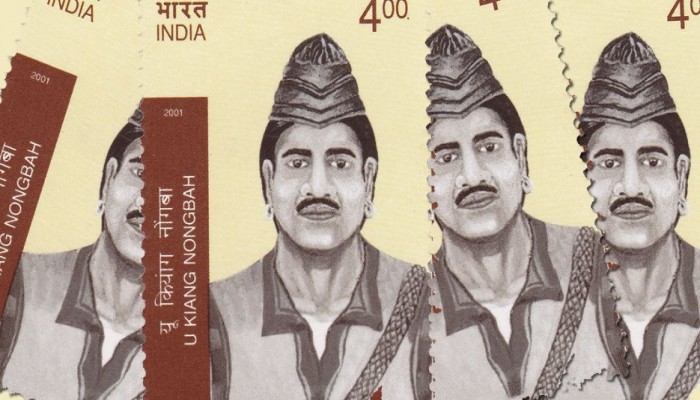
Nangbah belonged to the Syngkon sub-clan of the Soo kpoh khad-ar wyrnai clan (kur), which was started by the four progenitors of ka Bon, ka Tein, ka Wet, and ka Doh, the founding female deities and the first settlers of Jowai. Hence, it has been proved beyond doubt that U Kiang Nangbah was from Jowai and belonged to the sookpoh clan, because his last rites were performed by someone from the same clan. His hut was situated on the hilltop across the valley between the two hills where Iawmusiang and Tpep-Pale stand. This is the valley that derives its name wah Nangbah from the Nangbah family; wah Nangbah literally means the valley below Nangbah’s hut. Even as a child, Nangbah’s fighting spirit was aroused by the numerous stories that he used to hear about the dubious methods being employed by the British to annex the Jaintia hills. As he grew up, he was driven by a passion to oust the foreigners from his motherland and teach them a fitting lesson. Nangbah was a tall, well-built young man of a moderate stature by the Khasi Pnar standards. The story abounds that he was a very strong man who possessed extraordinary strength to plough double of what any young man of his age could in a day. Nangbah was fond of sports too, particularly athletics. After his regular morning bath, he would run for long distances all alone just because he enjoyed doing the exercise that also helped him in maintaining his fitness and strength.
Kiang Nangbah understood very early on that the might of the British Empire was not fully comprehended by the people of his community during those initial years of the freedom struggle, mainly because of their ignorance of the affairs of the world at large.
Ever since his childhood, Nangbah was a keen observer of the wonders of nature and the natural processes. He was so much fascinated by nature that he would often ask questions to his mother and elders about the occurrences in the plant and animal kingdoms and the natural environment. He was a curious child who mostly kept to himself but listened with rapt attention to the explanations provided by his elders to his queries. Being the only child in the family, Kiang Nangbah led a solitary life. He was the apple of his mother’s eye as was his mother to him. He was always concerned about the well-being of his mother and would look out for her whenever she went out to get firewood and water for the household. He always accompanied her whenever she ventured out into the open to work on their cultivated lands. He grew up as a deeply respectful and obedient child. He did not receive any formal education but was taught by his mother at home about the rights and duties of a responsible citizen. “They are foreigners and they want us to be their slaves” – said his mother one day to Kiang Nangbah. It sowed in him the seeds of dissent against the British from a very early age.
There was also no dearth of community education during those days, considering the nature of the close-knit society. Even if there were no schools and colleges in the villages, each elder took upon himself the responsibility to inculcate good moral values in the young ones.
There are many opinions on U Kiang Nangbah’s worldviews, the most popular one being that he did not know much about the world except his immediate neighbours, i.e. the Ahom kingdom, the Bengalis, and maybe to some extent the Burmese, but not beyond that. His life was a perfect embodiment of his love for freedom and justice, which drove him to take on the British, notwithstanding the dangers that he had to face. As a teenager, Nangbah was deeply distraught by the atrocities committed by the British on his people. The stories of the daredevil exploits of his maternal uncle, U Ksan Sajar Nangbah, who fought against the British at a place called Chanmyrsiang, greatly inspired him. Nangbah was quick to realise that a disciplined fighting force was the most important need of the hour which would help the natives challenge the military might of the British. With the passage of time and in the absence of adequate historical evidence, the story of Nangbah has become closely intertwined with folk beliefs, myths and legends that people have weaved and passed on orally from one generation to another.
This brings to light the grim reality of the overtly Mughal-centric standard historical discourse in post-Independent India. It has not only ignored the different aspects of the lives of the janjati communities of Northeast India, but also gradually erased from our history textbooks the valour of the great warriors from these communities.
In fact, the failures of our academic community, often working in the ‘denial mode’, are too glaring. Their myopic and parochial approach to understanding India’s history and civilisation defies the very soul and beauty of India’s unique plurality. Historians and social scientists have hidden the truth from the common masses by continuously taking recourse to colonial constructs such as race, isolation, mainland-periphery conflict, etc. Their “research” papers have focussed on ‘assumed’ grievances; in the process, either denying or ignoring the pan-Indian linkages of the different geographical regions of Bharat. Much of the credit goes to this cabal of so-called prominent “academicians” in generating a fear psychosis among their own people by a repeated reminder of and one-sided emphasis on factors such as the Siliguri bottleneck. An uncritical and blind acceptance of the views of the colonialists has proved to be the greatest weakness of our social scientists, historians, and anthropologists. Their obsession with ‘race’ as a category has fuelled intra- and inter-regional social divides between the Northeast and various other regions of the country, leading to further balkanisation of a region already mired in numerous social and political volatilities from time to time.
It is this nakedly visible negative role of the Indian academia that is partly responsible for the malady that infects our standard history textbooks. The reality is that racial distinction and “othering” are myths perpetrated by colonial scholars but later strengthened, normalised and made acceptable by the Left scholarship.
The Coming of the British
The Jaintia kingdom generally had a peaceful relationship with the neighbouring kingdoms of the Ahoms and the Kacharis, although occasionally, these relations were marred by bitter conflicts over land rights and resource use. However, the hills suffered comparatively little in these conflicts and they virtually remained intact till the end of the dynastic rule, i.e. until the annexation of the Jaintia Kingdom to the English East India Company in the year 1835. The hills possessed enough natural resources which could have been easily harnessed by the British. But, just like in other places, they initially adopted a policy of least interference in the internal affairs of the newly annexed kingdom which was passing through a period of an uneasy calm. As time passed, a series of measures were introduced in the Kingdom under the ‘Forward Policy’ of the Government, which antagonised its inhabitants, both rich and poor alike.
Raja Rajendra Singh of Jaintiapur, the then king of the Jaintia Kingdom, was deprived of his dominion through deceit when his revenue-yielding rich territory in the plains was taken over by the British. The British had asked Rajendra Singh to sign a new treaty which clearly stated that he should pay an annual tribute of 10,000 rupees. The king was left with no option but to rule over his people in the hills which offered him very little scope for earning revenue for maintaining his family and also for carrying out the administrative functions. Hence, the terms of the new agreement were stoically declined by him for he was unwilling to rule over a truncated country. He voluntarily surrendered the remaining territory to the British government. For about two decades thereafter, the destiny of the Jaintia hills became linked with that of the Khasi hills, the only difference being that while the Khasi Chiefs were left in virtual control of the administration of the local affairs in their respective territories; the Jaintia hills were placed under the supervision and control of a British Civil Officer through local officials called Dolois and Sirdas who functioned as the Company’s agents.
The Dolois also served as members of the State Council of the Jaintia king, assisting him in the day-to-day transaction of business of the Council and the Court. They were much more than temporal heads who exercised not only executive, political and magisterial powers, but also had religious duties and obligations to perform. This system remained in practice during the period of 1835-1853.
Though the institution of Kingship or Chieftainship does not exist anymore in the Jaintia hills, the institution of Doloiship is still existent and there are, at present, 18 Doloiships in the Jaintia Hills. The Dolois are in charge of their respective Elakas or Doloiships, which is administered by the Doloi with the help of officials called Pators and Sangots, each being allocated his own special responsibility. During the British rule, the former exalted status enjoyed by the Dolois changed. They not only lost much of their administrative powers but were also compelled to follow the laws that were introduced by the British. The colonial state legitimated its authority through a gradual de-legitimation of the pre-colonial authority at all levels ranging from the pre-colonial claimants to sovereignty to lower levels such as the native princes, chiefs, and the like. However, the colonial administrators and writers have presented a completely different view of colonial intervention in the lives and societies of people whom they labelled as “tribes”. They were described as ‘primitive’, ‘cultural isolates’, ‘barbarous’, head-hunters’, ‘criminals’, ‘opium-eaters’, etc. The aspects of pre-colonial socio-economic and polity formations were fully dumped and they were all made to fit into a category of so-called ‘undeveloped’, ‘uncivilised’, or ‘semi-civilised’ lot.
Colonial rule was projected as the greatest service to humanity for it was the saviour of the “tribal” society aimed at the liberation of its people from some of the worst forms of barbarism and savagery. As argued by Dr. Lamare, the unfortunate moves of the British to declare the pre-colonial socio-cultural and political developments among the Pnars as illegitimate, became one of the primary reasons for the Jaintia resistance that they faced.
(To be Contd…)
References:
- Amarendra Kr. Thakur. (2014). Resistance to British Power in the Hills of North-East India: Some Issues. Dialogue, Vol. 16, No. 1, pp. 117-128.
- District Census Handbook, Jaintia Hills. Census of India, 2011, Meghalaya. Series-18, Part XII-B. Directorate of Census Operations, Meghalaya.
- Dr. Harish Shetty. U Kiang Nangbah: A Forgotten Hero of North-East India. https://mindmoodsandmagic.blogspot.com/2012/08/u-kiang-nangbah-forgotten-hero-of-north.html?view=sidebar&m=1
- Dr. U. Hamlet Bareh. (2018). Builders of Modern India: U. Tirot Singh. Publications Division, Ministry of Information and Broadcasting, Govt. of India.
- H.H. Mohrmen. (2013). The Education of U Kiang Nangbah. The Shillong Times. https://theshillongtimes.com/2013/01/07/the-education-of-u-kiang-nangbah/
- Shobhan N. Lamare. (2005). The Jaintias: Studies in Society & Change. Regency Publications, New Delhi.
- https://theshillongtimes.com/2012/12/24/a-brief-history-of-u-kiang-nangbah/
- https://www.google.com/amp/s/nenow.in/north-east-news/meghalaya/u-kiang-nangbah-a-brief-life-sketch.html/amp
- https://www.google.com/amp/s/www.thenortheasttoday.com/blogs/the-khasis-of-meghalaya
Image Source: Office Holidays
Disclaimer: The opinions expressed within this article are the personal opinions of the author. MyIndMakers is not responsible for the accuracy, completeness, suitability, or validity of any information on this article. All information is provided on an as-is basis. The information, facts or opinions appearing in the article do not reflect the views of MyindMakers and it does not assume any responsibility or liability for the same.



 Loading...please wait
Comments