



Forging Steel and Strategy: How Bharat Can Leverage Japan’s Military Shift to Build a Global Defence Industrial Power
- In Military & Strategic Affairs
- 11:06 AM, Apr 28, 2026
- Siddhartha Dave
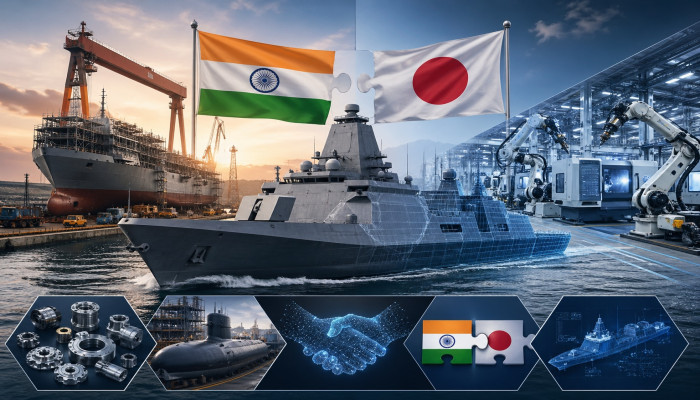
The global strategic landscape is undergoing a profound transformation. Nations that once remained restrained by historical doctrines are now recalibrating their security postures in response to emerging threats. Among the most significant of these shifts is the evolving military orientation of Japan—a country whose pacifist constitution, shaped in the aftermath of the Second World War, is now being steadily reinterpreted in light of contemporary geopolitical realities.
At the centre of this transformation stands Sanae Takaichi, often described as Japan’s emerging “iron lady.” Her assertion that a Chinese attack on Taiwan could threaten Japan’s survival underscores a decisive shift in Tokyo’s threat perception. Japan is no longer content with being a passive security actor; it is preparing to become an active participant in shaping regional and global security outcomes.
This shift is not merely rhetorical. It is being institutionalised through policy changes that allow Japan, for the first time in decades, to export lethal weapons. What was once constitutionally and politically unthinkable is now becoming a strategic necessity. The removal of restrictions on defence exports marks Japan’s transition from a constrained self-defence force to a nation seeking a meaningful presence in the global arms market.
For Bharat, this transformation presents a historic opportunity.
Japan’s Strategic Reawakening: From Pacifism to Production
Japan’s defence industrial base, long constrained by limited domestic demand and export restrictions, is now being revitalised. For decades, Japanese defence companies operated in a closed ecosystem with a single customer—the Japan Self-Defence Forces. This created a cycle of limited scale, high costs, and minimal innovation incentives. However, recent policy changes have broken this cycle.
Japanese firms such as Mitsubishi Heavy Industries, Kawasaki, and Fujitsu are now expanding their defence portfolios. These are not traditional defence contractors alone; they are industrial giants with capabilities spanning automobiles, electronics, aerospace, and advanced manufacturing. Their entry into the global arms market brings with it cutting-edge technological expertise and production efficiency.
The scale of this transformation is already visible. Japan’s defence industry has recorded significant growth, driven by both domestic military expansion and export ambitions. The landmark deal to supply Mogami-class frigates to Australia signals Tokyo’s intent to compete with established global defence exporters.
More importantly, Japan is actively seeking international partnerships to expand its defence production ecosystem. The emphasis is not just on selling weapons, but on co-producing them—integrating supply chains, sharing technologies, and building interdependent industrial networks.
Bharat’s Strategic Window: From Buyer to Builder
For Bharat, which has long been one of the world’s largest importers of defence equipment, this moment offers a strategic pivot. The convergence of Japan’s outward-looking defence policy and Bharat’s push for Atmanirbhar Bharat creates a unique synergy.
India’s defence industrial base has undergone significant evolution over the past decade. Public sector undertakings such as Hindustan Aeronautics Limited (HAL), Bharat Electronics Limited (BEL), and Mazagon Dock Shipbuilders Limited (MDL), along with a growing private sector ecosystem, have demonstrated increasing capability in producing complex platforms. Indigenous projects such as aircraft carriers, guided-missile destroyers, and nuclear submarines reflect a maturing industrial and technological foundation.
Yet, Bharat’s challenge has never been capability alone—it has been scale, integration, and global competitiveness.
This is where collaboration with Japan becomes transformative.
Co-Production as Strategy: The Mogami Model
The proposed co-production of Mogami-class frigates is not just a defence deal; it is a strategic template. By integrating Japanese design excellence with Indian manufacturing capacity, Bharat can achieve multiple objectives simultaneously.
First, it accelerates capability acquisition. Instead of developing platforms entirely from scratch, India gains access to proven, cutting-edge designs that can be adapted and produced locally.
Second, it strengthens industrial capacity. Co-production ensures that Indian shipyards move up the value chain—from assembly to design adaptation and eventually to indigenous innovation.
Third, it enhances export potential. By participating in global supply chains, Bharat can position itself as a competitive exporter of defence equipment, particularly to countries in the Indian Ocean Region and beyond.
Japan’s own experience offers valuable lessons. Its defence industry struggled for decades due to limited market access. Only after opening up to exports, had it began to scale and innovate. Bharat must avoid a similar trap by ensuring that its defence production ecosystem is outward-looking from the outset.
The Industrial Multiplier: Beyond Defence
The benefits of such collaboration extend far beyond the military domain. Defence manufacturing is inherently technology-intensive, driving advancements in materials science, electronics, artificial intelligence, and advanced engineering. These innovations often spill over into civilian sectors, boosting overall industrial growth.
Japan’s model illustrates this clearly. Companies that produce consumer goods—ranging from automobiles to electronics—also contribute to defence production. This dual-use ecosystem enhances efficiency, reduces costs, and fosters innovation.
Bharat, with its large industrial base and growing technological capabilities, is well-positioned to replicate and adapt this model. Collaboration with Japan can catalyse this transformation by introducing best practices in precision manufacturing, quality control, and supply chain integration.
Strategic Convergence: A Shared Security Vision
Beyond industrial considerations, the Bharat-Japan partnership is rooted in a shared strategic vision. Both nations face similar security challenges, particularly in the maritime domain. China’s expanding naval presence and assertive behaviour in regional waters have heightened the importance of collective deterrence.
Japan’s increasing engagement with global defence partners—including NATO members—reflects its recognition that security is no longer regional but interconnected. Bharat’s own outreach, including partnerships with countries like Germany, complements this approach, creating a multi-layered network of defence cooperation.
This convergence is not about forming rigid alliances but about building flexible, resilient partnerships that enhance collective security. By aligning their industrial and strategic interests, Bharat and Japan can contribute to a stable and balanced Indo-Pacific.
The Way Forward: From Opportunity to Execution
While the opportunities are immense, realising them requires strategic clarity and institutional efficiency. Bharat must ensure that co-production agreements are structured to maximise technology transfer and local value addition. It must also streamline procurement processes, reduce bureaucratic delays, and foster greater collaboration between public and private sector players.
Equally important is the need to develop an export-oriented mindset. Defence production should not be seen solely as a means of meeting domestic requirements but as a strategic industry capable of generating economic and geopolitical influence.
Japan’s journey—from a pacifist nation with a constrained defence industry to an emerging global arms exporter—offers a compelling case study. It demonstrates that policy shifts, when aligned with strategic intent, can transform national capabilities.
Building the Arsenal of a Rising Power
The world is entering an era where industrial capacity and military capability are deeply intertwined. Nations that can design, produce, and export advanced defence systems will wield disproportionate influence in shaping global order.
For Bharat, the partnership with Japan represents more than an opportunity—it is a strategic imperative. By leveraging its production capacities, integrating global technologies, and fostering robust industrial ecosystems, Bharat can transition from being a major importer to a leading producer and exporter of defence equipment.
In doing so, it will not only strengthen its own security but also contribute to a more balanced and resilient global security architecture.
The shift has begun. The challenge now is to sustain momentum and translate potential into power.
Disclaimer: The opinions expressed within this article are the personal opinions of the author. MyIndMakers is not responsible for the accuracy, completeness, suitability, or validity of any information on this article. All information is provided on an as-is basis. The information, facts or opinions appearing in the article do not reflect the views of MyindMakers and it does not assume any responsibility or liability for the same.


 Loading...please wait
Comments