




'Foreign Hand': Myth, Excuse or Reality? The Hidden Hand: External Interference in India since 1947 Part 1
- In Current Affairs
- 10:54 PM, Oct 20, 2026
- YagnaSri
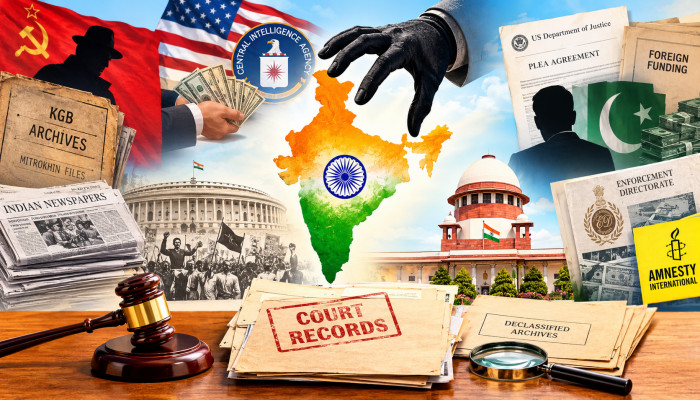
For fifty years, Indians have been told that the "foreign hand" is either everywhere or nowhere. The truth lies in court records, declassified archives, and admissions by foreign officials. This series follows the evidence, and only the evidence.
In the 1970s and 1980s, few phrases in Indian politics were used more often than "the foreign hand". People blamed unnamed foreign powers for strikes, riots, opposition rallies, and newspaper criticism. The charge was rarely backed by proof.
The result was predictable. The phrase became a joke. Cartoonists drew it as a disembodied glove. Critics treated any mention of foreign interference as an excuse for failure at home. That reaction was understandable. It was also a mistake. A charge that is overused is not thereby false. Some of the claims made in those years were later proved true by the foreign powers' own records.
Foreign interference in India since 1947 is not a matter of opinion. Documents produced by the interfering powers themselves, or tested in court, prove it. In 2005, Cambridge historian Christopher Andrew published files copied by the KGB archivist Vasili Mitrokhin. They record that by 1973, the KGB had ten Indian newspapers on its payroll. They claim it planted 3,789 articles in Indian papers in 1972 alone. A former KGB general described India as "a model of KGB infiltration of a Third World government".[1] Daniel Patrick Moynihan, the American Ambassador to India in 1973–75, wrote in 1978 that the CIA had twice given money to the Congress party to stop communist victories in state elections, once in Kerala and once in West Bengal.[2]
In 1985, a spy ring was found operating inside the Prime Minister's Office itself. Staff passed documents to French and Eastern Bloc diplomats. The Principal Secretary resigned. In 2004, a senior RAW officer, Rabinder Singh, fled the country, reportedly with American help.[3] In 2011, the Kashmir lobbyist Ghulam Nabi Fai pleaded guilty in an American court. The US Department of Justice said his Kashmiri American Council had received at least US$3.5 million from Pakistan's ISI over twenty years, and had sent its budgets to the ISI for approval.[4]
Indian courts have upheld convictions for the 2001 attack on Parliament and the 2008 Mumbai attacks. In 2019, the Supreme Court found "ample material" linking Hurriyat leaders to terror groups, in a case about money from Pakistan.[5]
In 2022, the Enforcement Directorate penalised Amnesty International's Indian arm ₹51.72 crore for routing foreign funds through investment routes to evade the Foreign Contribution (Regulation of Foreign Contribution) Act.[6] None of this is speculation. Each item rests on a court record, an official document or the admission of the people involved.
Where the charge failed
An honest series must also record the claims that did not survive scrutiny. There are several. The US$21 million that went elsewhere. In February 2025, President Donald Trump said that USAID had spent US$21 million on "voter turnout" in India. The claim caused a storm in Indian politics. It concerned Bangladesh, not India. In August 2025, the Ministry of External Affairs told Parliament, citing the American Embassy, that USAID ran no voter-turnout activity in India.[7]
The Supreme Court acquitted all six accused in the 2002 Akshardham temple attack case in 2014. The Bombay High Court acquitted all twelve accused in the 2006 Mumbai train blasts case in 2025. In 2024, the same court acquitted Delhi University professor G.N. Saibaba of charges of Maoist links. Each acquittal left a real crime without a proven culprit, and handed critics an argument.
In May 2024, the Supreme Court ordered the release of NewsClick founder Prabir Purkayastha, arrested in a case alleging Chinese funding. It held that the police had not given him the written grounds for his arrest. The case's merits remain untested.[8]
These failures matter. Each loose charge weakens the next true one. A country that cries "foreign hand" without proof teaches the world to ignore it when the proof exists.
How this series weighs evidence
Every significant claim in this series will carry one of three grades. The grade tells the reader how far to trust it.
|
Grade |
Meaning |
Examples |
|---|---|---|
|
A — Proved |
A court has found it, the actor has admitted it, or a legal order has been upheld. |
Convictions, guilty pleas, Supreme Court judgments, tribunal orders |
|
B — On record |
It rests on an official act or an authentic document, but no court has tested it. |
Government notifications, ministry data, declassified files, archival research |
|
C — Alleged |
A responsible source has made the claim, but it is contested or unproven |
Statements by officials, investigative reports, single-source stories |
A Grade C claim is not a finding of guilt. Where someone has been acquitted, or an arrest has been held illegal, the series will say so.
The series will also separate interference from engagement. Foreign trade, investment, aid, diplomacy and honest criticism are part of normal life for an open democracy. Interference begins where a foreign power acts in secret, breaks Indian law, or uses hidden money to shape Indian policy, opinion, faith or security.
Over the next thirty-one articles, this series will follow the hidden hand through every channel it has used since 1947:
-
Spies and the State: from the KGB's newspapers to today's online honey-traps.
-
Pakistan's proxy war: from the tribal invasion of October 1947 to Pahalgam and Operation Sindoor.
-
China's quiet campaign: espionage, money in Indian institutions and economic leverage.
-
Money, markets and ratings: political philanthropy, short-sellers, rating agencies and global indices.
-
Civil society as a channel: foreign-funded NGOs, green campaigns, conversion, Islamist networks and urban Maoism.
-
Shaping the world's view of India: think tanks, Western campuses and foreign media.
-
The response: what India has done, and what it still needs to do.
The aim is not to find a foreign hand behind every problem. Most of India's problems are made at home. The aim is to set out, plainly and with sources, where foreign powers have in fact reached into Indian affairs, how they did it, and how an open democracy can defend itself without closing its doors.
The test throughout will be simple: what can be proved? India deserves neither paranoia nor complacency. It deserves the record.
[1]"Indira's Foreign Hand", Outlook, September 2005, https://www.outlookindia.com/books/indiras-foreign-hand-news-228609, summarising Christopher Andrew and Vasili Mitrokhin, The Mitrokhin Archive II: The KGB and the World (Allen Lane, 2005).
[2]Daniel Patrick Moynihan with Suzanne Weaver, A Dangerous Place (Little, Brown, 1978).
[3]"When Coomar Narain, a PA-turned-spy, created havoc in South Block", Governance Now, https://www.governancenow.com/news/books-ideas/when-coomar-narain-a-paturnedspy-created-havoc-in-south-block.
[4]US Department of Justice, press release, 30 March 2012, https://www.justice.gov/opa/pr/2012/March/12-nsd-406.html.
[5]"Ample evidence by NIA to show link between Hurriyat, terror groups, says SC", Business Standard, 2 April 2019, https://www.business-standard.com/article/pti-stories/ample-evidence-by-nia-to-show-link-between-hurriyat-terror-groups-says-sc-cancels-watali-bail-119040201003_1.html.
[6]"Rs 62 crore FEMA penalty on Amnesty India, ex-CEO Aakar Patel", The Tribune, 8 July 2022, https://www.tribuneindia.com/news/nation/rs-62-crore-fema-penalty-on-amnesty-india-ex-ceo-aakar-patel-410605.
[7]"India did not receive $21 million from USAID for 'voter turnout'", Scroll, 22 August 2025, https://scroll.in/latest/1085783/scroll_in.
[8]"India Supreme Court orders immediate release of journalist detained in illegal funding case", Jurist, 16 May 2024, https://www.jurist.org/news/2024/05/india-supreme-court-orders-immediate-release-of-journalist-detained-in-illegal-funding-case/.



 Loading...please wait
Comments