




‘Forces that opposed Somnath Temple reconstruction still active’: PM Modi in Gujarat
- In Reports
- 03:14 PM, Jan 12, 2026
- Myind Staff
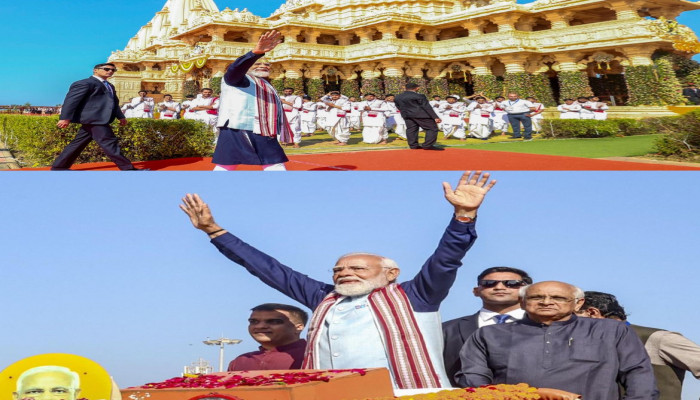
Prime Minister Narendra Modi on Sunday said that the forces which had opposed the reconstruction of the Somnath temple after Independence are still active in the country, though their methods have changed. He said these forces are now working through “other malicious means” instead of swords. The Prime Minister also said that the repeated attacks on the Somnath temple over centuries cannot be explained only as “acts of economic plunder”.
The Prime Minister was speaking at the Somnath Swabhiman Parv held at Prabhas Patan in Gujarat. The four-day event was organised to mark 1,000 years since Mahmud of Ghazni’s invasion of the Somnath temple in 1026. Addressing saints, priests, elected representatives and devotees on the final day of the event, Modi said the history of Somnath reflects continuity, resilience and pride.
“If the attacks on Somnath were only for economic loot, they would have stopped after the first major plunder a thousand years ago. But that did not happen,” the Prime Minister said. He added, “The temple was attacked again and again, its idols were broken, its form was altered repeatedly, and yet we were taught that it was only about loot.”
Modi said that some historians and political leaders, after Independence, tried to present invasions as routine acts of plunder. According to him, this attempt to “whitewash” history weakened collective memory and disconnected later generations from the sacrifices made to protect centres of faith. “Unfortunately, even today, forces remain active in the country that opposed Somnath’s reconstruction,” he said.
The Prime Minister said the Somnath Swabhiman Parv was not about remembering destruction but about celebrating continuity. “Somnath Swabhiman Parv was not a commemoration of destruction but of continuity,” he said. He added, “This festival is not merely a remembrance of the destruction that occurred a thousand years ago. It is a celebration of a thousand-year journey, and of India’s existence and pride.”
Giving a chronological account of the temple’s past, Modi said the story of Somnath is one of rebuilding and victory. “The history of Somnath is not one of destruction and defeat, but of victory and reconstruction,” he said, adding, “Invaders kept coming, but Somnath was re-established in every era.”
The Prime Minister recalled that after Independence, a decision was taken to rebuild the Somnath temple. He said Sardar Vallabhbhai Patel had pledged to restore the temple, but the decision faced resistance. Modi mentioned that there were objections even to President Rajendra Prasad attending the temple’s inauguration in 1951.
He credited Jam Saheb Digvijaysinhji of Nawanagar, the then ruler of Saurashtra, for playing an important role in the reconstruction. Modi said Jam Saheb supported the project, contributed funds, and became the first chairman of the Somnath Temple Trust.
According to the Prime Minister, the reconstruction of the temple in 1951 was an assertion of national self-respect. He also said that the completion of 75 years of the restoration in 2026 has added importance to the current celebrations.
Highlighting development work in the Somnath region, Modi spoke about several initiatives taken by the government. These include the establishment of Somnath Sanskrit University, the expansion of Keshod airport to improve connectivity for pilgrims, the launch of the Ahmedabad–Veraval Vande Bharat train, and the development of a pilgrimage circuit in the region.
“Today’s India remembers its faith while empowering it for the future through infrastructure, connectivity and technology,” the Prime Minister said.
Modi also linked cultural confidence with economic goals. He said India is preparing to become the world’s third-largest economy and aims to move further ahead. “Every Indian is committed to a developed India, and 140 crore people are determined towards future goals,” he said. He added that heritage sites like Somnath provide moral strength and energy to these national ambitions.
Gujarat Chief Minister Bhupendra Patel and other dignitaries were present at the event. During the Shaurya Sabha, participants displayed placards highlighting Somnath’s history and messages connected to national goals, including “Viksit Bharat@2047”.
Earlier in the day, the Prime Minister took part in the Shaurya Yatra organised as part of the Somnath Swabhiman Parv. He was accompanied by Gujarat Chief Minister Bhupendra Patel, Deputy Chief Minister Harsh Sanghavi, spokesperson minister Jitu Vaghani, and Education Minister Pradyuman Vaja.
The Prime Minister’s address focused on history, faith, national pride and development, while stressing that Somnath stands as a symbol of India’s resilience and continuous cultural journey.



 Loading...please wait
Comments