




Following the Money: The Institutional and Funding Case Behind the Christian Push for SC Status Part 4
- In Current Affairs
- 02:07 PM, Aug 13, 2026
- YagnaSri
Introduction
The demand to extend Scheduled Caste status to Christian converts is presented in public discourse as a grassroots plea from a neglected, impoverished community. It is worth examining, with the same rigour applied to the constitutional and historical questions in the earlier parts of this series, exactly which institutions have carried that demand forward, how those institutions are funded, and what the documented record — court filings, government data, and mainstream reporting, both Indian and international — actually shows. This article confines itself to claims that can be sourced to public records, official data, and named reporting, consistent with the standard the rest of this series has followed.
The Colonial-Era Missionary Economy and Mass Conversion
Christian missionary activity among Dalit communities in India was never a purely spiritual enterprise operating on local resources. The major nineteenth and early twentieth-century mission movements among Dalit communities in the Telugu-speaking districts, in Kerala, and in Tamil Nadu were financed substantially by mission boards headquartered in Britain, continental Europe, and North America — the London Missionary Society, the Church Missionary Society, and American Baptist mission boards prominent among them. These bodies ran extensive networks of schools, hospitals, and orphanages that served, among their legitimate humanitarian functions, as institutional platforms for the so-called "mass movements" that brought large numbers of Dalit converts into the Christian fold in this period. The institutional infrastructure built during this period — churches, seminaries, mission schools and colleges, hospitals — did not disappear at Independence. It forms the base of the extensive network that today gives Christian converts, as a matter of documented institutional fact, an educational and social-welfare cushion under Article 30 of the Constitution that indigenous Hindu Scheduled Caste communities, lacking any comparable centrally organised and externally resourced network, do not possess.
The Niyogi Committee: A State Government's Own Inquiry
The most detailed official examination of missionary methods and funding in independent India remains the report of the Christian Missionary Activities Enquiry Committee, appointed by the Madhya Pradesh state government (then under Congress rule) on April 14, 1954 and chaired by M. Bhawani Shankar Niyogi, a retired Chief Justice of the Nagpur High Court. Over a two-year inquiry, the Committee visited 77 Christian centres across fourteen regions of the state, examined institutions including hospitals, schools, and hostels run by various foreign missions, received 375 written statements, and interviewed more than 11,000 people — both Christian (missionaries and converts) and Hindu.
The Committee's published findings, submitted in 1956, recorded a marked increase in American mission personnel operating in India since the Constitution came into force, and concluded that inducements including offers of education, healthcare, and financial assistance were being used as instruments of conversion among tribal and Scheduled Caste communities in the state, in preference to purely doctrinal persuasion. This was not the finding of a partisan or externally funded body; it was the considered conclusion of an official inquiry commissioned by an elected state government of the day, based on the largest primary-evidence exercise of its kind conducted on the subject in independent India.
Present-Day Institutional Advocates
The contemporary campaign for extending SC status to Christian converts is carried forward by a small number of identifiable, named organisations, whose public filings and statements are a matter of record:
- The National Council of Dalit Christians (NCDC), whose coordinator, Franklin Caesar Thomas, has been the public face of litigation before the Supreme Court invoking the Ranganath Misra Commission and Sachar Committee findings in support of the extension demand.
- The All India Christian Council, a body that has separately filed public interest litigation before the Supreme Court seeking parity for converts of all faiths with Hindu, Sikh, and Buddhist Scheduled Castes.
- The Catholic Bishops' Conference of India (CBCI), the apex body of the Catholic Church in India, which has publicly and formally objected to the tightening of India's foreign-funding law (the Foreign Contribution Regulation Act, or FCRA) as it affects Christian institutions, describing recent amendments as granting the government excessive discretionary power over religious and charitable organisations.
These are not fringe or clandestine actors; they are established, named institutions whose positions are publicly stated and traceable. The point of naming them is not to impugn their legitimacy as advocacy bodies, but to make clear that the campaign is institutionally organised, not a spontaneous or unaffiliated grassroots movement, and that its principal vehicles are bodies with substantial international denominational and financial linkages.
What the FCRA Record Shows
India's Foreign Contribution Regulation Act requires organisations receiving funds from abroad to register and report their receipts, and successive governments — the framework itself dates to the Indira Gandhi era — have used cancellations and non-renewals as a regulatory tool. The scale of foreign funding flowing into Christian institutional infrastructure in India, as recorded in FCRA enforcement actions over the past decade, is substantial and a matter of public record:
- Compassion International, a US-based child-sponsorship organisation, was India's single largest recipient of foreign charitable funds when its FCRA registration lapsed in 2017, reportedly bringing in approximately $45 million annually before its India operations ceased, ending its support to close to 600 partner churches and roughly 147,000 children and young people.
- In 2021, the Missionaries of Charity, founded by Mother Teresa, had its FCRA renewal declined, one of 5,789 NGOs to lose their licence that year.
- In 2024, the FCRA registrations of World Vision India, the Church's Auxiliary for Social Action (CASA), and the Evangelical Fellowship of India were cancelled.
- Government data placed before Parliament recorded the cancellation or non-renewal of more than 20,000 FCRA licences over the decade to 2024, with independent reporting estimating that more than 10,000 of the organisations affected since 2011 were Christian-affiliated bodies.
- In 2026, Parliament further amended the FCRA specifically to bar the use of foreign contributions for religious conversion activity, a step the government has framed as closing a documented gap in the existing regulatory regime.
These figures establish, at minimum, that very substantial sums of foreign money have flowed into Christian institutional and charitable infrastructure in India over the past decade and a half, that the receiving organisations include some of the same denominational networks whose apex bodies (such as the CBCI) are actively engaged in opposing restrictions on that funding, and that Indian regulators have repeatedly found compliance failures serious enough to justify cancellation. What the FCRA record does not, on its own, establish is that this specific funding stream has been directed at financing the SC-status litigation and advocacy campaign as such; that campaign appears, on the public record, to be carried by the litigation and advocacy work of the NCDC, the All India Christian Council, and allied bodies rather than by the large service-delivery organisations named above. The honest conclusion is a narrower one: the same religious and denominational ecosystem that receives this scale of foreign funding for its broader institutional activity is also the ecosystem from which the SC-status campaign's organisational leadership is drawn — a relevant fact about institutional capacity and backing, even where a direct funding line to the specific campaign cannot be documented from public records.
The International Political Dimension
A further documented feature of this campaign, distinct from questions of direct funding, is active political mobilisation of foreign governments and international bodies on India's FCRA regime and the treatment of Christian institutions generally. When Compassion International's FCRA renewal was in question, its leadership has publicly stated that it engaged US lawyers and accountants, testified before the US House of Representatives' Foreign Affairs Committee, sought the intervention of then US Secretary of State John Kerry with his Indian counterpart, and mobilised more than 35,000 of its American sponsors to write to their members of Congress. The CBCI and allied international Christian advocacy networks have continued to raise India's FCRA regime before international bodies and in international Christian media as a religious-freedom concern.
This is legitimate advocacy activity by any normal democratic standard, and it is documented by the organisations' own public statements rather than by allegation. But it establishes, as a plain matter of record, that the debate over Christian institutional status in India — of which the SC-reservation demand is one strand is not confined to Indian domestic constituencies. It is actively contested through American legislative and diplomatic channels, international Christian media, and international human-rights reporting, in ways that indigenous Hindu Scheduled Caste communities, dispersed and without comparable international denominational infrastructure, have no equivalent capacity to mobilise on their own behalf.
Anticipating the Objection: "This Singles Out a Religious Minority Unfairly"
A predictable objection to the analysis above is that scrutinising the funding and institutional backing of Christian advocacy organisations amounts to targeting a religious minority for engaging in perfectly lawful advocacy, something majority-community organisations do routinely without equivalent scrutiny. This objection has real force in the abstract, and this series does not dispute that advocacy, lobbying, and international coalition-building are legitimate activities open to any community in a democracy.
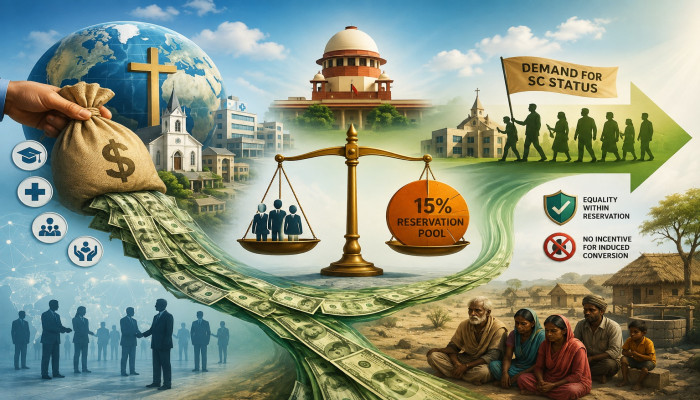
The relevant distinction, however, is not between majority and minority advocacy as such, but between advocacy and the specific constitutional claim being advanced. When any organisation — religious, secular, majority, or minority — seeks a change to the Presidential List under Article 341, the constitutional question is whether the change is justified by the untouchability-based rationale that alone grounds SC status, not by the size, wealth, or international reach of the organisation seeking it. The institutional and funding facts recounted in this article are relevant for a narrower and more specific reason than general suspicion of minority organising: Sections 9 and 10 of the underlying constitutional Representation this series draws upon identify a specific, documented risk — that a comparatively well-resourced, institutionally networked community entering a capped 15% reservation pool would disproportionately displace the least-resourced existing SC sub-groups, such as Madigas, Valmikis, and Musahars, who possess no comparable institutional cushion. That is an empirical and distributional concern about the mechanics of a finite quota, not a general objection to Christian civic participation.
The Article 30 Cushion in Concrete Terms
It is worth making the comparative institutional point concrete rather than abstract. Article 30 of the Constitution guarantees all religious and linguistic minorities, including the Christian community, the right to establish and administer their own educational institutions — a right the Christian community has exercised with particular success, building one of India's most extensive privately-run networks of English-medium schools, colleges, nursing and hospital-administration institutes, and seminaries, substantially funded through the same denominational and international channels traced above. Hindu Scheduled Caste communities, precisely because they remain within the Hindu social order that generated their disability in the first place, have no comparable community-specific, constitutionally protected institutional network of their own; their access to education and employment depends almost entirely on the reservation mechanism itself. Extending that same reservation mechanism to a community that already possesses this separate, substantial institutional advantage is not a neutral act of inclusion; it is the addition of a second, overlapping benefit to a community better placed, on the documented institutional evidence, to compete for the first one it would newly acquire.
Why This Matters for the Balakrishnan Commission
None of the institutional or funding facts recounted here settle the constitutional question examined in the earlier parts of this series; that question turns on the meaning of Article 17, the text of Article 341, and the reasoning of the Supreme Court in Soosai and its progeny, not on who funds whom. But institutional capacity is directly relevant to two of the specific concerns Sections 9 and 10 of the underlying constitutional Representation raise: the risk that a well-resourced, internationally networked community would disproportionately capture a finite 15% reservation pool at the expense of the least-resourced Hindu SC sub-groups, and the risk that extending statutory benefits would formalise incentives for the very inducement-based conversion practice the Niyogi Committee documented seventy years ago. A Commission examining whether to recommend extension of SC status to Christian converts is entitled to weigh not only the abstract question of continuing social disadvantage, but the concrete, documented institutional and financial position of the community and the organisations advancing the demand on its behalf.
The End
The Ambedkar That Today's ‘Ambedkarites’ Don't Quote Part 3
https://myind.net/Home/viewArticle/the-ambedkar-that-todays-ambedkarites-dont-quote-part-3



 Loading...please wait
Comments