




Five Stops, One Message: Modi Builds India's Multipolar Spine
- In Foreign Policy
- 03:56 PM, May 18, 2026
- Prasad Peketi
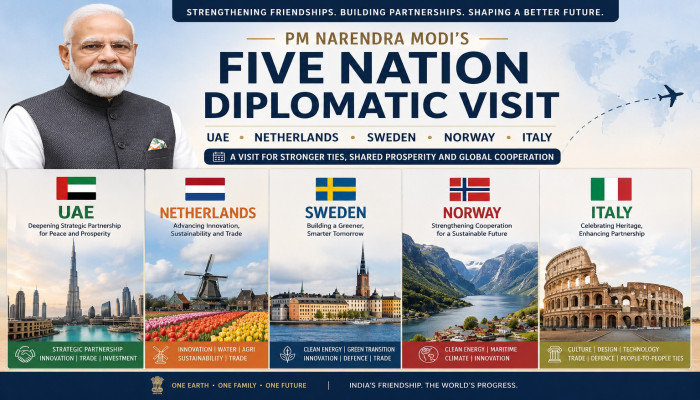
There is a certain geometry to how Narendra Modi does diplomacy. Every leg of a foreign tour pulls a thread — energy here, silicon there, a shipping lane tucked quietly into a joint statement — and before the week is out, the canvas looks unmistakably strategic. His six-day, five-nation sweep across the UAE, Netherlands, Sweden, Norway and Italy is perhaps the most geometrically precise exercise in Indian statecraft in years. It is not a tour. It is a blueprint. India's collective bilateral trade with just these five countries exceeds $70 billion, and the strategic logic running through each stop is even larger than the numbers.
Abu Dhabi: Gas, Grit and the Ghost of OIC
The first stop lasted barely four hours — enough to seal deals worth billions. The crown jewel was the ISPRL-ADNOC MoU: ADNOC is already the only foreign entity permitted to store crude inside India's underground strategic reserves; the new agreement extends this to potential storage at Fujairah, UAE. A second IOC-ADNOC deal secured long-term LPG supply — a direct answer to cooking gas price protests linked to Strait of Hormuz tensions from the Iran war. ADIA and India's NIIF committed $5 billion in fresh investments, while Cochin Shipyard signed with Drydocks World for a ship repair cluster at Vadinar, Gujarat.
- UAE: India's 3rd largest trade partner; $5 billion investment commitment from this single four-hour stop.
- 4.5 million-strong Indian diaspora in UAE — the largest Indian community outside South Asia.
The UAE's de-facto exit from the OIC's active consensus on certain positions has repositioned Gulf diplomacy. The deepening I2U2 framework — India, Israel, UAE, USA — represents a structural realignment that Modi's visit cements. This is win-win diplomacy with a geopolitical spine.
The Hague: Silicon, a 1,000-Year-Old Secret and a Dam
The Netherlands leg was the most technologically loaded stop of the tour. Tata Electronics signed an MoU with ASML — Europe's largest technology company by market value and the world's sole maker of extreme ultraviolet (EUV) lithography machines, without which leading-edge chips cannot be made. The deal supports Tata's $11 billion semiconductor facility in Dholera, Gujarat, ramping up production for AI and automotive-grade chips. Washington and Brussels have blocked China from accessing EUV technology since 2019. New Delhi has now ensured Indian firms are let in through the front door. The bilateral relationship was elevated to a Strategic Partnership, and a Letter of Intent was signed between India's Ministry of Jal Shakti and Dutch counterparts for cooperation on Gujarat's ambitious Kalpasar project — directly inspired by Modi's visit to the Afsluitdijk, the 32-kilometre barrier dam separating the North Sea from the freshwater IJsselmeer lake, currently being upgraded under the €800 million Afsluitdijk 2.0 programme.
- ASML: sole global maker of EUV machines; China blocked since 2019. Tata Dholera fab: $11 billion investment.
- Netherlands bilateral trade: $27.8 billion (2024-25); cumulative Dutch FDI into India: $55.6 billion — India's 4th largest investor.
Then came a moment of pure civilisational weight. Modi and Dutch PM Rob Jetten presided over the restitution of the Anaimangalam Chola Copper Plates — 21 large and 3 small copper plates dating to the 11th century CE, inscribed predominantly in Tamil with sections in Sanskrit, weighing roughly 30 kg and bound by the royal Chola seal. They document Rajendra Chola I's formal grant to a Buddhist vihara at Nagapattinam, originally an oral commitment by his father Rajaraja Chola I. Taken to the Netherlands in the 1700s by missionary Florentius Camper during the Dutch colonial occupation of Nagapattinam, they were preserved at Leiden University since 1862. India's embassy in The Hague pursued the return since May 2019; UNESCO's Intergovernmental Committee formally recognised India's claim, culminating in this week's handover. Modi called it a joyous moment for every Indian. It was also proof of a systematic cultural recovery drive unmatched in Indian diplomatic history: between 1947 and 2014, successive governments repatriated just 13 artefacts in 67 years; under Modi, that number reached 344 by January 2024 alone. The US has returned 578 artefacts since 2016, including 297 in a single handover during the Biden-Modi summit in September 2024 — many traced to art smuggler Subhash Kapoor, now serving 10 years in an Indian prison. UNESCO estimates 50,000 pieces of Indian art remain illegally held abroad.
- 344 artefacts repatriated under Modi by January 2024 — versus just 13 in 67 years before 2014.
- 578 returned from the US alone since 2016; 297 in a single Biden-Modi handover, September 2024.
Gothenburg: Polar Star, Bengali Beats and the China+1 Courtroom
Swedish Gripen fighter jets escorted Air India One into Swedish airspace — a military salute that signals the trust two democracies are building. On the ground, something even more moving awaited. Women in traditional Bengali attire performed classical folk dances and aarti rituals at Modi's hotel, while hundreds of diaspora members who had travelled from across Sweden waved the tricolour, some waiting two to three hours. Modi greeted them in Bengali, prompting diaspora member Nivedita to describe it as a dream come true. Devashree sang Jyoti Kalash Chhalke. ISKCON's Kamala Priya offered a Hare Krishna. For one evening, Gothenburg felt entirely Indian.
Sweden then conferred upon Modi the Royal Order of the Polar Star, Commander Grand Cross — the highest honour Sweden can bestow upon a foreign head of government. Established in 1748 by King Frederick I, bearing the Latin motto Nescit Occasum (It Knows No Decline), this became the 31st international honour conferred on Modi since 2014, making him the most internationally decorated Indian leader in history. Receiving it, Modi said simply: it is not just my honour — it is the honour of 140 crore Indians.
The bilateral outcomes from Gothenburg were substantive. India-Sweden relations were elevated to a Strategic Partnership anchored by a Joint Action Plan (2026-2030) built on four pillars: strategic security dialogue, next-generation economic partnership, emerging technologies and trusted connectivity, and people-planet-resilience. The headline deliverable was the India-Sweden Joint Innovation Partnership 2.0 and the launch of a virtual India-Sweden Joint Science and Technology Centre (ISJSTC). Its technology mandate is a map of the next decade's most consequential industries: AI, 6G, quantum computing, sustainable mining, critical minerals, space and life sciences. That over 80 Swedish companies participated in India's AI Impact Summit 2026 signals this is active industrial engagement, not diplomatic boilerplate. Modi and Kristersson also exchanged gifts celebrating the shared legacy of Rabindranath Tagore — a reminder that the partnership carries civilisational depth alongside balance-sheet ambition.
- Royal Order of the Polar Star (est. 1748): highest Swedish honour for a foreign head of government — Modi's 31st international award.
- Joint Innovation Partnership 2.0: covers AI, 6G, quantum computing, critical minerals, space, life sciences. 80+ Swedish firms at India's AI Impact Summit 2026.
- India-Sweden trade: $7.75 billion (2025); Swedish FDI: $2.825 billion cumulative (2000-2025). ERT roundtable hosted by Volvo Group.
Gothenburg: India's Investment Pitch to Europe's Industrial Elite
The European Round Table (ERT) roundtable, hosted by the Volvo Group, was where Modi shifted from diplomat to salesman — and did so with data. Addressing the most powerful gathering of European corporate chiefs alongside Kristersson and EU Commission President Ursula von der Leyen, Modi made a four-word pitch that crystallised India's investment story: talent, demand, stability, scale. India has a ready-made talent pool, the domestic demand engine, the political stability under a strong mandate, and the proven ability to build at scale. The time, he told them, has come to convert intent into investment. He then laid out five distinct investment destinations — each backed by a sector-specific policy architecture that European capital can plug directly into.
── MODI'S FIVE INVESTMENT PILLARS FOR EUROPE ──
① Telecom · Digital Inclusion · Secured Connectivity
India is the world's second-largest 5G market. By the end of 2025, over 518,000 5G base stations were deployed nationally — a rollout that achieved 85 per cent population coverage and 99.9 per cent district coverage in under three years, a pace that matches the United States and China. Jio alone has over 253 million 5G users as of early 2026; subscriber count crossed 400 million and is projected to hit 1 billion by 2031. BSNL's indigenous 5G stack — built on C-DOT and TCS architecture with 98,000 4G-convertible towers — is about to enter service, positioning India not just as a 5G consumer but as a potential global exporter of cost-effective, end-to-end telecom solutions. For Swedish and European telecom firms operating in an era of Huawei exclusion, India is simultaneously a massive market and a credible manufacturing alternative for trusted network infrastructure.
- 518,000+ 5G BTS deployed by end-2025; 400 million 5G subscribers; target: 1 billion by 2031.
- 5G cell tower market: $2.6 billion in 2026, growing to $4.6 billion by 2031 at 12.1% CAGR. BSNL's indigenous 5G stack slated for launch in 2026.
② AI · Semiconductors · Deep Tech Manufacturing
India's semiconductor ambitions are no longer aspirational — they are operational. The India Semiconductor Mission was launched with a ₹76,000 crore (~$10 billion) outlay; as of May 2026, 12 manufacturing projects have been approved across six states with cumulative investments exceeding ₹1.6 trillion (~$19 billion). The centrepiece is Tata Electronics' 28nm fab in Dholera — ₹91,000 crore, targeting 50,000 wafer starts per month, with first silicon targeted by December 2026. Kaynes Semicon's OSAT facility in Sanand reached commercial production in March 2026 — just 14 months after breaking ground — shipping India's first commercially produced chips. The Union Budget 2026-27 allocated ₹8,000 crore to the semiconductor mission, the largest single-year outlay since the programme launched alongside India Semiconductor Mission (ISM 2.0) focused on semiconductor equipment, materials and indigenous IP. On AI, India's engineers constitute approximately 20 per cent of the world's total semiconductor designers; Bengaluru is Asia's largest chip design hub outside Taiwan and South Korea. Modi's ASML deal in The Hague directly feeds this pillar — the EUV machines that Europe's finest technology company will supply to Dholera are the bridge between India's design heritage and its fabrication future.
- ISM outlay: ₹76,000 crore. 12 approved projects; cumulative private investment: ₹1.6 trillion+. First Made-in-India chips commercially shipped March 2026.
- Tata Dholera fab: ₹91,000 crore, 28nm, 50,000 wafers/month; first silicon December 2026. India's semiconductor market projected to reach $180 billion by 2034.
③ Green Transition · Hydrogen · Clean Energy
India's National Green Hydrogen Mission, approved in January 2023 with an outlay of ₹19,744 crore, targets 5 million metric tonnes per annum of green hydrogen production by 2030 — backed by an additional 125 GW of dedicated renewable energy capacity. The mission is projected to attract over ₹8 lakh crore in total investments, create 6 lakh jobs, and avert 50 MMT of annual CO₂ emissions. The target production cost is $1.5 per kg by 2030. Three major ports — Deendayal (Gujarat), V.O. Chidambaranar (Tamil Nadu), and Paradip (Odisha) — have been designated Green Hydrogen Hubs for integrated production, consumption and export. India's target is to secure 10 per cent of global green hydrogen production capacity. For Swedish firms like Vattenfall and European energy majors, India's renewable energy ecosystem — already at 220 GW of installed capacity — offers some of the lowest-cost solar and wind inputs on the planet, making a partnership here a structural cost advantage, not merely a moral one.
- Green Hydrogen Mission outlay: ₹19,744 crore; target 5 MMTPA by 2030; projected ₹8 lakh crore in total investment; 6 lakh jobs.
- India's renewable energy installed capacity: 220 GW. Target: 500 GW non-fossil electricity by 2030. Green hydrogen cost target: $1.5/kg by 2030.
④ Infrastructure · Mobility · Urban Development · Logistics · Aerospace
India's infrastructure story is arguably the most tangible evidence of what a stable government with a long mandate can deliver. The Union Budget 2025-26 raised the capital investment outlay for infrastructure to ₹11.21 lakh crore — 3.1 per cent of GDP — with ₹2,65,200 crore earmarked for railways alone, an all-time high. The National Infrastructure Pipeline has added 3,500 projects worth ₹25 lakh crore in FY25 alone, spanning roads, ports, metro networks, airports and urban systems. India's logistics market is valued at $317 billion in 2024 and projected to reach $484 billion by 2029 at 8.8 per cent CAGR. PM Gati Shakti — the national master plan for integrated infrastructure — has onboarded 44 central ministries and 36 states, assessed 208 major projects worth ₹15,39,000 crore, and eliminated the inter-ministerial silos that historically slowed project execution. India is also building the world's most ambitious urban mobility network: 27 cities have metro rail projects underway; 50 new airports are under development or upgrade. For European firms in aerospace, port logistics, sustainable urban transport and smart city infrastructure, India is a decade-long order book.
- Infrastructure capex 2025-26: ₹11.21 lakh crore (3.1% of GDP). Railways: ₹2,65,200 crore — all-time high. Logistics market: $317 billion (2024) → $484 billion (2029).
- NIP FY25 addition: 3,500 projects, ₹25 lakh crore. PM Gati Shakti: 208 major projects worth ₹15,39,000 crore assessed. 27 cities with metro projects underway.
⑤ Healthcare · Life Sciences · Medical Devices · Vaccines
India's healthcare and life sciences sector is among the most underinvested relative to its scale. The Indian medical devices market was valued at $18 billion in 2024 and is projected to reach $30 billion by 2033. India is already the fourth-largest medical devices market in Asia and among the top 20 globally. The National Medical Devices Policy 2023 sets an ambitious target of growing India's global market share from 1.5 per cent to 10-12 per cent over 25 years, with a PLI scheme outlay of ₹3,420 crore earmarked for 55 high-end device categories. The Pradhan Mantri Ayushman Bharat Health Infrastructure Mission invested ₹64,180 crore between 2021 and 2026, establishing 175,338 Ayushman Arogya Mandirs. India is the world's largest vaccine manufacturer — the country produces 60 per cent of global vaccine volumes and is the backbone of international immunisation programmes. Modi specifically called out Philips, Nestlé and Unilever by name as companies with long India roots that must now deepen their partnerships, and challenged the assembled CEOs to move from goodwill to greenfield. Sweden's Mölnlycke, with its wound care and surgical solutions, AstraZeneca's India R&D centre, and a wave of digital health platforms, are proof that European healthcare capital and Indian healthcare scale are already discovering each other — Modi was asking them to move faster.
- ► Indian medical devices market: $18 billion (2024) → $30 billion (2033). India: world's largest vaccine manufacturer — 60% of global vaccine volumes.
- ► Ayushman Bharat: ₹64,180 crore invested 2021-2026; 175,338 health centres established; 33,000 hospitals empanelled. PLI for medical devices: ₹3,420 crore.
Von der Leyen, co-chairing the session, was direct and historic in equal measure. She described the India-EU Free Trade Agreement — concluded in New Delhi in January — as the mother of all deals: a combined market of over 2 billion people, nearly a quarter of global GDP, with over 9 per cent in tariff cuts. She signalled that the next step must be an India-EU investment agreement — the missing piece of the puzzle in our reinforced economic cooperation. Her conclusion was unambiguous: this dynamic new era in EU-India relations opens historic opportunities, and we are determined to seize them. Modi replied on X: 'Fully agree with you on the strong potential of India-Europe ties, especially in the wake of the India-EU FTA.' When the EU's most powerful official calls your trade deal the mother of all deals in front of Europe's top industrialists, every CEO in the room recalculates their capital allocation. That was the point of Gothenburg. That was the point of this entire tour.
Oslo: 43 Years of Silence, Broken
The last Indian Prime Minister to visit Norway did so in 1983. In those 43 years, Norway discovered oil, became one of the world's wealthiest per-capita nations and accumulated the Government Pension Fund Global — $1.7 trillion, the world's largest sovereign wealth fund. India was not on Oslo's strategic radar for most of that period. Modi's visit to Oslo for the 3rd India-Nordic Summit, co-chaired with leaders of Norway, Denmark, Finland, Iceland and Sweden, changes that permanently. The India-EFTA Trade and Economic Partnership Agreement (including Norway) entered into force on October 1, 2025 — India's first FTA with a bloc of developed European economies. India's Himadri Arctic research station on Svalbard has hosted over 400 scientists since 2008; ISRO antennas there became operational in 2026. As Arctic ice melts, the Northern Sea Route could cut Europe-Asia shipping by 10-15 days compared to Suez. Norway, with deep marine expertise and Arctic jurisdiction, is a partner India needs at that table.
- Norway sovereign wealth fund: $1.7 trillion. India-EFTA TEPA in force since October 1, 2025 — India's first FTA with developed European economies.
- India's Himadri station, Svalbard: 400+ scientists since 2008. ISRO antennas operational 2026.
Rome: The Meloni Chemistry and the Mediterranean Gateway
The final stop carries a warmth that is visibly personal. Modi and Italian PM Giorgia Meloni share a political chemistry rare in contemporary diplomacy, and their engagement around the Joint Strategic Action Plan 2025-2029 has real strategic content. Italy-India bilateral trade reached $16.77 billion in 2025; cumulative FDI stands at $3.66 billion. The larger prize, however, is Italy as the European end-point of the India-Middle East-Europe Economic Corridor (IMEC). As this corridor takes shape — connecting Indian ports through Gulf infrastructure to Haifa and then European terminals — Italian Mediterranean ports are positioning themselves as its logical European terminus. Meloni has been an unambiguous champion of the India-EU FTA and of India's hosting of the 2026 AI Impact Summit.
The Larger Arc: India Finds Its Poles
Step back and the pattern is unmistakable. Energy security through UAE. Semiconductor sovereignty through the Netherlands. Quantum computing, 6G and the Polar Star through Sweden. Maritime and Arctic positioning through Norway. Mediterranean connectivity through Italy. The lesson the Modi government has absorbed — accelerated by Trump's disruptions — is to not anchor to a single pole in a multipolar world. Expand beyond the US, exploit the seas, use the Eurasian landmass via the Indian Ocean and now the Arctic. The multipolar world is not a think-tank abstraction. It is being built, one MoU, one copper plate, one Polar Star at a time.



 Loading...please wait
Comments