



Finnish police seize vessel sailing from Russia over suspected cable sabotage
- In Reports
- 12:54 PM, Jan 01, 2026
- Myind Staff
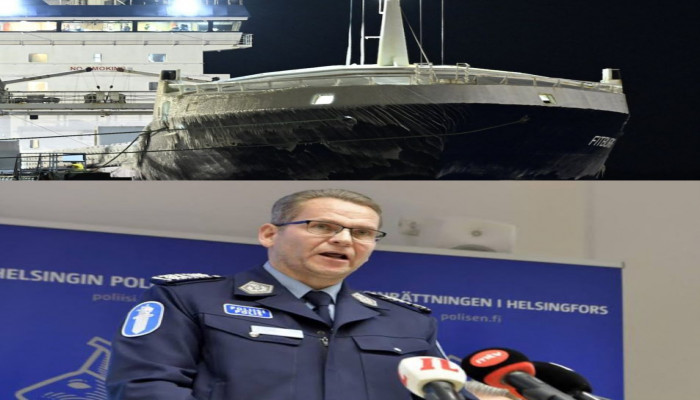
Finnish police have seized a cargo vessel sailing from Russia on suspicion of damaging an undersea telecommunications cable that connects Finland and Estonia across the Gulf of Finland. The incident has raised fresh concerns in Europe about the safety of critical infrastructure in the Baltic Sea region, which has witnessed several similar disruptions in recent years.
The ship, identified as Fitburg, was travelling from the Russian port of St Petersburg to Israel when it was intercepted by Finnish authorities. Finland’s Border Guard confirmed the seizure during a press conference held in Helsinki. According to officials, the vessel was suspected of dragging its anchor along the seabed, which may have caused damage to the telecoms cable.
Helsinki Chief of Police Jari Liukku told reporters that the case is being treated seriously. “At the moment, we suspect aggravated disruption of telecommunications and also aggravated sabotage and attempted aggravated sabotage,” he said.
The telecom cable that was damaged belongs to Finnish telecommunications company Elisa. Authorities said the Fitburg was directed into Finnish territorial waters after it was observed dragging its anchor in the sea. Investigations are currently underway to determine whether the damage was accidental or deliberate.
The ship was sailing under the flag of St Vincent and the Grenadines and had 14 crew members on board. Finnish police confirmed that all crew members are being held as part of the investigation. The crew included nationals from Russia, Georgia, Kazakhstan and Azerbaijan.
According to data from the London Stock Exchange Group (LSEG), the vessel is owned by Fitburg Shipping Company Ltd and managed by Albros Shipping and Trading Ltd. Reuters reported that it was unable to reach either company for comment by telephone.
The incident comes at a time of growing concern among European countries over what officials describe as an increase in “hybrid threats” from Russia following its invasion of Ukraine in 2022. Russia has denied carrying out such actions. Hybrid threats include a mix of military and non-military tactics aimed at weakening an adversary. These can involve cyberattacks, disinformation campaigns, sabotage of critical infrastructure, and the use of drones or irregular armed groups.
Earlier this month, NATO’s top military commander warned that the alliance must be prepared to respond to such threats to defend its territory. Eight NATO member states border the Baltic Sea, which also shares a coastline with Russia. Since the start of the Ukraine conflict, these countries have remained on high alert due to repeated outages affecting power cables, telecoms links and gas pipelines laid along the Baltic seabed.
As a response to these incidents, NATO has increased its presence in the region in recent years, deploying frigates, aircraft and naval drones. An official from the military alliance said NATO was closely following the latest developments. “We remain in contact with the Finnish authorities, through exchange of information, via the NATO shipping centre located at our Allied Maritime Command in Northwood, UK,” the official said.
The situation also raised concern in Estonia. The country’s justice ministry reported that a second telecom cable connecting Estonia to Finland suffered an outage on the same day. It was not immediately clear whether this cable, owned by Sweden’s Arelion, was running parallel to the Elisa cable. An Arelion spokesperson later confirmed that the company had experienced an outage.
Estonian President Alar Karis expressed concern over the reports. “I’m concerned about the reported damage… Hopefully, it was not a deliberate act, but the investigation will clarify,” he said in a post on X.
The European Commission is also monitoring the situation closely. EU technology commissioner Henna Virkkunen said on X that the Commission was keeping a close watch on the incident.
This is not the first such case in the region. In December 2024, Finnish authorities boarded a Russian-linked oil tanker named Eagle S. Investigators said the tanker had damaged a power cable and several telecoms links in the Baltic Sea by dragging its anchor. However, in October, a Finnish court dismissed criminal charges against the Eagle S captain and other crew members. The court ruled that prosecutors had failed to prove intent and said that any alleged negligence should be pursued by the ship’s flag state or the crew’s home countries.
As investigations into the Fitburg incident continue, Finnish authorities have not yet concluded whether the damage was intentional or accidental. Officials have stressed that all possibilities are being examined, and further details will emerge as the probe progresses.



 Loading...please wait
Comments