




EU imposes fresh sanctions on individuals and firms over Russian oil
- In Reports
- 05:45 PM, Dec 16, 2025
- Myind Staff
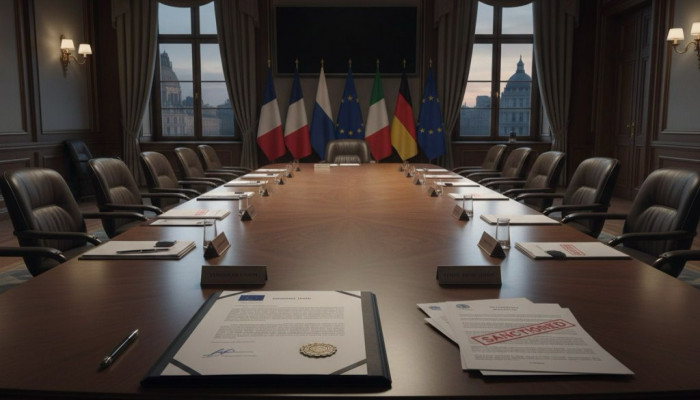
The European Union has approved a new round of sanctions targeting individuals and companies accused of helping Russia bypass Western restrictions on oil exports, a key source of funding for Moscow’s war in Ukraine.
According to the Council of the European Union and details published in the EU’s Official Journal, the latest sanctions focus on those linked to Russia’s so-called “shadow fleet” a network of oil tankers operating outside the Western shipping and insurance system. These vessels have allowed Russia to continue exporting oil despite multiple rounds of sanctions imposed by Western countries.
So far, the EU has rolled out 19 sanctions packages since Russia launched its invasion of Ukraine. However, despite these measures, Moscow has managed to adapt and continues to sell millions of barrels of oil, mainly to India and China, often at prices lower than global market rates.
A large portion of this oil is transported through tankers that do not rely on Western maritime services, allowing Russia to sidestep restrictions on shipping, insurance, and financing. The latest sanctions target nine individuals and entities accused of supporting Russia’s shadow fleet and oil trade. The EU has now sanctioned more than 2,600 individuals and companies in total since the start of the war.
Under the new measures, EU citizens are prohibited from doing business with those listed. The sanctions also limit the targets’ access to key shipping services, insurance providers, and financial systems linked to the European Union. Among those sanctioned is Valery Kildiyarov, the finance director of Litasco Middle East DMCC, a trading subsidiary of Russian oil major Lukoil.
The EU has also sanctioned Anar Madatli, Talat Safarov, and Etibar Eyyub for their links to oil trading firm Coral Energy, which has since been renamed 2Rivers Group. These individuals are accused of helping move Russian oil through non-Western channels.
Another prominent name on the list is Murtaza Lakhani, a Canadian-Pakistani oil trader and the chief executive officer of trading company Mercantile & Maritime.
According to the EU’s Official Journal, Lakhani has played a key role in enabling Russia’s oil exports. “Through his companies, he enables shipments and export of Russian oil, notably from the Russian state-owned oil company Rosneft,” the EU listing said. It further stated, “In particular, Murtaza Lakhani controls vessels transporting crude oil or petroleum products, originating in Russia or being exported from Russia.”
The sanctions apply not only to Lakhani but also to companies linked to him, including Mercantile & Maritime. At the time of publication, Lakhani, Mercantile & Maritime, Litasco Middle East DMCC, and 2Rivers Group had not responded to requests for comment.
Lakhani, aged 63, has been under close scrutiny in recent years due to his long career in global oil trading. He began his career at commodities giant Glencore, which sent him to Baghdad during the era of Iraqi leader Saddam Hussein. He later moved to Iraq’s Kurdistan region, where he worked as an intermediary between the oil ministry and international energy companies.
In 2014, Lakhani founded Mercantile & Maritime Group, a mid-sized oil trading firm with offices in Singapore and London. Despite the growing sanctions pressure on Moscow, Lakhani has previously argued that the world cannot afford to cut off Russia’s energy resources.
Speaking to Russia’s SolovievLive channel at the St Petersburg Forum in June, he said, “This country (Russia) is the largest resource country in the world. Hampering it is a very short-term effect, not a long-term goal for anybody. They will always need Russia.”
The EU’s latest sanctions underline ongoing efforts by Western countries to limit Russia’s ability to earn revenue from oil exports, which are seen as crucial to sustaining its military campaign in Ukraine. However, officials acknowledge that Russia’s use of alternative shipping networks and buyers outside Europe has made enforcement increasingly difficult. The bloc has signalled that further measures could follow if Moscow continues to evade existing restrictions.



 Loading...please wait
Comments