




Elon Musk unveils $25 billion ‘Terafab’ in Austin
- In Reports
- 05:59 PM, Mar 23, 2026
- Myind Staff
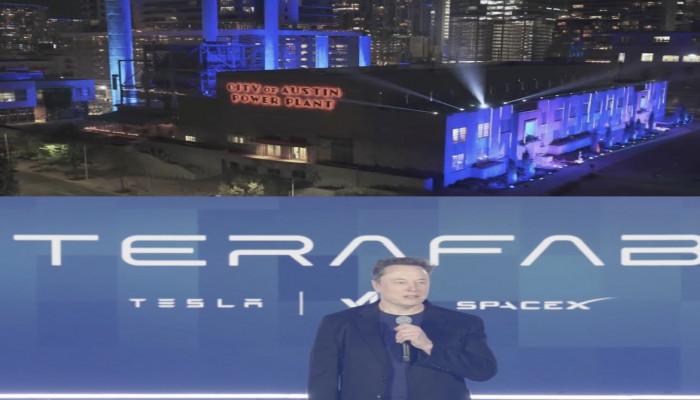
Inside the old Seaholm Power Plant in downtown Austin, Elon Musk made a dramatic announcement about a massive semiconductor project that could reshape the global tech industry. The historic industrial building, lit up with powerful beams visible across the skyline, set the stage for what Musk described as an unprecedented venture. Addressing an audience that included Texas Governor Greg Abbott, Musk declared, "The most epic chip-building exercise in history, by far," signalling the scale of his ambition.
The project, named Terafab, is a joint effort involving Tesla, SpaceX, and xAI. It will be developed at the North Campus of Giga Texas in eastern Travis County. This location is already known as a major industrial hub, but under Terafab, it will be transformed into a highly advanced semiconductor complex. The facility aims to handle every step of chip production, including design, manufacturing, packaging, and testing, all in one place. Musk highlighted this integrated approach by saying, "To the best of my knowledge, this doesn't exist anywhere in the world."
The estimated investment for Terafab is between $20 billion and $25 billion, though some analysts believe the cost could go as high as $40 billion, depending on how quickly the project scales. Interestingly, Tesla’s Chief Financial Officer has already indicated that this investment is not part of the company’s planned capital expenditure for 2026, which itself is expected to exceed $20 billion. This shows that Terafab is a separate and highly ambitious undertaking beyond Tesla’s usual operations.
The facility is expected to produce two main types of advanced chips. The first category includes processors designed for “edge inference,” which will be used in Tesla’s vehicles, robotaxis, and Optimus humanoid robots. The second category, referred to by Musk as the D3 chip, is designed for space applications. These chips will be radiation-resistant and capable of operating at higher temperatures, making them suitable for use in orbital data centres. Terafab aims to produce between 100 billion and 200 billion advanced 2-nanometre chips annually, which is an enormous scale compared to current global production.
Musk also outlined a bold vision for computing power. He stated that Terafab would eventually support one terawatt of AI computing annually. To put this into perspective, one terawatt equals one trillion watts, which is roughly twice the electricity output of the entire United States grid at any given time. According to Musk, about 80 per cent of this computing power will be used in space-based systems powered by solar energy, with data transmitted using laser links through Starlink technology.
The motivation behind this project comes from real challenges in the current semiconductor supply chain. Musk acknowledged the role of existing partners like Samsung, TSMC, and Micron, but pointed out their limitations. He said, "We're very grateful to our existing supply chain, to Samsung, TSMC, Micron and others," Musk said, "but there's a maximum rate at which they're comfortable expanding. That rate is much less than we would like… and we need the chips, so we're going to build the Terafab." This highlights the urgency driving the project, especially as demand for AI chips continues to rise rapidly.
Recent delays in chip manufacturing have added to these concerns. Tesla had signed a $16.5 billion deal with Samsung to produce its AI6 chips, but production has been delayed due to technical challenges with the 2nm process. A key step in chip production, known as “tape-out,” has also faced delays. Musk himself acknowledged the uncertainty, stating on social media, "With some luck and acceleration using AI, we might be able to tape out AI6 in December." As a result, mass production has been pushed to late 2027, affecting timelines for Tesla’s vehicles and robotics projects.
One of the most important aspects of Terafab is its vertically integrated model. Unlike traditional semiconductor companies, which separate design and manufacturing, Terafab aims to combine everything in a single location. This approach allows for faster development cycles, as engineers can quickly test and refine designs without relying on external partners. While this idea is ambitious, it is also seen as technically possible and could significantly reduce the time needed to develop new chips.
However, achieving this vision is extremely challenging. Building a 2nm semiconductor facility requires advanced equipment like High-NA EUV scanners, which are produced only by ASML. Each of these machines costs around $400 million and is available in limited numbers worldwide. Even with access to such technology, achieving high production quality, known as yield, remains a major hurdle that even established companies like Samsung are still working to overcome.
Terafab is also part of a broader strategy that connects Musk’s companies into a single ecosystem. Tesla will design and manufacture chips, SpaceX will transport them into orbit, and xAI will use them in space-based data centres. This integrated system extends from manufacturing on Earth to computing infrastructure in space. The idea is to create a complete technological stack that operates across different domains, from vehicles and robots to satellites and AI systems.
The timing of this project is significant, as global demand for semiconductors is growing rapidly. In 2025, global semiconductor spending reached $793 billion, with AI chips accounting for a large share. This figure is expected to rise further, with AI infrastructure spending projected to exceed $1.3 trillion in 2026. Major companies like Apple, Google, Amazon, and Microsoft are already developing their own chips to reduce dependence on suppliers like Nvidia. Terafab takes this trend a step further by aiming to control not just chip design but also manufacturing.
Despite the ambitious plans, Musk’s track record suggests caution. Past projects, such as Battery Day promises and Full Self-Driving technology, have faced delays and challenges. While Musk is known for setting bold goals, timelines have often been extended. The semiconductor industry, in particular, operates on strict timelines that are difficult to accelerate, even with advanced technology.
Still, there are signs that Terafab is moving forward. Construction activity has already been observed near the Giga Texas site, and job postings related to the project have appeared in Austin. The presence of Governor Abbott at the launch also indicates strong support from the state government, likely including incentives to encourage investment.
Ultimately, the success of Terafab will depend on whether it can achieve its first major milestone: building a working semiconductor facility that produces chips at competitive quality levels. If this happens, it could change how the industry views Tesla and Musk’s broader ambitions. If not, it may remain an example of an idea that was ahead of its time.
Musk ended his presentation with a futuristic vision, saying, "I want us to live long enough to see the mass driver on the moon," Musk told the Austin audience, "because that's going to be incredibly epic." While such ideas may seem far from current reality, they reflect the scale of ambition behind Terafab—a project that could redefine the future of technology if it succeeds.



 Loading...please wait
Comments