




Echoes of 1893 World Parliament of Religions in Chicago: The Universal Oneness Celebration at Madison Square Garden
- In Current Affairs
- 12:51 PM, Aug 30, 2026
- Rudra Dubey
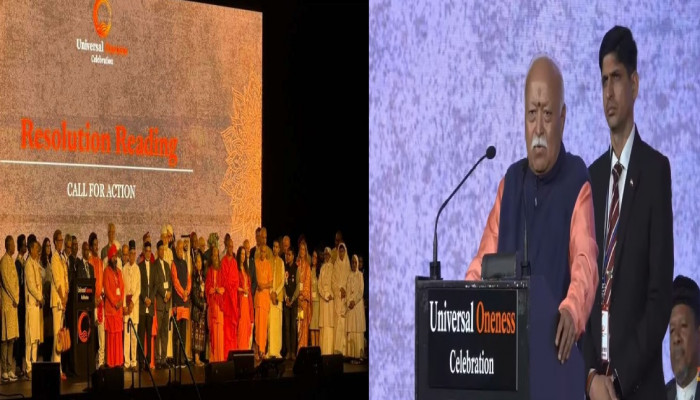
NEW YORK CITY — In a historic gathering that mirrored one of modern spiritual history's most defining milestones, more than 6,000 attendees from 39 states and hundreds of multi-faith leaders representing 16 distinct religious traditions converged at Madison Square Garden on August 29, 2026. Organised by the American Hindus for Engagement and Dialogue (AHEAD) Forum in partnership with over 135 Hindu-American organisations, the Universal Oneness Celebration delivered a resounding contemporary message of global unity, civic responsibility, and ecological harmony.
The event coincided with the Hindu festival of Raksha Bandhan, reimagining its traditional theme of familial protection into a broader, universal responsibility toward all of humanity and the natural world.
अयं निजः परो वेति गणना लघुचेतसाम् ।
उदारचरितानां तु वसुधैव कुटुम्बकम् ॥
[ Chapter 6, Verse 72 of the Maha Upanishad (part of the Samaveda tradition)]
The Modern Chicago of 1893
The atmosphere inside Manhattan’s premier arena carried the distinct weight of civilisational history, drawing immediate parallels to the 1893 World Parliament of Religions in Chicago. 133 years prior, a young Swami Vivekananda stunned the Western world by opening his historic address with, “Sisters and Brothers of America!”—a speech that introduced Vedanta to global consciousness, championed universal tolerance, and pleaded for the end of sectarianism and fanaticism.
The 2026 Manhattan assembly re-anchored that exact sentiment. Rather than emphasising theological uniformity, the multi-faith leaders and indigenous elders on stage echoed Vivekananda’s foundational view that diversity is not a barrier to unity, but rather a beautiful decoration of it.
Key Messages and Selected Quotes from Multi-Faith Speakers
The multi-faith addresses centred on shared human dignity, the divine spark in every person, the possibility of unity despite different paths, and the practical call to connect, serve, and choose compassion across religious and cultural boundaries. Drawn from the live stream of the event, their core messages and supporting remarks include:
1. Rabbi Jacob Blumenthal (CEO of the Rabbinical Assembly)
Core message: Humanity is created in the divine image, giving every person infinite and equal value. True oneness comes from recognising the godliness in one another, overcoming loneliness through connection, and blessing our differences as part of creation. He linked this to the Jewish observance of Shabbat (a day of rest and soul renewal) and the American ideal of e pluribus unum (“from the many, one”).
Key quotes:
- “God created humanity… ‘Let us make humanity in our image and our likeness.’ … This one phrase… insists that every one of us is imbued with godliness. Every one of us has infinite value. Every one of us is equal, valued, and loved because when God looks at us, it is like God looking at a mirror. And when we look at one another, we also see the divine.”
- “The point of religion isn’t only that we have faith in God, but it’s about realising that God has faith in us… God is the eternal optimist.”
- “I am convinced that much of what troubles us in our society today is that we are lonely… I am so grateful… for giving us this opportunity to overcome our loneliness, to connect with one another, to seek oneness in our community.”
He led the audience in exchanging “Shabbat shalom”—a wish for peace and soul renewal.
2. Reverend Adrianne Thorne (Senior Minister of Riverside Church, New York)
Core message: People of different faiths, cultures, and histories are climbing the same mountain by different paths and can still arrive at the same place. In a divided and fearful time, simply choosing to gather, listen, and see one another’s shared humanity is sacred. Compassion is a path every tradition can walk together.
Key quotes:
- Recalling an imam’s words from years earlier: “We’ve all come from different places, but somehow we managed to find our way to the same location… Faith is like that. All of us taking different paths up the mountain, yet somehow managing to find our way to the same location.”
- “Before our titles, before our religions, before our politics, before the borders on a map, we are human beings, children of God. We laugh in the same language. We cry in the same language. We grieve in the same language. And we love in the same language.”
- “The world needs us to remember that we belong to one another. The mountain… may have different paths, many paths, but compassion is a path that every faith tradition can walk. And when we walk that path together, we become living proof that fear is not stronger than love… Division is not stronger than connection. And hatred is not stronger than hope.”
- “We found our way to the same place… and may we leave here remembering that we share the same future, too.”
3. Imam Dr Talib M. Sharif (President and Imam of Masjid Muhammad, “the Nation’s Mosque,” Washington, D.C.)
Core message: The word “universe” itself points to “one message” or “one communication” directed to every human soul. There is one human soul shared by all, sustained by the same Lord (Rabb — the Guardian, Cherisher, and Sustainer of all the worlds).
Key quotes:
- “The word ‘uni’ means what? One… And the next word is ‘verse’… Uni-verse is certainly saying there’s one message. There’s one communication… one communication to every soul. All of us have a human soul — one human soul.”
- “...the Lord of that universe… who we call Rabb… translated lord, guardian and evolver, cherisher and sustainer of all the worlds.”
Keynote Address: Dr Mohan Bhagwat
Delivering the keynote address as part of the RSS centenary global outreach tour, Dr Mohan Bhagwat explicitly invoked Swami Vivekananda's legacy to explain Bharat's (India's) timeless ethos. He emphasised that true universal oneness cannot be achieved through the rigid lens of dogmatic religion, but through the expansive concept of Dharma.
1. Dharma vs. Religion & The Oneness of Prakriti
Bhagwat repeatedly distinguished Dharma from religion or ritualistic worship. He presented it as the deeper, universal sustaining principle of the cosmos itself. Because Dharma operates at the level of the entire universe (not confined to any one faith’s doctrines or rituals), it naturally supports a vision of oneness that includes all of Prakriti — plants, animals, the natural order — rather than stopping at human solidarity.
Key quotes:
- “On that basis, the sustaining principle that we call Dharma. Dharma is not religion. It is not worship. It is beyond all this. It is the rule through which the universe is sustained. It is the rule through which human beings can manage dualities of life.”
- Diversity is “the rule of nature. Unity is the truth behind nature.”
- “Diversity is a decoration of our innate unity. It has to be accepted, respected and protected. As I protect my own specific nature, I have to protect others also.”
2. The Ancestral Seers and Civilisational Vision
Bhagwat rooted the message of oneness in India’s civilisational wisdom (the insights of the sages), linking it to the idea that truth is one even though expressed in many ways, and that all paths ultimately lead to the same goal. The traditional understanding posits that all paths lead to the same divinity, and that superficial differences are ultimately illusions that will fade.
Key quotes:
- “I am working in a society which traditionally says that religions might be different, but humanity is one. Truth is one, and humanity is a product of that truth… That truth is one truth, but it is described in many ways according to the describer.”
- “Those who know they view a dog and a vidvan brahmana [a learned person] equally… because all these are differences which decorate the nature… But the reality which is always present is we are one.”
3. The Global Destiny and Obligation of Bharat
Framing the vision of Vasudhaiva Kutumbakam (The World Is One Family) as a collective global obligation, Bhagwat framed this as Bharat’s civilisational destiny and duty. He positioned Bharat’s historic realisation of this truth as carrying a continuing responsibility to awaken and share that consciousness globally, so that a sustainable and peaceful world becomes possible for both humanity and Prakriti.
Key quotes:
- “Nations are not merely geographical entities. In the design of this universe, nations have to carry out a duty. Swami Vivekananda said, every nation has a destiny to fulfil. What is the destiny given to Bharat? Bharat is there to realise, and from time to time make the world realise, this unity in diversity. [That] we are one. And due to diversity, that oneness is decorated.”
- “For Bharat, both unity and diversity are in its DNA.”
- “We as RSS… because we have this knowledge that all humanity is one. It is our duty to go all over the world and tell everybody that in spite of our diversity we are one.”
- Diversity must be celebrated and protected while keeping the feeling of oneness, so that humanity can live in harmony with itself and with the larger order of nature.
Resolutions & Action Items Ahead
To ensure the event served as a launching pad for tangible change rather than just a symbolic dialogue, participating multi-faith leaders and organisational representatives collectively outlined key resolutions and action items for the "Universal Oneness" roadmap:
- The Raksha Bandhan Global Pledge: Expanding the traditional thread-tying ceremony into a civic commitment. Attendees pledged a shared responsibility to protect not only vulnerable human communities across racial and religious divides, but also to protect the environment (Prakriti) from ecological collapse.
- Interfaith Action Corridors: Establishing localised, continuous dialogue platforms across 39 U.S. states to actively combat social polarisation and geopolitical radicalism through joint civic and humanitarian service projects.
- Diaspora Inter-Cultural Exchanges: Utilising the network of the 135+ partner organisations to spearhead educational programming that highlights common spiritual values across different faiths, offering a contemporary model of pluralism to global youth.
Reawakening the Spirit of Vivekananda
The 2026 Universal Oneness Celebration at Madison Square Garden closed by explicitly sealing the bridge between the historic Chicago speech of 1893 and the modern geopolitical realities of today. When Swami Vivekananda addressed the World Parliament, his core message was a plea to move past the "sectarianism, bigotry, and its horrible decadence, fanaticism" that had long possessed the earth. Dr Mohan Bhagwat’s keynote neatly intersected with this prophetic vision by offering Dharma as the structural remedy to those exact historical ailments.
By distinguishing Dharma from rigid, exclusionary religions, Bhagwat underscored exactly what Vivekananda meant by universal acceptance: true oneness does not erase differences, but honours them as the necessary, decorative fabric of a single reality. Where Vivekananda spoke of the convergence of different streams into a shared ocean, Bhagwat pointed to Bharat’s civilisational DNA as carrying an enduring, global obligation to keep that ocean clean—reminding the modern world that human harmony cannot be separated from our duty to Prakriti (nature).
Ultimately, the gathering proved that the century-old call for universal brotherhood is no longer just an abstract spiritual ideal. Through tangible resolutions like the Global Pledge and Interfaith Action Corridors, the multi-faith leaders collectively affirmed that surviving a fractured world requires transforming Vivekananda's "unity in diversity" from a philosophical insight into an active, everyday practice.
Disclaimer: The opinions expressed within this article are the personal opinions of the author. MyIndMakers is not responsible for the accuracy, completeness, suitability, or validity of any information on this article. All information is provided on an as-is basis. The information, facts or opinions appearing in the article do not reflect the views of MyindMakers and it does not assume any responsibility or liability for the same.



 Loading...please wait
Comments