



EAM Jaishankar meets UAE leadership, discusses energy, economic ties
- In Reports
- 01:00 PM, Apr 13, 2026
- Myind Staff
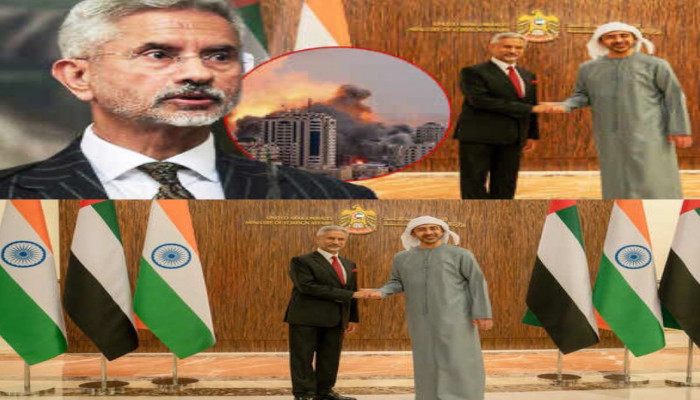
India’s External Affairs Minister S Jaishankar held key meetings with the top leadership of the United Arab Emirates during his recent visit, focusing on strengthening economic and energy ties while also addressing the welfare of the large Indian community living in the country. His visit comes at a crucial time when tensions in West Asia remain high following recent conflict developments involving Iran and the United States.
Jaishankar is the second Indian minister to visit the region in recent weeks, after petroleum minister Hardeep Singh Puri travelled to Qatar. These visits are taking place during a two-week ceasefire in the Iran-US conflict. The aim is to review India’s energy security situation and assess regional stability, as West Asia remains a critical supplier of oil and gas for India.
During his visit, Jaishankar met UAE President Mohamed bin Zayed Al Nahyan and conveyed a message from Prime Minister Narendra Modi. He also expressed India’s appreciation for the UAE leadership’s efforts in taking care of the Indian community during what he described as a difficult period. The welfare of nearly four million Indians living in the UAE was a central part of the discussions.
The minister also held talks with UAE Foreign Minister Abdullah bin Zayed Al Nahyan, who also serves as the deputy prime minister. Their discussions covered the evolving situation in the region and its broader implications. According to official statements, both sides exchanged views on recent developments, including the ceasefire between Iran and the US and its possible impact on regional stability.
Speaking to ANI after his meetings, Jaishankar highlighted India’s deep interest in the region. “We’ve had a very intense conflict in this region. Obviously, India has very major stakes and a very big interest in the stability and security of this region,” he said. “I’m very pleased to have an opportunity to come here, sit down directly [and] express our interests and…share the feedback of the Indian community.” His remarks underline India’s dual focus on safeguarding its strategic interests and ensuring the well-being of its citizens abroad.
Jaishankar further stated that the concerns of the Indian community were a top priority in his discussions. He emphasised that while economic and energy ties are important, the safety and welfare of Indians living in the UAE remain “first and foremost” in India’s diplomatic engagements.
Energy security remains a key factor driving India’s outreach in the region. The UAE is currently India’s fifth-largest source of crude oil, contributing nearly 6 per cent of India’s total imports. It is also the third-largest supplier of liquefied petroleum gas (LPG) and other petroleum products. Similarly, Qatar plays an even more significant role, being India’s largest supplier of liquefied natural gas (LNG) and LPG. In the financial year 2024–25, India imported 11.19 million metric tonnes of LNG from Qatar, valued at $6.39 billion, along with 4.89 million metric tonnes of LPG worth $3.21 billion.
The visits by Indian ministers are also aimed at evaluating how the ongoing conflict has affected energy infrastructure in the region. Any disruption in supply chains could have serious implications for India’s energy needs and economic stability, making such diplomatic engagements essential.
A readout from the UAE foreign minister’s office noted that Jaishankar and Abdullah bin Zayed discussed the “repercussions of the brutal and terrorist Iranian missile attacks” that targeted the emirates and other friendly countries. They also reviewed the situation following the announcement of the temporary ceasefire and reaffirmed the importance of strategic ties between India and the UAE. However, specific details of the discussions were not disclosed.
Meanwhile, diplomatic efforts to resolve tensions between Iran and the United States are still facing challenges. Senior officials from both countries recently held their first face-to-face talks in Islamabad. Despite lasting for 21 hours, the negotiations ended without any significant breakthrough.
Jaishankar’s visit reflects India’s proactive approach in maintaining strong ties with key partners in West Asia during uncertain times. With energy security, regional stability, and the welfare of its citizens at stake, India continues to closely engage with countries like the UAE and Qatar to safeguard its national interests.



 Loading...please wait
Comments