




Durga Puja in the North-East
- In Religion
- 02:10 PM, Oct 21, 2026
- Dr. Ankita Dutta
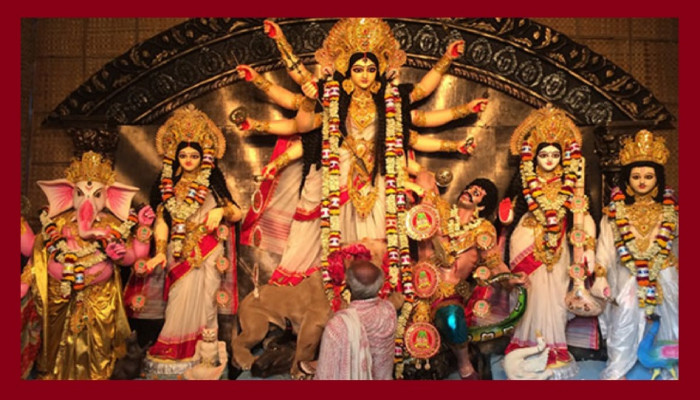
The mention of ‘Durga Puja’ itself naturally brings to our minds images of the bustling city of Kolkata and its Durga Puja pandals, abounding with different varieties of food, music and entertainment for all. But Durga Puja isn’t only about Bengal; it has a history far deeper and far richer beyond Bengal, in the sacred land of Ma Kamkhya or present-day Assam, including all other states of North-East India. For a long time after the Partition in 1947, a persistent narrative painted Assam and the North-East as never truly “Indian,” claiming that the region was unconquered by Indian empires, including the Mughals, and that its people are “less Hindu” or geographically isolated, with even customs like eating dogs or snakes prevalent here. These are deliberate narratives rooted in historical agendas that later served evangelical efforts of Christian missionaries and separatist organisations alike.
The North-East isn’t a fringe region, but a vital thread in Bharat’s cultural fabric. It is not, and was never, alien to or different from Indian civilisation. Its roots run deep into the heart of Sanatana Dharma. Long before the word “Assam” came into popular usage, this land was known as Pragjyotishpur and Kamarupa: two names that appear prominently in the Mahabharata, Ramayana, and various Puranas. It was considered a sacred geography, associated with divine legends, powerful kings, hermits, sages and saints. They lived here with religious austerities and built hermitages and engaged in spiritual or self-disciplining activities. It is said that the great saint Sri Kapilmuni had his hermitage in this place. ‘Pragjyotishpur’ is mentioned in the ancient epics as the abode of Naraka, while Kamarupa became more popular in the later years.[1]
The ancient name of the Kingdom of Kamarupa was Dharmaranya. Its references can be found in the 7th century travelogues of the Chinese Buddhist pilgrim Xuanzang (Huien Tsang), who noted numerous temples but little presence of Buddhism in the region. He explains how archaeological remains and sculptures confirm Assam was a strong Shaivite stronghold where the worship of Shiva was immensely popular, though the evidence of Buddhism does still exist. It is clear logic: when Shiva is worshipped, Shakti too would certainly be worshipped. But whenever Durga Puja lights up the North-East every year, and the people welcome their beloved Ma Durga in Her own different forms, a familiar chorus begins, often claiming that festivals like Durga Puja and Kali Puja are recent imports brought to Assam from West Bengal, and from Assam it gradually spread across different places of the North-East.
According to this narrative, Durga Puja is a borrowed tradition that somehow does not truly belong to the land and soil of Assam and the North-East. Such narratives are not only historically inaccurate but also intellectually dishonest. The truth is that Durga Puja in the North-East carries centuries of history and has grown through different indigenous and local traditions, from Manipur’s Sankirtan to the rhythms of Jhumur and Madal among Assam’s tea garden communities. The region also has its own visual language: fierce Mahishasurmardini forms, unusual iconography, traditional weapons, bamboo craftsmanship, and rituals that have survived across generations.
It is because Assam, or the ancient land of Pragjyotishpur and the Kingdom of Kamarupa that encompassed the entire present-day North-East, has been one of the greatest and most revered centres of Shiva and Shakti worship in Bharat since time immemorial. It has a strong tradition of associating Shiva-Shakti with the indigenous sacred landscape. Mountains, rivers, forests, and springs frequently acquired religious significance, and the worship of Shiva and Shakti became intertwined with local traditions and practices. Long before Durga Puja became popular in Bengal or elsewhere, this region was deeply steeped in the Shakta tradition.
The all-powerful Kamakhya Temple atop the Nilachal Hill and numerous other Devi shrines across the state stand as living proof that the worship of the Divine Mother has flowed through Assam’s veins for more than thousands of years, not as an imported custom, but an integral part of its own ancient spiritual and civilisational heritage. Kamarupa is synonymous with Shakti or Ma Kamakhya and vice-versa. As mentioned in the Kalika Purana:
দেৱীক্ষেত্ৰং কামৰূপং বিদ্যতে ন তৎসমম্।
অন্যত্ৰ বিৰলা দেৱী কামৰূপে গৃহে গৃহে॥
Meaning, Kamarupa is Devi’s Kshetra and She resides here in every house in Her different forms. The Yogini Tantra too, mentions the same:
কামৰূপং দেৱীক্ষেত্ৰং কুত্ৰাপি তৎসমং ন চ।
অন্যত্ৰ বিৰলা দেৱী কামৰূপে গৃহে গৃহে॥
Meaning: There is no place like Kamarupa, the Kshetra of Devi. Devi is rare elsewhere, but in Kamarupa, Devi exists in every house. That is why Ma Kamakhya is worshipped as ‘Kamakhya-Sharada’ and as well as ‘Durga’. The Kalika Purana mentions a specific mantra in this regard:
পুষ্পং আৰোপ্য কামাখ্যাং শাৰদাম্ আহ্বয়েন্মুহুঃ।
এহ্যেহি পৰমেশানি সান্নিধ্যম্ ইহ কল্পয়॥
দুৰ্গে দুৰ্গে ইহাগচ্ছ সৰ্বৈঃ পৰিকাৰৈঃ সহ॥
Meaning, Kamakhya is worshipped as ‘Sharadi Durga’. It is natural that a land associated with Yogini Tantra would not be unfamiliar with the worship of different manifestations of Ma Durga, also conceived as Mahamaya or Jagadamba.
In several Assamese folk songs too, we find the heart-touching narrative of Ma Durga’s longing to visit her father’s house and taste the food prepared by her mother, Menaka. On Dashami, She has to return to Mount Kailash from her mother’s home. Assamese folk singers vividly capture the situation in which Menaka weeps incessantly as her daughter prepares to leave. These folk narratives are further enriched by parallel representations of Ma Durga in archaeology and history, proving that Durga worship has been an integral part of the socio-cultural fabric of Assam since time immemorial. A 9th-10th century bronze plaque of the pre-Ahom era found at Kahilipara in Guwahati depicts the face of the three-eyed Mahishasurmardini Durga. The rare tribal Durga stone sculpture discovered in Mangaldoi town of Darrang district is a unique artefact from the later Ahom period. Scholars view the sculpture as a fascinating intersection where classical Shakta (Goddess) worship blended with local tribal and ethnic spiritual traditions, representing living continuities of artistic expressions of ancient Assam. More than an ancient sculpture, it is a story in stone, of Assam’s communities, creativity, and cultural journey across centuries.
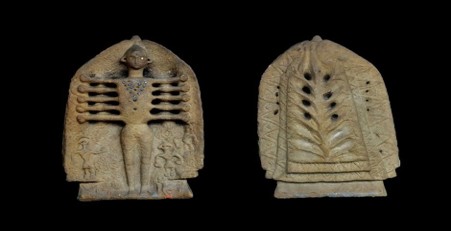
Tribal Durga sculpture of Mangaldoi, currently preserved at the Assam State Museum in Guwahati
All these details from history, archaeology, and everyday life confirm that the worship of Ma Durga is prevalent in Assam since antiquity. Recorded history says the first grand celebration of Durga Puja was started by Bali Narayan, the King of Darrang, in 1614 A.D. Noteworthy of mentioning that the tradition of offering Puja to the clay idol of Ma Durga spilled over the borders to the Ahom Kingdom during the reign of Pratap Singha. The clay idol of the Devi was worshipped for the first time at Bhatiapara village, on the Western banks of the Namdang River in Sivasagar.
In fact, the first recorded Durga Puja in the Ahom Kingdom took place at Bhatiapara, sometimes in the 1640s. The idols for this Puja were made by the Khanikars of Marangiyal, on the lines of the tradition started by the idol-makers of the Koch Kingdom. Thus, the practice of worshipping the clay idol of Durga heralded the beginning of a new period of Shakti worship in the Brahmaputra Valley that coincided with the barbaric Islamic invasions. Later, during the period of reign of Ahom monarch Rudra Singha, the idol of Ma Durga was brought from the Jaintia Hills of present-day Meghalaya and Durga Puja was held at the Shree Shree Burhi Gosani Devalaya in Jorhat as a royal celebration.
During the reign of Siva Singha, son of Rudra Singha, Krishnaram Nyayabagish composed the ‘Durgavasana Manjari’ to systematise the worship of Shakti as Mahishasurmardini Durga. His wife, Queen Phuleswari Devi (also known as Pramatheswari Devi), played a significant role in elevating the status of Durga Puja and Shaktism in the Ahom Kingdom. Deeply influenced by her Guru, Parvatiya Gosain, she actively promoted the worship of the Goddess and organised Durga Puja under royal patronage with great pomp and ceremony in the Ahom capital, Rangpur. This was one of the earliest instances of the festival being celebrated on a large, state-sponsored scale in the Ahom court, receiving strong royal support, greater visibility, and institutional importance.
The worship of some of the most violent and fiercest forms of Shakti constituted an integral component of warfare against the enemy across Hindu society in entire Bharatvarsha. The same held true for Assam and the present-day North-East as well.
As per historical records, Assam could never be subjugated by any outside force till the decline of the Ahom monarchy and the arrival of the British in the late 18th and early 19th centuries. The people of Pragjyotishpur kept alive their age-old tradition of Shakti worship despite many changes at the cultural and societal levels. For example, families of the Ahom royals such as Tamuly Phukan, Silpani Barua, Rasendra Barua, Kalicheng Barua, Parbatia Phukan, Dowerah Kakati, Chaliha Kakati, Paragania Choudhury (of Elengidal, Nalbari) and others celebrated Durga Puja in their homes every year. But it was mostly ‘Ghot Puja’ (worshipping an urn symbolising Devi), and only in rare instances were clay idols constructed for the Puja. The Durga Puja held at the Jorhat residence of freedom fighter Maniram Dewan when he was serving as ‘Barbhandar Barua’ in the administration of the Ahom monarch Purandar Singha is well-documented.
Over the course of the 19th century, as the British Raj consolidated, native officials such as Darogas, Mauzadars, Pleaders, and Vakils instituted Durga Puja among their household rituals. The Pujas organised at the residences of Kaliprasad Ukil (Sivasagar), Purnananda Barua Daroga (Jorhat), Janaki Ukil (Nagaon), and Hazari Mouzadar (Jorhat) are noteworthy in this regard. Affluent traders and urban elites like Dharma Narayan Ghosh of Goaltuli (present-day Goalpara district) and local tea planters celebrated Durga Puja in a grand fashion, gradually giving rise to elaborate festivities and popular forms of entertainment such as song, dance, and quiz competitions. Some families even invited Jatra parties from Bengal to perform in the evening hours of Maha Navami. An instance here may be cited of the family of Lakshmi Prasad Barua in Guwahati’s Uzanbazar area, who were amongst the early initiators of co-acting in theatre performances.
With the passage of time, as the power equations changed, so did people’s economic status. Many of these household Durga Pujas ceased to exist, giving rise to Sarbojanin (public) Pujas like the Barowari Durga Puja at Uzanbazar and Hari Sabha Durga Puja at Panbazar, both in Guwahati. This gradual transformation of a festival from a rural family ritual to an urban one was clearly visible in 20th-century Assam during the British Raj. Several local and unique features of the Durga Puja festival celebrated by Hindus in different parts of Assam still stand out. For example, the 400-year-old Gauripur Rajabari Puja in Dhubri is known for the idol of Ma Durga made of sholapith or kuhila. Another famous Puja held at Puranigudam in Nagaon has kept alive its tradition of carving wooden idols of the Devi, started by one Lerela Khanikar in 1901. Professor Atul Chandra Hazarika, in his memoir, ‘Smritilekha’, refers to three major Durga Puja celebrations by Barada Kanta Bisaya, Kalicharan Sen, and Professor Chunnilal Dey in Guwahati, in the early part of the 20th century, highlighting their unique features, such as the presence of Kamarupiya Bardhol players.
The different rites and rituals prevalent till date across the Shakti Peethas of Assam and the North-East are intense and traditional, rooted in the Tantric system of worship. Many historic temples such as Burha Gosai Than at Howli of Mohanpur village in Darrang district, Ugratara Devalaya in Guwahati, Mahamaya Dham in Dhubri, Shree Shree Burhi Gosani Devalaya in Jorhat, Kako Gosani Durga Than in Bokakhat, Devi Doul in Sivasagar, and Bilbeswar Devalaya at Belsor village of Nalbari, have preserved their timeless tradition of celebrating Durga Puja in their own unique and distinctive flavours. Durga Puja is the main festival held in these temples, besides Kali Puja, Jagaddhatri Puja, Annapurna Puja, and Ma Manasa Puja.
Thousands of devotees throng the age-old tradition of buffalo sacrifice (also known as Maha Navami’r Maha Bali in Assamese) at Nalbari’s Bilbeswar Devalaya on the day of Maha Navami during the annual Durga Puja festivities. Besides Bilbeswar, the Durga Puja held at Barnardi village in Nalbari is one of the oldest in Assam. The Prasadam (locally known as ‘Gosani[2] Bhog’) mainly consists of offerings of fish and meat made to Devi, influenced largely by local eating habits. Another example that can be cited here is of the Durga Puja organised at the Burha Gosain Temple in Mohanpur where, as a ritual, women perform congregational kirtan every evening beginning from the day of Shashthi. The worship of weapons and other royal belongings of the rulers of the past, commonly known as Dar Puja, is one of its most distinctive features. The Ram Dao (sacrificial sword) used earlier for animal sacrifices at the temple is circumambulated in the early hours of Vijaya Dashami.
In neighbouring Meghalaya too, Durga Puja is celebrated with fervour and enthusiasm by the local Khasi, Garo, and Jaintia people, besides the large Bengali Hindu population residing in Shillong and its neighbouring areas. Even though we often associate Shillong with its Christmas, the Durga Puja celebration here is equally grand and colourful, with local artisans, musicians, and food vendors coming together to shape the celebration itself.
Among the oldest and most prominent Pujas of Shillong are the R&R Colony Durga Puja, Laban (Harisabha) Durga Puja, Rilbong Durga Puja, Jailroad Durga Puja, and Matri Mandir Durga Puja. Cultural activities and competitions are very popular among people here. Apart from songs and dances, traditional rituals like conch-blowing (Sankha Dhwani) and Dhamail (traditional wedding dance performed by women) are also organised. In some places, plays called Natok are held that go on till the wee hours of the morning.
However, the Durga Puja held at Meghalaya’s Nartiang village stands out among them all. Based on unique traditional rituals, this is one of the rare Pujas that reflects the deep cultural heritage of Meghalaya rooted in Sanatana traditions. It is held at the ancient Nartiang Durga temple, where the idol of Ma Durga is distinctively made from a banana tree and decked in white clothes and flowers by the village elders. The celebrations begin on the day of Mahalaya, with early morning rites led by the Doloi (head Pujari) along with his ministers, Pator, Lyndoh, and Pujaree. This is followed by the sacred ritual of Ka Pom Blang (goat sacrifice), in which a goat adorned with a human mask and a dhoti is sacrificed, representing a human. It is said that the altar where the sacrifice is made is connected through a tunnel to the river Myntdu, flowing downhill from the temple; once the ritual is complete, the head with the blood of the animal is believed to roll down and fall into the river, and people consider it a symbol of “acceptance” by the Goddess. The same sword is used for the sacrifice from centuries to date. On the day of Maha Navami, Kar Puja, or Bam Ar-wa-liang, takes place at the Shiva temple in Lum Sahmai (Shiva is locally invoked as U-Sahmai), with devotees offering goats. On Dashami (Sngi Lai Um), villagers perform Shad Pastieh Kaiksoo, a traditional sword dance, before escorting the deity of Ma Durga to the Myntang River. The celebration concludes with the immersion of the idol and the symbolic release of a dove and a Pdit bird as a traditional gift or offering to Ma Durga.
In Tripura, the first royal Durga Puja began at Udaipur (the ancient capital of Tripura), later moved to Amarpur, and finally relocated to Agartala in the early 18th century during the reign of Maharaja Krishna Kishore Manikya Bahadur, who built a temple for the deity. Royal patronage continues to this day, with the State Government supporting the historic Durgabari Puja held at the historic Durgabari temple in Agartala. In fact, Tripura is one of the very few states in India where the Government directly sponsors and administers a centuries-old royal Durga Puja (overseen jointly by the West Tripura District Magistrate as Sebayet and members of the erstwhile royal family like Bibhu Kumari Devi). Unlike the traditional idol of Ma Durga having ten hands, the deity at the Durgabari temple is famously worshipped with two hands, a tradition stemming from a royal dream during Maharaja Krishna Kishore Manikya's reign. On Dashami, the idols are taken for immersion with offerings of fruits, vegetables, and non-vegetarian items like fish, meat, and eggs, alongside liquor.
In predominantly Christian-majority Mizoram, Durga Puja is largely a community-driven celebration led primarily by the state’s Hindu and Gorkha populations who continued to observe the festival even during the height of the Mizo insurgency from the mid-1960s till the 1980s. Traditionally, clay idols were brought from Silchar in Southern Assam or crafted locally. Following complaints by local evangelical organisations about clay idols destroying local hill rivers and causing chemical pollution, the organising committees in many places transitioned to reusable fibreglass statues. Sometimes, images of the Goddess are also printed on non-biodegradable flex and these are again used the next year. At present, the Pujas held at the Gorkha temples of Bawngkawn, Zotlang, Khatla, Tuampui, and Maubawk neighbourhoods of Aizawl are particularly noteworthy. The Central Gorkha Mandir Committee manage the pujas. Durga Puja is also celebrated in a few Reang villages situated along the Tripura-Mizoram border.
In Arunachal Pradesh, Durga Puja is celebrated with deep devotion, community harmony, and unique cultural fusions by local residents, the Gorkha community, and the Hindu Bengali diaspora in several towns across the state. Major hubs of Durga Puja celebration include Pasighat in East Siang district, the capital complex of Itanagar and Naharlagun bordering Assam, Namsai, Bomdila, Tezu, and even border areas like Tawang and Ruksin. The Namsai Durga Mandir stands as one of the oldest continuing Durga Puja mandaps in the state, active for over seven decades.
In Nagaland, Durga Puja is primarily celebrated by the small and close-knit Hindu community residing in the commercial hubs of Dimapur, Kohima, and Chumoukedima. The tradition grew alongside the settlement of traders, merchants, Government employees, and security personnel from Bengali, Gorkha, and other non-Christian communities in Dimapur. Organised by local committees and groups like Hindu Seva Samiti and Linguistic Minority Forum of Nagaland, Ma Durga in puja pandals is dressed in traditional Naga attire instead of the usual outfit that She is generally clad in. This practice drew strong objections from local groups, including the Nagaland Baptist Church Council (NBCC) and other missionary organisations. Church leaders have expressed resentment, stating that using traditional Naga attires, artefacts, and cultural pieces as decorative elements inside or outside Hindu puja pandals can cause hurt and misrepresent or insult traditional Naga heritage. Durga Pujas in the state are held at the Durga Temple of the Hindu Navyuk Sangh, Durgabari, and Gorkha Singhadevi Mandir.
On Vijaya Dashami, idols are traditionally taken in processions from assembly points like Khermahal in Dimapur to designated ghats such as the Purana Bazar Dhansiri River Ghat.
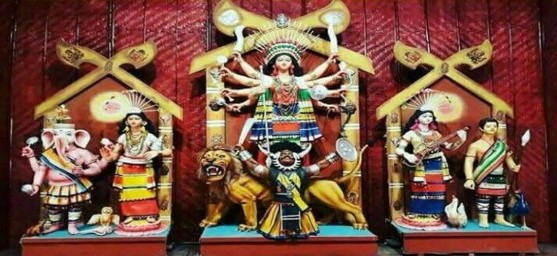
Source: https://www.facebook.com/time8news/posts/unique-durga-puja-pandals-in-2017-heres-a-puja-pandal-somewhere-in-nagaland-wher/289954118174352/
In Manipur, Durga Puja is celebrated alongside Panthoibi Iratpa, honouring Panthoibi (Pan = rule; Thoi = to excel or win; Bi = female, or the woman who excels and rules), the ancient Manipuri Goddess of war and civilisation, love, fertility, handicraft, victory, war, wisdom, and courage. Panthoibi, also sometimes addressed as ‘Nongpok Leima’ (consort of Nongpok Ningthou), rides on a tiger and shares strong parallels with Mahishasurmardini Durga. Panthoibi Iratpa is celebrated with the advent of Mera Tha (Mera month) in Manipur, as per the lunar calendar of Manipuris.
Celebrations at prominent sites feature traditional Manipuri art forms like Nat Sankirtan and the rhythmic beats of Dhop Pala. The Durga Pujas held at Wangkhei Puja Lampak in Imphal East, Kalibari Mandir in Thangal Bazar, and Hiyangthang Lairembi Temple in Imphal West are particularly well-known. Hiyangthang Lairembi Temple in Imphal is particularly famous for Kumari Puja rituals on Maha Ashtami and Maha Navami, where Ma Durga is historically revered by women as the Goddess of fertility. On both these days, devotees perform the traditional symbolic Bali Pratha using vegetables such as bananas, cucumbers, lemons, gourds, or pumpkins, amid the tunes of the pena (a violin-like traditional Manipuri musical instrument), paying tribute to the might of Panthoibi, the most-loved Goddess of Manipur.
After sunset, Wari Leeba, a traditional Manipuri narrative art of storytelling, is performed. At dusk, traditional dances and devotional songs are performed in between rituals. Nowadays, cultural programmes like martial arts performances, comedy shows, Jagoi (dance), etc. are performed as entertainment in many places in Imphal. The last day of the festivities, known as Kwak Tanba or Kwak Yatra (driving away the crow) or killing of Ravana, represents the victory of righteousness over evil.
In Buddhist-majority Myanmar too, Durga Puja or Sharadotsav is celebrated by the numerically small yet close-knit Meitei and Bishnupriya Manipuri communities with their limited resources. Besides Holi and Rath Yatra, Durga Puja is one of the most important festivals of Manipuris residing in Myanmar. To recall, Durga Puja celebrations in the country were begun by Manipuri Brahmans (‘Paona’ in Burmese language) who migrated from Manipur and worked as court astrologers under the Burmese King.
At present, in Yangon and a few other localities of Rakhine/Arakan State in Western Myanmar bordering Bangladesh, Durga Puja is performed in two ways: either in the form of pran-pratishtha of idols, or only with a Navapatrika Sthapana in permanent temples, so that the immersion of idols can be avoided on the day of Vijaya Dashami and unnecessary troubles prevented. Most of the rituals are similar to what we follow here in Bharat, beginning from Bel Shashthi Puja to Navapatrika Sthapana on Saptami, Mahasnan of the deity, Balidan (as most of the Manipuris are Vaishnavite, commonly vegetables are offered as bali, but there are some rare cases where Matsya Balidan also takes place), Sandhi Puja, and concluding with Homa on Maha Navami.
Such celebrations by Hindus in countries like Myanmar are a living testimony that Devi worship isn’t limited to only a particular region of Bharat, and therefore no single community of people from any state or region should try appropriating it as solely their own. There is also no one “correct” or “pure” way to celebrate Durga Puja or Navaratri, because the history of these festivals and their associated rituals and culinary traditions says otherwise. What makes Durga Puja in the North-East so special and unique is a mix of faith, creativity, and togetherness. It has evolved through ancient Shakta traditions rooted in Tantra and Bali Vidhan, local customs, royal patronage, household rituals, and community practices. The different pandals give every area its own identity, turning the festival into a colourful display of art and imagery. When the final Dhak beats fade after Devi Visarjan, the streets become quiet again, but the beautiful pandals, shared moments, and memories remain long after the festival ends.
[1] While analysing inscriptional records, it can be seen that almost all rulers of Kamarupa have traced their lineage from Naraka. The name ‘Naraka’ is mentioned in the inscriptions of all rulers of ancient Kamarupa, elaborated in detail in the Kalika Purana, also known as Kalika Tantra or Sati Purana. The examination of the representation of Naraka in the pre-Ahom era inscriptions of Assam throws light on the nature of the polity and important socio-religious events of the time.
[2] Gosani is an Assamese term for the Goddess.


 Loading...please wait
Comments