



DRDO successfully tests Gaganyaan drogue parachute for safe astronaut return
- In Reports
- 06:44 PM, Feb 19, 2026
- Myind Staff
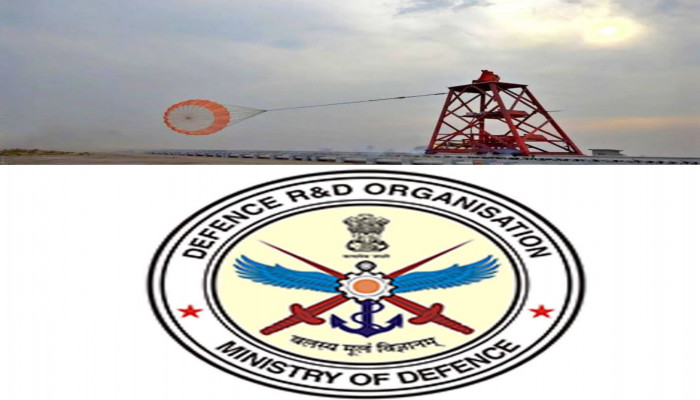
The Defence Research and Development Organisation (DRDO) has successfully completed an important qualification-level load test of the drogue parachute for India’s Gaganyaan human spaceflight mission. This test was carried out at the Rail Track Rocket Sled (RTRS) facility in Chandigarh, which is considered one of India’s most advanced ground-based dynamic testing systems. The successful trial marks a major milestone in ensuring the safety of Indian astronauts who will travel to space under the Gaganyaan programme.
The test was conducted at the Terminal Ballistics Research Laboratory (TBRL), which houses the RTRS facility. The Rail Track Rocket Sled is widely used for high-speed aerodynamic and ballistic evaluations. It is designed to simulate extreme real-life conditions, allowing scientists and engineers to test crucial aerospace and defence equipment at very high speeds. The facility plays an important role in checking whether equipment can handle stress, force, and pressure during real missions.
The drogue parachute is a highly important part of the Gaganyaan mission. It is used during the early stage of the crew module’s descent back to Earth. When the crew module re-enters Earth’s atmosphere and begins falling, the drogue parachute is deployed first. Its main job is to stabilise the crew module and reduce its speed before the larger main parachutes open. Without proper stabilisation, the crew module could rotate or wobble dangerously, which may put astronauts at risk. Therefore, the drogue parachute must work perfectly under harsh conditions.
Officials explained that this qualification test was done under loads that were higher than the maximum expected load during the actual mission. This is done to ensure an extra safety margin. Testing beyond normal limits is a standard practice in aerospace projects because it helps confirm that the system will not fail even in unexpected or extreme situations. The successful completion of this high-load test proves that the parachute design is strong and reliable enough for human spaceflight.
The test was carried out with support from multiple organisations. DRDO worked in collaboration with the Vikram Sarabhai Space Centre (VSSC) under the Indian Space Research Organisation (ISRO). DRDO’s Aerial Delivery Research and Development Establishment (ADRDE) was also involved in the process. These institutions have been working together closely to ensure that the parachute system meets all safety standards required for India’s first human space mission.
Specialised teams from TBRL played a key role in conducting the test. They provided the necessary technical support, instrumentation, and operational expertise needed for such a high-speed evaluation. The RTRS test requires accurate measurement of force, speed, and stress, and the involvement of expert teams ensures that every detail is monitored properly. Their successful support during this test highlights the importance of advanced testing infrastructure in India’s space and defence programmes.
The success of this parachute test also reflects India’s increasing capability in designing and manufacturing complex aerospace equipment. The drogue parachute used in Gaganyaan is a high-strength ribbon parachute, which is known for its durability and stability under extreme conditions. According to officials, the test result shows that India has developed strong expertise in producing such parachutes for advanced missions. This is a major achievement because human spaceflight requires systems that must work without failure.
Defence Minister Rajnath Singh congratulated DRDO, ISRO, and industry partners for achieving this milestone. He described it as a significant step towards strengthening the vision of Atmanirbhar Bharat, especially in critical space technology. He stated that such achievements prove India’s ability to build important systems with indigenous technology, reducing dependence on foreign suppliers.
The Secretary of the Department of Defence R&D and Chairman of DRDO also praised the teams involved. They appreciated the hard work and dedication of all scientists, engineers, and technical staff who contributed to completing the qualification test successfully. The leadership highlighted that such achievements are essential for making India’s space programme stronger and safer.
With every successful test like this, India moves closer to achieving its dream of sending its own astronauts into space and safely bringing them back. The Gaganyaan programme is not only about launching humans into orbit, but also about ensuring that every part of the mission—from launch to landing—is safe and reliable. Parachute systems are among the most critical safety components because they are responsible for slowing down the returning spacecraft and ensuring a controlled landing.
Gaganyaan is ISRO’s flagship human spaceflight programme. Its main objective is to demonstrate India’s ability to send a three-member crew into Low-Earth Orbit (LEO) for a period of about three days. The mission will involve launching a habitable crew module using the human-rated Launch Vehicle Mark 3 (LVM3) rocket. The spacecraft will be sent to an altitude of around 400 kilometres above Earth.
After completing the mission in orbit, the crew module will return to Earth and safely splash down in Indian waters. The astronauts will be recovered after landing. A safe return is one of the biggest challenges in human spaceflight, which is why the parachute system is being tested with such strict standards.
As per the planned schedule, the first uncrewed flight, called G1 is expected to take place in March 2026. This mission will be an important step in testing all systems before humans are sent into space. The Gaganyaan programme is also a major part of India’s long-term space vision. It will support future plans such as building the Bharatiya Antariksha Station by 2035 and aiming to land an Indian astronaut on the Moon by 2040.
Overall, the successful drogue parachute test is a major boost for the Gaganyaan mission. It proves that India is making steady progress in developing safe, indigenous technologies for human spaceflight. It also highlights the strong cooperation between DRDO, ISRO, and other research institutions. With such achievements, India is getting closer to becoming one of the leading nations capable of independent human space exploration.



 Loading...please wait
Comments