



DRDO successfully completes three final-configuration trials of indigenous VSHORADS
- In Reports
- 05:52 PM, Feb 28, 2026
- Myind Staff
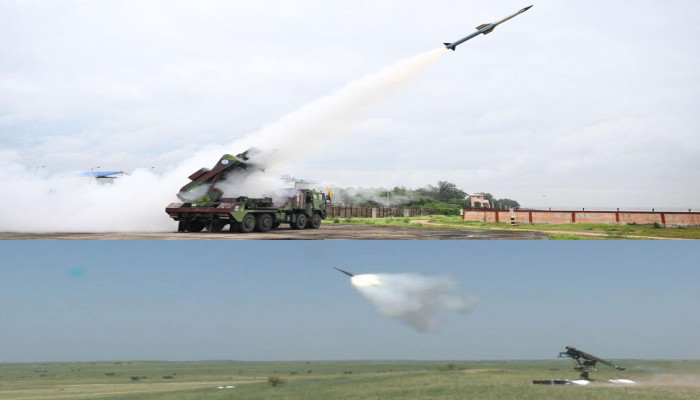
The Defence Research and Development Organisation (DRDO) has successfully carried out three back-to-back flight trials of its indigenous Very Short-Range Air Defence System (VSHORADS), marking a major achievement for India’s defence capabilities. The tests were conducted at the Integrated Test Range in Chandipur, located off the coast of Odisha. These trials were important because they revalidated the missile’s ability to take down fast-moving aerial threats in different operational situations. The successful interceptions confirmed that the system can effectively deal with high-speed targets under varied conditions.
During the trials, the focus was on checking whether the missile could neutralise targets flying at different speeds, distances, and altitudes. In all three tests, the VSHORADS missiles accurately intercepted and destroyed simulated hostile aircraft. The performance of the system met all the predefined parameters set by the testing teams. This means the missile performed exactly as expected in terms of speed, accuracy, tracking, and destruction capability.
These trials were especially significant because they were conducted in the system’s final deployment configuration. This configuration closely mirrors real battlefield conditions, ensuring that the missile is ready for actual operational use. Field operators were responsible for acquiring the targets and launching the missiles, which made the exercise realistic and similar to how Indian armed forces personnel would use the system during combat. The successful handling of the system by field operators showed that it is ready for induction into service.
To ensure accurate results, comprehensive data were collected during the trials. Telemetry systems, electro-optical trackers, and ground-based radars stationed at Chandipur recorded every movement and action during the engagements. The data confirmed the missile’s reliability and effectiveness across multiple threat profiles. This detailed monitoring further strengthened confidence in the missile’s performance and readiness.
Observers from all three branches of the Indian armed forces—the Army, Navy, and Air Force—were present during the trials. Senior DRDO officials and representatives from development and production partners also attended. Their presence highlighted that the tests served as user validation exercises, meaning the armed forces themselves were involved in assessing the missile before its induction. This step is crucial for ensuring smooth integration into service inventories.
VSHORADS is the result of indigenous innovation led by the Research Centre Imarat (RCI) in Hyderabad, a key DRDO laboratory. The system was developed with support from other DRDO laboratories and private industry partners. It is a man-portable air defence system (MANPADS), designed to fill critical gaps in India’s short-range air defence for all three Services. The missile uses advanced infrared homing guidance, which allows it to lock onto targets either before launch or after launch. This feature increases its flexibility and effectiveness in different combat scenarios.
The missile’s compact design makes it easy for a single soldier to carry and operate. It also features a vertical launch mechanism, which improves its performance against low-altitude threats such as helicopters, drones, and low-flying jets. These types of threats are becoming more common in modern asymmetric warfare. By addressing this challenge, VSHORADS strengthens India’s ability to protect its forces and key assets.
The development of VSHORADS is in line with India’s Atmanirbhar Bharat initiative, which aims to reduce dependence on foreign defence imports. Until now, India relied on imported MANPADS systems such as the Igla and Stinger. Earlier prototypes of VSHORADS had been tested since 2022, with continuous improvements made to their propulsion system, seeker technology, and warhead performance. The latest three trials in the final configuration mark the successful completion of these refinements.
Defence Minister Rajnath Singh praised the achievement and called it a “significant milestone.” In his statement, he congratulated DRDO scientists, armed forces representatives, and industry partners. He also said that induction into operational service is imminent following these back-to-back successes.
DRDO Chairman Samir V Kamat also appreciated the accomplishment and highlighted the collaborative effort behind it. He praised the teams for their dedication in design, development, and rigorous testing, and acknowledged the important contributions of Services personnel and production agencies in validating the system’s combat readiness.
Strategically, VSHORADS strengthens India’s layered air defence network. It works alongside medium-range systems like Akash-NG and QRSAM, while covering the ultra-short-range category that was earlier dependent on imports. This layered approach improves protection for mechanised infantry units, forward bases, and naval vessels against low-level aerial threats.
The success of these trials also reflects the growing strength of India’s indigenous manufacturing capabilities. Public and private sector production partners are now prepared for large-scale production of the missile. There is also potential for exporting VSHORADS to friendly countries as part of India’s defence diplomacy efforts.
In the coming months, DRDO expects clearance for bulk procurement. There are also plans to integrate the system with night-vision sights and digital fire-control networks. This would allow the missile to operate effectively in all weather conditions and at all times of the day, across terrains ranging from the Himalayas to maritime zones. The Chandipur trials not only confirm the missile’s technical readiness but also show strong coordination among the three Services. As regional security challenges evolve, including threats from drones and stealth aircraft, VSHORADS is set to play a key role in protecting India’s skies.



 Loading...please wait
Comments