




DRDO, Rashtriya Raksha University sign MoU to strengthen internal security collaboration
- In Reports
- 07:05 PM, Dec 22, 2025
- Myind Staff
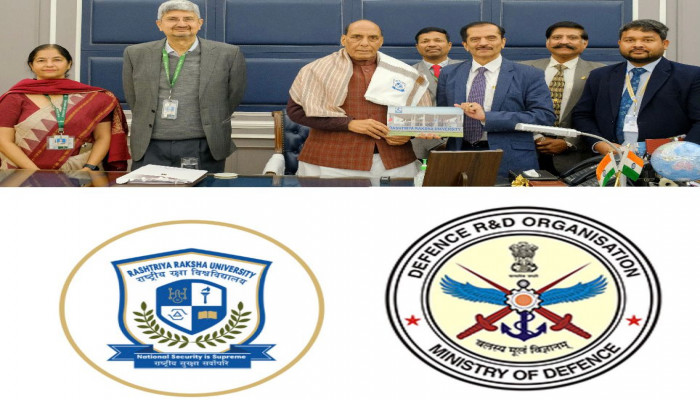
In a significant step aimed at strengthening India’s defence and internal security framework, the Defence Research & Development Organisation (DRDO) and Rashtriya Raksha University (RRU) have signed a Memorandum of Understanding (MoU). This agreement will help both organisations work closely in key areas such as research, education, training and technology support for defence and internal security.
The MoU was signed at South Block, New Delhi, on December 22, 2025. The ceremony saw the presence of important dignitaries, including India’s Defence Minister, Rajnath Singh, who witnessed the signing of the agreement.
The document was officially inked by Dr. Chandrika Kaushik, who is a Distinguished Scientist and Director General (Production Coordination & Services Interaction) at DRDO, and Prof. Bimal N Patel, Vice Chancellor of Rashtriya Raksha University. Also present at the event was Dr. Samir V Kamat, Secretary of the Department of Defence R&D and Chairman of DRDO.
Under this MoU, both DRDO and RRU have agreed to join hands so that they can work together on various activities that support India’s defence forces and security agencies. They will focus on improving research work, building knowledge and skills, sharing expertise, and supporting technology-related work that can benefit internal security as well as defence systems.
One of the key aims of this collaboration is to help India become stronger and more self-reliant in defence and internal security technologies. This goal is part of the Aatmanirbhar Bharat initiative and the idea of working together as a “whole-of-nation” during Amrit Kaal. The MoU reflects the shared commitment of both organisations to combine technology, knowledge, and practical insights to enhance the nation’s security preparedness.
Rashtriya Raksha University is an institution recognised as being of national importance. It functions under the Ministry of Home Affairs and is also designated by the University Grants Commission (UGC) as the Nodal Centre for Defence Studies. The university brings strong academic, training, and policy expertise in the field of internal security, which makes it an important partner in this agreement.
On the other hand, DRDO is India’s premier defence research and development organisation. It is well known for providing cutting-edge technologies and solutions to meet the requirements of the country’s armed forces and security agencies. Through its wide range of research and technological innovations, DRDO plays a crucial role in strengthening India’s defence capabilities.
The MoU offers several opportunities for collaboration between the two institutions. They will work together on joint research projects that focus on areas of mutual interest. This includes research that can help improve technologies used by defence forces and security agencies.
Another important area of cooperation will be PhD and fellowship programmes. Students and researchers from both organisations will have the chance to take part in advanced academic work that deepens their understanding of defence and internal security challenges. This will help build a future workforce that is skilled in both theoretical knowledge and practical application.
In addition to research and academic programmes, the MoU also provides scope for specialised training and capacity-building programmes. These programmes will be designed to train personnel from security forces and other related agencies. Training will be focused on emerging challenges and new technologies so that personnel are better prepared to face modern security threats.
Both organisations will also work on studies related to future operational challenges faced by defence and internal security forces. They will assess technology gaps, analyse future requirements, and look at how systems developed by DRDO can be better used by various security agencies. This includes looking at the life-cycle management of systems once they are introduced into service.
By pooling their expertise, DRDO and RRU hope to bring together the best of academic knowledge and practical technology capabilities. This partnership is meant to benefit not just the defence forces, but also internal security agencies such as the Central Armed Police Forces. Through this collaboration, both organisations aim to build a stronger foundation for India’s security forces, helping them remain well-equipped to handle current and future threats.
The signing of this MoU is seen as a positive move towards enhancing India’s defence and security framework through shared expertise, improved research, and joint training. It marks an important milestone in defence-academic cooperation, as both DRDO and Rashtriya Raksha University continue to work together for the safety and security of the nation.



 Loading...please wait
Comments