



Dharma on Trial: The Sabarimala Civilisational Debate — Part I
- In Current Affairs
- 02:02 PM, Apr 03, 2026
- Siddhartha Dave
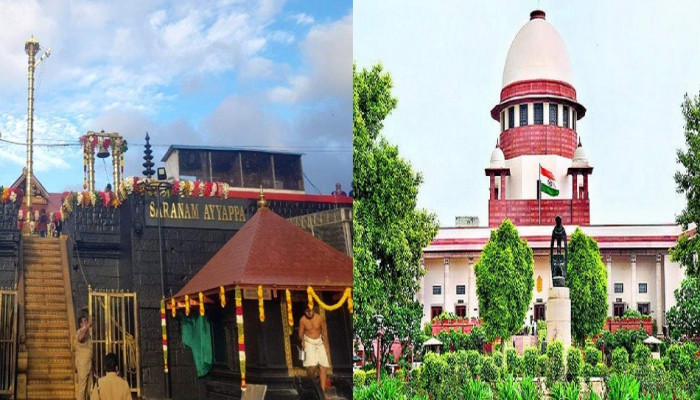
Sabarimala Before the Supreme Court: A Civilisational Question Before the Nine-Judge Bench
The decision of the Supreme Court of India to revisit its 2018 Sabarimala judgment marks not merely a judicial reconsideration, but a profound civilisational introspection. Beginning April 7, 2026, a nine-judge constitutional bench will hear a batch of review petitions that question the very foundations upon which modern constitutional jurisprudence has engaged with Bharat’s ancient and living traditions.
This article is the first in a four-part series titled “Dharma on Trial: The Sabarimala Civilisational Debate.” The subsequent parts will examine the doctrine of Essential Religious Practices, the reinterpretation of Articles 25 and 26, and the broader question of the State’s relationship with Dharma.
At one level, the case concerns the entry of women into the Sabarimala Temple. But at a deeper level, it interrogates the philosophical foundations of the Bhartiya civilisation itself. It asks whether a civilisation that has sustained itself for millennia through lived traditions can be interpreted—and if necessary, restructured—through a modern constitutional framework derived largely from Western categories.
The 2018 verdict, delivered by a Constitution Bench in a 4:1 majority, permitted entry of women of all age groups into the temple, overturning a long-standing custom that restricted the entry of women between the ages of 10 and 50. The judgment was hailed in certain circles as a victory of gender equality. Yet, the reaction across Bharat revealed a far more complex reality.
Contrary to simplified narratives, the resistance to the judgment was not merely patriarchal backlash. It was a civilisational assertion. Devotees—men and women alike—rose in defence of what they perceived not as discrimination, but as a sacred discipline intrinsic to the nature of the deity worshipped at Sabarimala.
Bhagwan Ayyappa is revered as a Naishtika Brahmachari, a deity in eternal celibacy. The traditions associated with the temple are not arbitrary social constructs but expressions of this theological identity. In Bhartiya spiritual thought, the nature of the deity determines the nature of worship. To alter the practice is, in essence, to alter the deity itself.
This is where the Sabarimala debate transcends legal categories. It is not about access to a public institution. It is about the integrity of a sacred tradition.
The Expanding Role of the Judiciary in Matters of Faith
One of the most significant issues raised by the review petitions is the expanding role of the judiciary in determining religious practices. The doctrine of “Essential Religious Practices,” developed in the Shirur Mutt case of 1954, has increasingly allowed courts to decide what constitutes the core of a religion.
While originally intended as a protective mechanism, this doctrine has evolved into a tool of intervention.
The petitioners argue that this shift has enabled courts to step into domains that are inherently theological. They contend that judges, however well-intentioned, are not equipped to determine the spiritual significance of practices rooted in centuries of tradition.
The concern is not merely theoretical. If courts assume the authority to define what is essential to a religion, they effectively become arbiters of faith. This represents a fundamental departure from the principle of religious autonomy.
A Question of Civilisational Misunderstanding
At the heart of the Sabarimala argument lies a deeper issue—the mismatch between Western legal frameworks and Bhartiya civilisational realities.
In Western thought, religion is often viewed as an organised system of beliefs, separate from the public sphere. It is institutional, codified, and often centralised. Constitutional protections in such contexts are designed to regulate these institutions.
Bharat presents a radically different picture.
Here, Dharma is not confined to institutions. It is an all-encompassing way of life that integrates philosophy, ritual, culture, and social order. It is decentralised, pluralistic, and deeply contextual.
When such a civilisation is interpreted through frameworks designed for entirely different historical and cultural contexts, distortions are inevitable.
The Sabarimala verdict, critics argue, reflects precisely such a distortion. It applies the logic of individual rights—developed in a Western liberal tradition—to a context where collective spiritual practices hold equal, if not greater, significance.
The Role of Women in the Sabarimala Movement
One of the most striking aspects of the post-2018 developments was the active participation of women in opposing the verdict.
This challenges the dominant narrative that frames the issue purely in terms of gender discrimination.
Many women devotees argued that the restriction was not a denial of dignity, but a recognition of the unique spiritual discipline associated with the temple. They viewed their exclusion not as marginalisation, but as participation in a larger sacred order.
This perspective is difficult to comprehend within a purely rights-based framework. It requires an understanding of Dharma as a system where duties and roles are often prioritised over individual assertions.
The presence of women petitioners opposing the 2018 judgment underscores the complexity of the issue. It demonstrates that the debate cannot be reduced to binaries of equality versus tradition.
The Call for Religious Autonomy
Among the most significant interventions in the review petitions is the demand for recognising religious traditions as autonomous entities.
Spiritual leaders and organisations have argued that Bhartiya religions lack independent legal recognition. As a result, they are unable to assert their rights effectively within the judicial system.
This structural limitation, they contend, leaves religious communities vulnerable to state intervention.
The call, therefore, is not merely for the protection of specific practices, but for a broader rethinking of how the Constitution engages with Dharma.
There is also a demand for greater consultation with religious scholars in matters involving theological questions. Just as courts rely on medical experts in technical cases, it is argued, they should engage with dharmic authorities when adjudicating issues of faith.
Kerala Government’s Shift: A Subtle Acknowledgement
In a significant development, the Kerala government has indicated that courts should consult religious scholars before making decisions on long-standing traditions.
This marks a departure from its earlier position supporting the 2018 verdict.
While the reasons for this shift may be political or pragmatic, it nonetheless reflects an acknowledgement of the complexity of the issue. It suggests a growing recognition that questions of faith cannot be resolved through legal reasoning alone.
Beyond Sabarimala: A Precedent for the Future
Perhaps the most important aspect of the case is its implications beyond Sabarimala.
The issues raised in the review petitions extend to a wide range of religious practices across communities. From entry restrictions in places of worship to rituals and customs, the principles established in this case could have far-reaching consequences.
If the Court reaffirms its authority to define essential practices, it may open the door to increased judicial intervention in religious matters.
If, on the other hand, it recognises the autonomy of religious traditions, it could mark a significant shift towards a more civilisationally rooted jurisprudence.
The Nine-Judge Bench: A Constitutional Moment
The constitution of a nine-judge bench underscores the gravity of the issues involved.
Such benches are reserved for questions of exceptional constitutional importance. The decision of this bench will not only determine the future of the Sabarimala tradition but also shape the contours of religious freedom in Bharat.
It will address fundamental questions about the limits and role of judicial authority in matters of faith—whether courts can legitimately determine what constitutes an essential religious practice, how conflicts between individual rights and collective traditions ought to be reconciled, and what the appropriate balance should be between the authority of the State and the autonomy of Dharma within Bharat’s civilisational framework. These are not merely legal questions. They are civilisational questions.
Dharma at the Crossroads
The Sabarimala case represents a moment of reckoning.
It compels Bharat to confront a fundamental dilemma:
Can a civilisation rooted in Dharma be fully understood—and governed—through a framework that does not emerge from it?
The answer to this question will have implications far beyond the courtroom.
As the nine-judge bench begins its deliberations, the nation watches not just for a verdict, but for a direction.
Will the Court reaffirm a jurisprudence shaped by external frameworks?
Or will it move towards a more nuanced understanding that respects Bharat’s civilisational uniqueness?
The answers will unfold in the days to come.
In the next article of this series, we will examine the doctrine of Essential Religious Practices—its origins, evolution, and its profound implications for the future of Dharma in Bharat.
Disclaimer: The opinions expressed within this article are the personal opinions of the author. MyIndMakers is not responsible for the accuracy, completeness, suitability, or validity of any information on this article. All information is provided on an as-is basis. The information, facts or opinions appearing in the article do not reflect the views of MyindMakers and it does not assume any responsibility or liability for the same.


 Loading...please wait
Comments