




Democratic Dissent and the Crisis of Values: Reflections on Dharma in Contemporary India
- In Current Affairs
- 10:14 AM, Jul 26, 2026
- Dr. Pinku Jha
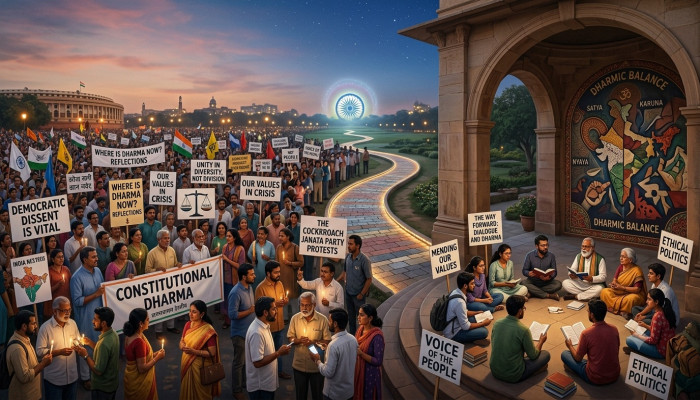
The resignation of the Education Minister in response to the ongoing protests initiated by the Cockroach Janta Party, alongside the active participation of members of Gen Z, has brought to the forefront a number of significant questions concerning democracy, public morality, political responsibility, and the contemporary nature of dissent. In the initial phase of protests, it was assumed that it would be largely peaceful in its stated character. However, gradual encounters between protesters and the police and administration at many points became strained and confrontational. The circulation of numerous videos, memes, and other forms of digital content across social media further demonstrated that the movement was not merely a conventional protest characterised by physical gatherings, slogans, and demonstrations against governmental institutions. Rather, it appeared to represent the accumulation of dissatisfaction, frustration, and anger towards the government and existing institutional arrangements. This discontent found expression through unconventional forms of political participation, including satire, humour, memes, videos, and other forms of digital communication.
The causes that brought people together across different parts of the country through different forms of protest were, in my view, significant and deserving of serious consideration. In particular, the demand for reform in the education system gave the movement a broader constitutional and democratic significance. The demand for educational reform was not merely a demand for an administrative change; it reflected a larger concern regarding the nature of institutions, governance, accountability, and the future of society. In this sense, the protest could be understood as an attempt by citizens to exercise their democratic right to question authority and demand institutional reform. At the same time, however, the entire episode raises a deeper question concerning the emergence of a possible crisis of values. This question cannot be confined only to the conduct of the protesters. It must equally be extended to all the actors involved in the situation, including ministers, government officials, administrators, police and security personnel, media professionals, and citizens. Are individuals occupying positions of authority sufficiently conscious of the values associated with the offices and responsibilities they hold? Does the exercise of institutional power remain guided by constitutional morality, public responsibility, and a concern for the welfare of society? Similarly, are citizens and protesters conscious of the ethical responsibilities that accompany the exercise of their democratic rights?
This question becomes particularly significant when examined through the idea of dharma. Dharma, understood in a broader philosophical and ethical sense, is not merely a religious obligation or a fixed set of ritual duties. It may also be understood as a principle of responsibility, conduct, and moral order that guides an individual in relation to oneself, society, and the larger collective. The dharma of an individual is therefore not necessarily identical to the dharma of a ruler, administrator, police officer, journalist, or protester. Each position carries its own responsibilities, and the ethical character of public life depends upon the manner in which these responsibilities are performed.
From this perspective, the question of values cannot be directed exclusively towards the government. A government has a responsibility to act with justice, accountability, restraint, and sensitivity towards citizens. The police and administration have a duty to protect public order while simultaneously respecting constitutional rights and human dignity. The media has a responsibility to inform rather than merely sensationalise. Similarly, citizens have a responsibility to express dissent and demand reform while remaining conscious of the consequences and ethical implications of their methods of political participation. This does not imply that citizens should be expected to protest only in ways that are comfortable for those in authority. Democracy necessarily includes dissent, disagreement, criticism, satire, and resistance. In fact, the right to question power is one of the essential conditions of democratic life. The participation of Gen Z has also demonstrated that political expression is no longer restricted to conventional modes of protest. Memes, videos, satire, digital campaigns, and humour have become important instruments through which political dissatisfaction is communicated. These forms of expression may therefore be understood as new forms of political participation emerging within the digital public sphere.
Nevertheless, another question remains relevant: while raising questions, creating posters, using satire, producing memes, and adopting humorous modes of political expression, are participants sufficiently conscious of how these forms may be interpreted by others? Can the use of humour and satire sometimes obscure the seriousness of the cause? Can unconventional forms of protest be perceived as disrespectful, even when the underlying demand is legitimate? And, ultimately, should such perceptions matter? There was a lot of negativity, vile language and abuse in the communication being used by the Gen Z protestors, and this invited much criticism from many who were concerned about the irresponsible nature of the protest.
There may not be a simple answer to these questions. The value of a protest cannot be judged merely by its outward form. A serious cause may sometimes be expressed through humour, just as an apparently peaceful protest may conceal deep anger and frustration. At the same time, the method of protest may influence the way in which the cause is understood by society. The means through which a demand is articulated can therefore become as important as the demand itself. This is not to suggest that protesters should be denied the freedom to adopt unconventional forms of expression, but rather that democratic participation also requires a degree of ethical self-reflection.
As someone who was not directly involved in the protest, I do not consider myself entitled to prescribe what the “correct” form of protest ought to be. Those who experience a particular grievance directly may possess a depth of emotional and social understanding that an external observer cannot fully comprehend. Every protest emerges from a specific context, and the form it assumes is shaped by the experiences, frustrations, and aspirations of those who participate in it. Yet, the broader question of responsibility remains important. If the objective of a movement is to demand a value-conscious government, a responsive administration, meaningful educational reform, and a more just society, then the movement also invites a larger reflection upon the values that shape democratic action. In this sense, the idea of ‘Dharma may provide a useful framework for understanding the responsibilities of all actors involved.
The dharma of the government is to govern with justice, accountability, and concern for the welfare of the people. The dharma of institutions is to uphold the constitutional principles and public purposes for which they exist. The dharma of the police and administration is to maintain order without losing sight of justice and human dignity. The dharma of the media is to facilitate informed public discourse. The dharma of citizens is to remain vigilant, question authority, and participate in democratic life. The dharma of the protester, therefore, may be understood not as unquestioning obedience, but as the responsible exercise of dissent in pursuit of a larger public good.
This understanding also allows us to move beyond the simplistic opposition between the government and the protesters. A democracy is not sustained merely by governments, nor merely by movements of resistance. It is sustained by the ethical relationship between authority and dissent. Both authority and resistance must, in their own ways, remain connected to the larger question of national welfare and collective responsibility. The contemporary protest therefore raises a question that extends beyond the resignation of a minister or the demand for educational reform. It compels us to ask whether a value crisis exists not merely within the government, but across the broader social and political order. Are individuals conscious of their responsibilities towards themselves, society, and the nation? Are institutions performing their respective dharma? Are citizens exercising their rights with an awareness of their responsibilities? And are we capable of distinguishing between the legitimacy of a cause and the limitations of the methods through which it is expressed?
Perhaps the most important lesson is that the demand for a value-conscious government cannot be separated from the need for value-conscious citizens and institutions. A society cannot expect ethical governance while completely separating governance from the ethical responsibilities of individuals and institutions. The pursuit of reform, therefore, must also involve a process of self-reflection. In this sense, the protest may be understood not merely as a political demand or a moment of collective anger, but as an opportunity for democratic introspection. It raises questions about the kind of government we desire, the kind of citizens we are becoming, and the values that ought to guide both authority and resistance. The deeper challenge before us is not simply to determine whether a protest is peaceful or unconventional, serious or humorous, traditional or digital. The more fundamental question is whether the entire democratic community i.e. government, administration, police, media, protesters, and citizens is willing to reflect upon its own dharma and its responsibility towards the larger welfare of society and the nation.
A protest demanding educational reform may therefore be understood as more than a demand for institutional change. It may also become a moment of collective ethical reflection: a moment in which the government is compelled to examine its responsibility towards citizens, protesters are compelled to reflect upon the means of dissent, and society is compelled to reconsider the values that should guide public life. The ultimate question, therefore, is not only what kind of education system we seek to create, but also what kind of individuals, institutions, citizens, and nation that system ought to cultivate.



 Loading...please wait
Comments