




Defence Minister Rajnath Singh commissions stealth frigate INS Taragiri
- In Reports
- 06:27 PM, Apr 03, 2026
- Myind Staff
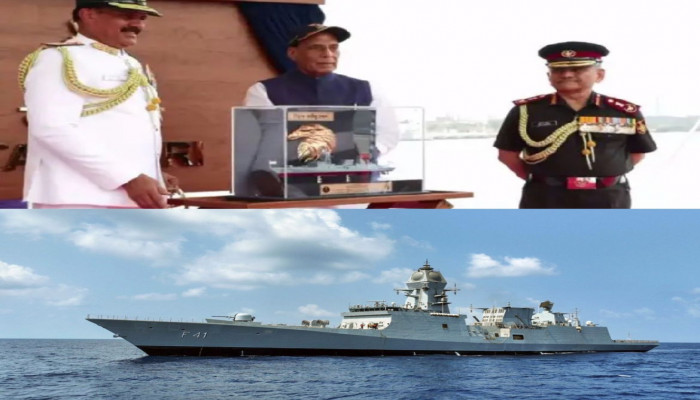
India marked a significant step in strengthening its naval capabilities as Defence Minister Rajnath Singh commissioned the advanced stealth frigate INS Taragiri in Visakhapatnam on Friday. The warship is part of the Indian Navy’s ambitious Project 17A programme, which focuses on building next-generation stealth frigates with enhanced combat and operational features. The ceremony was attended by top defence officials, including Indian Navy Chief Admiral Dinesh Kumar Tripathi and Chief of Defence Staff Anil Chauhan, along with other senior naval officers.
The commissioning of INS Taragiri comes at a time when India’s eastern coastline is gaining increasing strategic importance. This rise is driven by changing security dynamics in the region and India’s growing role in the Indo-Pacific. This latest addition is part of the Indian Navy’s continued effort to enhance its combat readiness and expand its fleet with modern and capable warships.
INS Taragiri is the fourth vessel under Project 17A and represents a major advancement in indigenous shipbuilding. Weighing around 6,670 tonnes, the ship is not just a military asset but also a symbol of India’s push for self-reliance under the ‘Make in India’ initiative. It showcases the progress made by domestic shipyards in designing and constructing complex naval platforms with modern technology.
The frigate has been built by Mazagon Dock Shipbuilders Limited (MDL) in Mumbai. It features a more refined and stealth-oriented design compared to earlier ships. Its reduced Radar Cross-Section allows it to remain less visible to enemy detection systems, making it highly effective in modern naval warfare. With more than 75 per cent indigenous content, the ship highlights the strength of India’s growing defence manufacturing ecosystem. Over 200 Micro, Small and Medium Enterprises (MSMEs) have contributed to its construction, supporting employment and boosting the country’s industrial base.
INS Taragiri is powered by a Combined Diesel or Gas (CODOG) propulsion system. This enables the ship to achieve both high speed and long endurance, making it suitable for extended missions across vast maritime zones. Its design supports multi-dimensional operations, allowing it to perform effectively in various combat and surveillance roles.
The warship is equipped with a powerful and advanced weapons suite. It includes supersonic Surface-to-Surface Missiles, Medium Range Surface-to-Air Missiles, and a dedicated Anti-Submarine Warfare system. These weapons are integrated through a modern Combat Management System, which allows the crew to detect, assess, and respond to threats quickly and accurately. This level of integration ensures that the ship can operate efficiently in high-risk situations.
Beyond combat, INS Taragiri is also designed for a wide range of missions. Its flexible operational profile allows it to take part in humanitarian efforts such as Humanitarian Assistance and Disaster Relief (HADR). This makes it a valuable asset not only in times of conflict but also during natural disasters and emergency situations, where rapid response is critical.
The induction of INS Taragiri reflects the Indian Navy’s vision of becoming a strong, self-reliant, and technologically advanced force. It highlights the country’s commitment to securing its maritime interests while promoting indigenous development. As India continues to expand its presence in the Indo-Pacific region, platforms like Taragiri will play a key role in maintaining security and stability.
INS Taragiri stands as a symbol of India’s rising maritime strength. It represents a future where naval assets are designed, built, and operated within the country. With its advanced capabilities and strategic importance, the warship is set to serve as a strong guardian of India’s maritime frontiers.



 Loading...please wait
Comments