



Defence Minister flags off first batch of guided Pinaka rockets to Armenia from SDAL’s Nagpur facility
- In Reports
- 05:53 PM, Jan 19, 2026
- Myind Staff
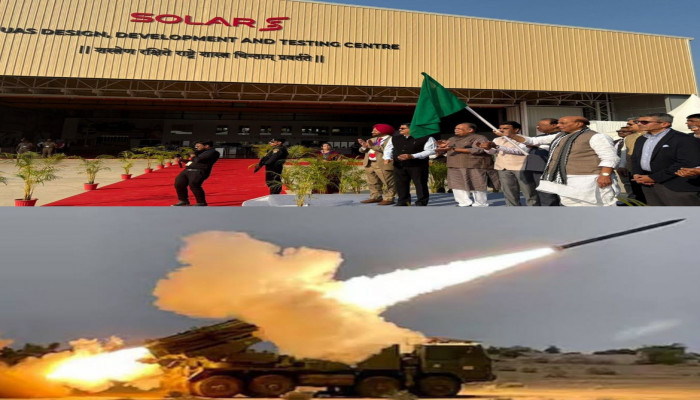
India’s Defence Minister Rajnath Singh on Sunday, 18 January 2026, flagged off the first batch of the Guided Pinaka rocket system for export to Armenia from the Solar Defence and Aerospace Limited (SDAL) facility in Nagpur, Maharashtra. The event marked an important step in India’s growing defence export journey and highlighted the increasing role of the private sector in manufacturing advanced defence equipment.
The flag-off ceremony took place after the inauguration of SDAL’s new Medium Calibre Ammunition Facility at its Nagpur plant. During the visit, the Defence Minister toured various sections of the facility, including the rocket assembly area, where he closely observed the production process of the precision-engineered Guided Pinaka system.
The Guided Pinaka is a multi-barrel rocket launcher system known for its high accuracy and extended range. Its export to Armenia signals India’s emergence as a reliable supplier of advanced and indigenous defence technology to global partners. Armenia is considered a key strategic partner, especially in the context of ongoing regional tensions.
Addressing industry leaders and officials present at the event, Rajnath Singh said that the Nagpur facility is playing a crucial role in beginning the export of the Pinaka missile system. He pointed out that several other countries have shown strong interest in acquiring this indigenous weapon system. “This achievement is not only the capability of our defence industry but also further strengthens India’s export potential,” the Defence Minister said.
Singh expressed confidence that the Guided Pinaka system would soon strengthen India’s own defence preparedness as well. He stated that after the completion of ongoing and upcoming testing processes, the system would prove to be a “strong and reliable shield” for the country’s armed forces.
Praising the work culture and efficiency of Solar Defence and Aerospace Limited, Singh said that the private defence unit reflects “a new resolve, a new enthusiasm, new energy, and innovation” dedicated to the nation’s development and the goal of self-reliance in defence manufacturing.
The Defence Minister also spoke about the broader transformation of India’s defence production ecosystem. He recalled that the sector was once dominated almost entirely by public sector undertakings, and there were serious doubts and hesitation about allowing private companies to enter defence manufacturing. Singh said these challenges were addressed through consistent policy reforms that encouraged private participation, investment, and innovation.
Drawing from his earlier visit to the same facility in 2021, Singh shared a personal reflection. During that visit, he had handed over the first full lot of indigenously produced Multi-Mode Hand Grenades to the Army Chief. These grenades were manufactured entirely by a private company. He described that moment as a “significant step towards self-reliance,” which laid the foundation for the export-ready defence systems being seen today.
The export of the Guided Pinaka aligns closely with India’s Atmanirbhar Bharat initiative in the defence sector. This push towards self-reliance has helped India move from being a major defence importer to becoming one of the leading exporters. In the financial year 2024–25, India’s defence exports crossed ₹23,000 crore, with private companies such as SDAL contributing significantly to this growth.
Solar Defence and Aerospace Limited, a subsidiary of the Solar Industries group, has rapidly expanded its operations in Nagpur to meet rising domestic and international demand for precision-guided munitions. The newly inaugurated Medium Calibre Ammunition Facility has increased production capacity for artillery shells and rocket components. The facility uses advanced automation and quality assurance systems that meet international standards.
The Defence Minister also highlighted the technological evolution of the Pinaka system. Originally developed by the Defence Research and Development Organisation (DRDO) and produced with the support of private partners, the guided version of Pinaka uses GPS and INS-based navigation systems. This enables it to achieve high accuracy at ranges of up to 75 kilometres.
Singh also referred to the system’s operational credibility, noting its deployment in Operation Sindoor, where the Nagastra loitering munition variant demonstrated its effectiveness against unpredictable threats.
The event was seen as significant within defence and industrial circles, especially due to Nagpur’s growing importance as a hub for aerospace and munitions manufacturing. Observers described the flag-off as recognition of Maharashtra’s contribution to national security.
As India targets defence exports worth ₹50,000 crore by 2029, initiatives such as SDAL’s Guided Pinaka production underline the strong coordination between government vision and private sector execution. Singh’s focus on innovation and self-reliance indicates continued momentum in positioning India as a global centre for ammunition and rocket systems manufacturing.



 Loading...please wait
Comments