




Decolonising Bharat’s Military Mind: Why the Time Has Come to Rethink Foreign Military Training
- In Current Affairs
- 02:14 PM, May 15, 2026
- Siddhartha Dave
The appointment of Lt Gen N S Raja Subramani has triggered an important but long-overdue strategic conversation within Bharat’s defence circles — should senior Bhartiya military officers continue to undergo advanced training in Western institutions, particularly in the United Kingdom, or is it time for Bharat to fundamentally reorient its military intellectual ecosystem?
The question is not about the individual competence of officers trained abroad. Nor is it about rejecting global exposure. The deeper issue is whether Bharat, as an emerging civilisational power aspiring to strategic autonomy, can continue to rely on intellectual frameworks inherited from the colonial and post-colonial era.
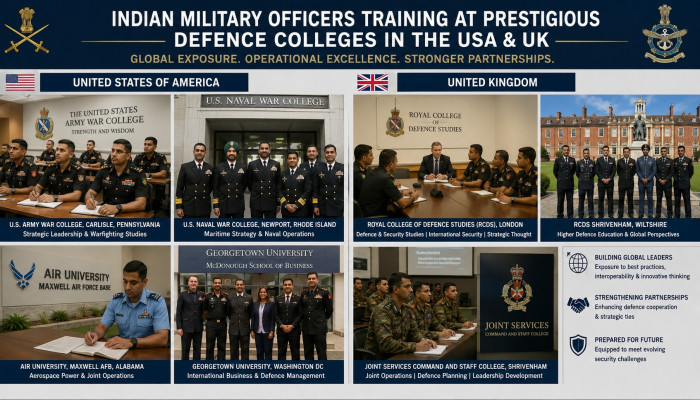
General Raja Subramani’s attendance at the Joint Services Command & Staff College in Bracknell, UK, reflects a long institutional tradition. For decades, elite Bhartiya military officers have attended courses in Britain, the United States, and other Western countries. These programmes offered exposure to advanced operational planning, joint warfare doctrines, military diplomacy, and strategic networking. During the Cold War and immediately after independence, such engagement carried practical value because Bharat lacked many indigenous higher military education structures of global standing.
But the geopolitical world of 2026 is not the world of 1960.
Bharat today is not a newly independent state searching for a strategic orientation. It is a nuclear power, a space power, a major maritime actor in the Indo-Pacific, and destined to become a Vishwaguru seeking to shape global narratives rather than merely absorb them. The military education system that produces its future commanders must therefore reflect Bharat’s own geopolitical realities, civilisational worldview, and security challenges.
The fundamental concern with excessive dependence on Western military institutions lies not in professionalism, but in intellectual conditioning.
Every military academy produces officers through the lens of its own national interests, strategic culture, and historical experiences. British and NATO-oriented institutions naturally teach warfare from the perspective of Atlantic alliances, expeditionary operations, coalition warfare, and Eurocentric threat perceptions. Their strategic assumptions emerge from Western geopolitical priorities.
Bharat’s security environment, however, is profoundly different.
Bharat faces a live continental threat from China across the Himalayas, an unstable Western Front with Pakistan, maritime competition in the Indian Ocean Region, insurgencies in difficult terrain, drone infiltration, cyber warfare, narrative warfare, and long-duration grey-zone conflict. Future Bhartiya wars may involve simultaneous multi-domain operations across mountains, deserts, oceans, cyberspace, and information ecosystems.
The Russia-Ukraine conflict has further transformed military thinking worldwide. The war has exposed the limitations of many assumptions that dominated post-Cold War Western military doctrines. Precision air campaigns alone have not ensured victory. Instead, the conflict has revived the importance of artillery, logistics endurance, trench warfare adaptation, electronic warfare, drone integration, missile saturation, industrial production capacity, and strategic resilience.
Ironically, many of these lessons resemble the operational realities Bharat itself may confront in a future high-intensity conflict.
This is where proponents of deeper engagement with Russia argue that Moscow’s military education ecosystem may offer more relevant exposure for Bhartiya officers. Russia possesses vast historical experience in continental warfare, extreme-weather operations, integrated air defence systems, missile warfare, and large-scale land combat. These experiences resonate more directly with Bharat’s Northern and Western security challenges than many NATO operational templates.
Moreover, Russia has historically remained one of Bharat’s most dependable defence partners. From the MiG era to S-400 systems, from submarines to strategic technologies, Moscow has repeatedly supported Bharat even during periods when Western countries imposed sanctions or strategic restrictions. A significant portion of Bharat’s military inventory still remains Russian-origin or Soviet-derived. Greater doctrinal familiarity with Russian operational thinking could therefore enhance interoperability, maintenance philosophy, and strategic understanding.
However, the debate should not be simplistically framed as “Britain versus Russia.”
That would be intellectually inadequate.
The real issue is whether Bharat should continue importing military thought altogether.
The deeper challenge is decolonisation of strategic consciousness.
For nearly two centuries, colonial rule shaped the intellectual architecture of Bhartiya institutions. Even after independence, many sectors — bureaucracy, academia, law, diplomacy, and military structures — continued functioning within frameworks designed originally to serve imperial interests. English-speaking elite validation often became synonymous with strategic sophistication.
This phenomenon also influenced military education. Western strategic literature became dominant. NATO frameworks became aspirational benchmarks. Bhartiya military history was studied more as heritage than as a living doctrinal source.
Yet Bharat possesses one of the world’s oldest civilisational traditions of statecraft and warfare.
From the strategic insights of Chanakya and the Arthashastra to the operational brilliance of Chhatrapati Shivaji Maharaj, Bharat’s historical experiences offer lessons in asymmetric warfare, maritime strategy, intelligence operations, fortress defence, decentralised command structures, psychological warfare, and civilisational resilience.
Unfortunately, these traditions rarely occupy central space in modern military education.
The success of recent integrated operational exercises, including lessons emerging from Operation Sindoor, demonstrates why Bharat now requires its own doctrine-building ecosystem. Modern conflicts are no longer won solely through kinetic superiority. They are shaped by narrative control, information warfare, technological adaptation, supply-chain resilience, civil-military coordination, cyber capability, and societal cohesion.
Western doctrines cannot fully account for Bharat’s unique civilisational realities.
For example, Bharat’s military operates within a democratic yet deeply civilisational society where religion, culture, geography, social cohesion, and strategic psychology intersect in ways unlike Europe. Border populations in Arunachal Pradesh, Ladakh, Rajasthan, Gujarat, Jammu & Kashmir, and coastal regions are not merely geographic entities — they are civilisational frontiers. Warfare in Bharat’s context therefore includes preserving cultural continuity, managing demographic vulnerabilities, and countering ideological subversion.
Similarly, Bharat’s future conflicts with China may involve not merely military confrontation, but technological competition, economic coercion, information manipulation, cyber disruption, and influence warfare across the Bhartiya Upmahadweep and the Indian Ocean Region.
This requires commanders who think beyond imported templates.
The coming era of theatre commands further intensifies this necessity. Theatre warfare demands integration across services, intelligence agencies, cyber structures, space assets, diplomacy, logistics, and information operations. Bharat’s future military leaders must therefore be educated not only in operational art, but in comprehensive national power.
Institutions such as the National Defence College, Defence Services Staff College, and the College of Defence Management should now evolve into world-leading strategic universities capable of attracting foreign officers rather than merely sending Bhartiya officers abroad.
Bharat should aspire to become an exporter of military thought.
This transformation will also require curricular reform. Military education must increasingly include artificial intelligence warfare, autonomous systems, quantum technologies, space militarisation, information operations, economic warfare, civilisational psychology, and indigenous strategic philosophy. Bhartiya officers must study not only Clausewitz and NATO doctrines, but also Kautilya, Shivaji’s campaigns, the Ahom resistance model, maritime traditions of the Cholas, and lessons from Kargil, Galwan, and counter-insurgency operations.
Most importantly, Bharat must cultivate intellectual self-confidence.
True strategic autonomy cannot emerge merely through indigenous weapons production while continuing to outsource strategic thinking. A nation destined to become a Vishwaguru must generate its own doctrines, define its own security vocabulary, and shape military thought rooted in its own experiences.
The question, therefore, is not whether Bhartiya officers should stop learning from the world. They absolutely should. The real question is whether Bharat is finally prepared to stop viewing the world through borrowed strategic lenses.
That intellectual transition may ultimately prove as important as any military reform or weapons acquisition programme.
Jai Hind


 Loading...please wait
Comments