




Danish firms ready to pay premium to build ships in India: Denmark envoy
- In Reports
- 02:11 PM, Aug 27, 2026
- Myind Staff
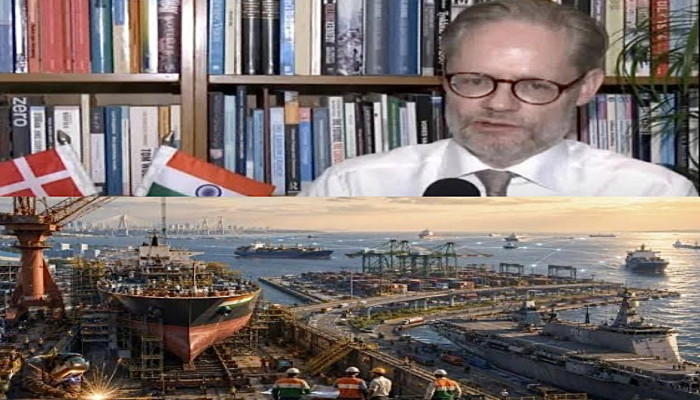
Danish companies are ready to pay a higher initial cost to build ships in India as Western economies look to reduce their dependence on East Asian shipyards. Denmark’s Ambassador to India, Rasmus Abildgaard Kristensen, said geopolitical tensions are pushing companies to diversify their shipbuilding supply chains.
“Geopolitical uncertainties mean you cannot put all your eggs in one basket, and while the first couple of ships built in India will be more expensive than what you get in China or Korea—which have a fine-tuned machine with all sub-suppliers ready to go—Danish companies are willing to pay a smaller premium,” Kristensen said during an interaction with reporters.
He said Denmark considers India the strongest potential alternative to East Asia for shipbuilding. The industry remains highly concentrated in countries such as China and South Korea. Danish companies have already commissioned around 10 ships in India, with a combined capacity of nearly 40,000 tonnes. Kristensen said more orders are expected as Indian shipyards develop their capabilities.
The concentration of global shipbuilding is clear from recent order figures. Chinese shipyards received around 35.37 million compensated gross tonnes (CGT) of new orders in 2025. This accounted for about 63% of total global orders. South Korean shipyards received 11.6 million CGT, or nearly 21% of the global total, according to Clarksons Research.
India now wants to create a stronger alternative manufacturing base for the global shipbuilding industry. The country has set a target to expand its shipbuilding capacity 40-fold by 2047. The government is supporting this goal through initiatives such as Sagarmala 2.0, which was announced in 2025.
Kristensen said India should use this opportunity to move ahead with newer technologies instead of following the traditional shipbuilding models used by China and South Korea. He said Indian shipyards could first focus on smaller vessels and later move towards larger ships as their skills and supplier networks improve.
“We’ll probably start seeing smaller ships, coasters, and then gradually as India’s capabilities grow, then even the big container ships will be built here,” he said, adding that shipbuilding on an industrial scale is not going to come back to Europe.
The ambassador said India should avoid competing with established Asian shipbuilders only through traditional methods. He suggested that India should focus on newer and cleaner technologies, including ships powered by methanol, ammonia and other alternative fuels.
“India should not try to compete with the old-fashioned way of doing ships as they have been done in China and Korea for many years now,” he said, pointing instead to vessels powered by methanol, ammonia and other new fuels.
India and Denmark have also expanded their cooperation in the maritime sector. The two countries established their Green Strategic Partnership in 2020. Maritime cooperation received further support through the Indo-Danish Centre of Excellence on Green Shipping in 2025.
The partnership focuses on several areas of maritime development, including green shipping, digitalisation, maritime training, port-state control, regulation and sustainable ship recycling. These areas are expected to support India’s efforts to develop a more modern and sustainable maritime industry.
A joint Denmark-India feasibility study is also examining opportunities in both naval and commercial shipbuilding. In addition, a pre-feasibility study has identified possible green shipping corridors to and from India. These initiatives could strengthen cooperation between the two countries while supporting India’s larger ambitions in shipbuilding and green maritime transport.
India’s growing role in global shipbuilding comes at a time when Western companies are seeking alternatives to heavily concentrated supply chains in East Asia. Danish firms are willing to absorb some of the higher costs in the early stages. Their approach reflects the growing importance of supply-chain diversification and India’s potential to become a major shipbuilding centre in the years ahead.



 Loading...please wait
Comments