



Cuban advisers leave Venezuela amid mounting U.S. pressure on Rodriguez’s government
- In Reports
- 02:24 PM, Feb 23, 2026
- Myind Staff
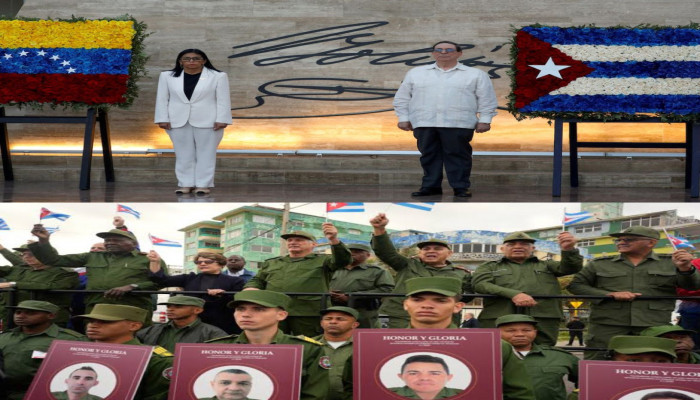
Cuban advisers leave Venezuela amid mounting U.S. pressure on Rodriguez’s government
Cuban security advisers and doctors have been leaving Venezuela as Interim President Delcy Rodriguez’s government faces heavy pressure from Washington to end one of Latin America’s most important left-wing alliances. Eleven sources familiar with the situation confirmed that departures have taken place in recent weeks.
According to four of those sources, Rodriguez has now placed her security in the hands of Venezuelan bodyguards. This marks a clear shift from former president Nicolas Maduro and his predecessor, the late Hugo Chavez, who both depended on elite Cuban security forces for protection.
The Cuban government said that 32 Cubans were killed during the U.S. military operation on January 3 that led to Maduro’s capture. These individuals were part of a long-standing security arrangement between Caracas and Havana that began in the late 2000s. Under that agreement, Cuban intelligence agents were embedded across Venezuela’s military and inside the powerful DGCIM counterintelligence agency. The DGCIM played a central role in identifying and removing domestic opposition.
Alejandro Velasco, an associate professor of history at New York University and an expert on Venezuela, emphasised the importance of this partnership. “The Cuban influence was absolutely essential” to the survival of the Chavista government, he said.
A former Venezuelan intelligence official stated that some Cuban advisers working within DGCIM have been removed from their positions. In addition, two sources said that Cuban medical workers and security advisers have recently flown back to Cuba.
One source close to Venezuela’s ruling party said the departures were ordered by Rodriguez because of U.S. pressure. However, other sources were unsure whether the Cubans were being forced out by the new leadership, leaving voluntarily, or being called back by Havana. The move to remove Cubans from the presidential guard and the counterintelligence agency has not been previously reported.
Before the operation that removed Maduro, thousands of Cuban doctors, nurses, and sports coaches were working in Venezuela. They were part of social welfare programs started under Chavez. In return, Venezuela supplied Cuba with much-needed oil.
After the U.S. military action, President Donald Trump made it clear that he wanted to end the Venezuela-Cuba security relationship. On January 11, he wrote on Truth Social, “Cuba lived, for many years, on large amounts of OIL and MONEY from Venezuela. In return, Cuba provided ‘Security Services’ for the last two Venezuelan dictators, BUT NOT ANYMORE!”.
In response to questions about U.S. pressure on Venezuela to cut ties with Cuba, a White House official said the United States has “a very good relationship with the leaders of Venezuela” and believes that Rodriguez’s “own self-interest aligns with advancing our key objectives.”
Breaking Venezuela’s ties with Cuba is part of Washington’s wider effort to weaken and eventually remove Cuba’s communist government. Since mid-December, the United States has blocked Venezuela from sending oil to Cuba, putting serious economic strain on the island.
The White House official added that the U.S. government is “talking to Cuba, whose leaders should make a deal,”
Cuba has said it is open to dialogue if it is based on equal terms. At the same time, it has strongly criticised the oil blockade and promised to resist U.S. interference.
Neither the Venezuelan nor the Cuban governments responded to requests for comment. Publicly, both nations have continued to affirm their close relationship.
Rodriguez, the daughter of a former Marxist guerrilla, has long been a close ally of Maduro and a member of Venezuela’s ruling Socialist Party. Ten U.S. and Venezuelan sources said she also has personal ties with Cuban officials.
On January 8, Rodriguez stood beside Cuban Foreign Minister Bruno Rodriguez at a memorial service in Caracas for those killed in the U.S. attack. The ceremony was filled with flowers. Addressing the gathering, Bruno Rodriguez said, “To the brave Venezuelan people, we express Cuba’s deepest solidarity.” He ended his speech with the famous phrase of Cuban revolutionary leader Ernesto “Che” Guevara: “Hasta la victoria siempre.”
Later in January, Delcy Rodriguez spoke by phone with Cuban President Miguel Diaz-Canel. After the call, she said the two countries remained “united.” Diaz-Canel also confirmed Cuba’s commitment to “continue strengthening the historic relations of brotherhood and cooperation.”
When asked about these public statements, the White House official said, “President Trump understands that they have to make certain statements for domestic political reasons.”
A source familiar with the Cuban government’s position said that some Cuban military personnel injured in the January 3 attack have returned to Cuba, while others have remained active in Venezuela. The same source said that many Cuban doctors are still providing medical care in the country.
Cuban state media reported in early January that the suspension of commercial flights and the closure of Venezuelan airspace created a backlog. This prevented Cuba from bringing home doctors who were on vacation or finishing their missions. Those flights resumed the week after the U.S. attack.
A U.S. source said that although the Cuban presence is decreasing, some undercover intelligence agents are likely to remain in Venezuela to monitor how the political situation develops.
Frank Mora, former U.S. ambassador to the Organisation of American States during the Biden administration, said Rodriguez is acting cautiously. “Rodriguez is treading very carefully.” He added, “She wants to keep the Cubans at a distance until this situation calms down, until her hold on power is clear, but not entirely throw them under the bus, either.”
Four sources said that at least some Cuban military advisers are still working in Venezuela. A former police officer also stated that Cuban professors continue to teach at the state university for police and security forces, known as UNES.
John Polga-Hecimovich, a professor at the U.S. Naval Academy in Maryland who has studied Cuban security involvement in Venezuela, said the effects of Cuba’s counterintelligence system can still be seen in Caracas. Maduro’s loyal supporters remain in powerful positions. “The Cubans didn’t manage to protect Maduro, but they played a key role in keeping the Chavista government in power," he said. “The coup-proofing worked brilliantly.”



 Loading...please wait
Comments