



Court can’t sit in judgment of matters of religious belief of a denomination: TDB to SC
- In Reports
- 06:12 PM, Apr 15, 2026
- Myind Staff
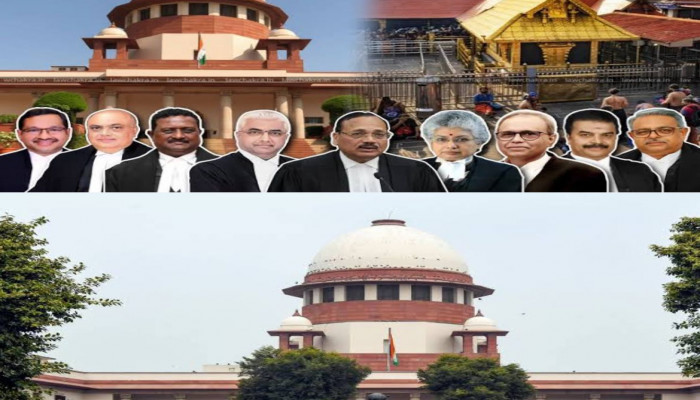
The Travancore Devaswom Board (TDB), which manages the historic Sabarimala Temple, informed the Supreme Court of India that courts should not judge matters of religious belief. The submission was made on Wednesday before a nine-judge Constitution bench led by Chief Justice Surya Kant.
The board explained that religion is based on beliefs and practices followed by a group or denomination with a shared identity. It argued that these beliefs are subjective and must be understood from the perspective of the community itself. According to the TDB, the court is bound to accept these beliefs rather than examine or question them.
The TDB also highlighted its role as a statutory autonomous body managing over 1,000 temples in South India. It stressed that religious practices are deeply rooted in tradition and community faith, and outside authorities should not interfere in such matters.
Senior advocate Abhishek Singhvi, appearing for the board, clarified the legal position regarding religious rights. He stated, "Religion is a set of beliefs and practices followed by a group/sect/denomination with a broadly similar identity. While Article 25 clearly vests in an individual the right to profess, practice and propagate religion, such individual rights cannot be allowed to extend to an area which intrudes upon the mass of individual rights of all other adherents of that religion or denomination."
He argued that while Article 25(2)(b) can be claimed by all sects of Hindus to demand entry to a Hindu religious institution of public character. However, the religious denomination will have the right under Article 26(b) to regulate how the inner rituals must be performed. He advocated for a harmonious interpretation of Article 25(2)(b) and Article 26(b). He also stated that constitutional protection cannot be restricted to essential religious practices and that Courts can’t determine whether a religious practice is essential or not.
Today is the fourth day of the hearing. The arguments are progressing before the bench comprising CJI Surya Kant, Justice BV Nagarathna, Justice MM Sundresh, Justice Ahsanuddin Amanullah, Justice Aravind Kumar, Justice Augustine George Masih, Justice Prasanna B Varale, Justice R Mahadevan and Justice Joymalya Bagchi.



 Loading...please wait
Comments