




Corruption crackdown slows China’s military industry as global arms revenues surge: SIPRI Report
- In Reports
- 06:29 PM, Dec 01, 2025
- Myind Staff
Revenues at China’s big military companies fell last year as corruption investigations slowed arms contracts and procurement, according to a report released on Monday by a leading conflict research institute.
The fall in China stands out because large arms and military services companies across the world saw strong revenue growth driven by the wars in Ukraine and Gaza and rising tensions in many regions, the study by the Stockholm International Peace Research Institute (SIPRI) reported.
“A host of corruption allegations in Chinese arms procurement led to major arms contracts being postponed or cancelled in 2024,” said Nan Tian, director of SIPRI’s Military Expenditure and Arms Production Programme.
“This deepens uncertainty around the status of China’s military modernisation efforts and when new capabilities will materialise.”
The People’s Liberation Army became one of the key targets of a wider corruption drive ordered by President Xi Jinping in 2012, and this effort reached the senior ranks in 2023 when the Rocket Force came under investigation.
Eight senior generals were expelled from the ruling Communist Party on corruption charges in October, including the country’s number two general, He Weidong. He had worked under Xi on the Central Military Commission, which is China’s top military command.
Asian and Western diplomats say they are still trying to understand how the crackdown is affecting China’s military rise and how far down the chain of command the investigations extend.
Revenues of China’s top military firms fell 10 per cent last year, while revenues in Japan rose 40 per cent, Germany 36 per cent and the US revenues increased 3.8 per cent, the SIPRI data showed.
Revenues of the world’s 100 biggest arms companies grew 5.9 per cent to a record $ 679 billion, the report said, and China’s decline made Asia Oceania the only region where top arms firms recorded a revenue fall.
China’s weapons revenue went down despite Beijing increasing its defence budgets for thirty years as part of its strategic rivalry with the United States and amid tensions over Taiwan and the disputed South China Sea.
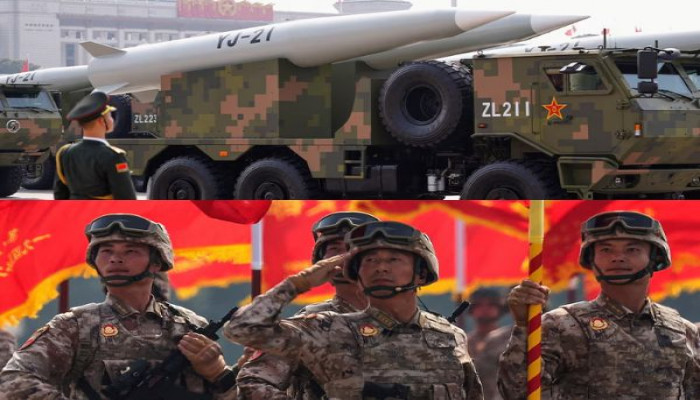
The military buildup is still showing results as China now operates the world’s largest naval and coast guard fleets, which include a potentially advanced new aircraft carrier, along with new hypersonic missiles, nuclear weapons and air and sea drones.
Revenue fell at AVIC, China’s biggest arms maker, at land systems producer Norinco and at aerospace and missile manufacturer CASC, all state-owned, according to SIPRI. Norinco saw the sharpest fall, dropping 31 per cent to $ 14 billion.
The research found that personnel changes linked to corruption at the top of Norinco and CASC led to government reviews and project delays, while deliveries of military aircraft by AVIC also slowed.
China’s defence ministry and the three companies did not respond immediately to faxed requests for comment from Reuters.
The timeline of advanced systems for the Rocket Force of the People’s Liberation Army, which manages its growing arsenal of ballistic, hypersonic and cruise missiles, could be revealed along with aerospace and cyber programs, said SIPRI researcher Xiao Liang.
This adds more uncertainty to the PLA’s aim of securing key capabilities and full war-fighting readiness in time for its 100th anniversary, Liang said. The PLA’s predecessor, Mao Zedong’s Red Army, was founded in 1927.
“However, in the medium and longer term, sustained investment in defence budgets and political commitment behind modernisation will continue, albeit with some program delays, higher costs and tighter control of procurement,” Liang said.



 Loading...please wait
Comments