




Closing the Loophole: The Church's Misuse of FCRA, the 2026 Amendment, and Why the Church's Objections Don't Hold Up Part 5
- In Current Affairs
- 02:21 PM, Aug 08, 2026
- YagnaSri
Introduction
India's Foreign Contribution (Regulation) Act, 2010 (FCRA) exists for a narrow but important purpose: to ensure that money flowing into India from abroad does not compromise the country's sovereignty, security, public order, or the integrity of its democratic institutions. Christian ecclesiastical bodies have, for decades, been among the largest institutional recipients of foreign contributions in India, and as this article documents, among the most frequent subjects of enforcement action for misusing that funding, including for religious conversion activity the law does not permit. This article sets out the documented pattern of misuse, explains what the Foreign Contribution (Regulation) Amendment Bill, 2026 (informally "FCRA 2.0") and its accompanying Amendment Rules actually do to address that pattern, and examines the principal objections the Catholic Bishops' Conference of India (CBCI), the All India Christian Council (AICC), and allied international bodies have raised against the amendment before explaining, point by point, why those objections do not withstand scrutiny.
Part One: The Documented Pattern of Misuse
A Century-Old Method, Modernised
This article on present-day conversion practice traced the documented continuity between colonial-era "Rice Christian" conversions, famine relief deployed as an instrument of religious persuasion, and its twenty-first-century equivalent, in which FCRA-funded welfare activity has, in specific and judicially examined instances, been structured to achieve the same end. The 1956 Niyogi Committee, appointed by the Madhya Pradesh state government, had already documented this pattern using primary evidence from over 11,000 interviews: missionary inducements, education, healthcare, and financial assistance deployed as instruments of conversion in preference to doctrinal persuasion. What FCRA regulates today is, in substantial part, the funding pipeline for the modern version of the same practice.
Enforcement Action Against Major Christian Organisations
Over the past decade, India's FCRA enforcement record shows a consistent pattern of action against major Christian institutional recipients of foreign funds. Compassion International, once India's single largest recipient of foreign charitable contributions at approximately $45 million annually, had its registration lapse in 2017 after the Ministry of Home Affairs placed it on a watch list, requiring prior scrutiny of individual grants. The Missionaries of Charity had its FCRA renewal declined in 2021, one of 5,789 organisations to lose their licence that year. In 2024, the Ministry cancelled the registrations of World Vision India, the Church's Auxiliary for Social Action (CASA), and the Evangelical Fellowship of India. None of these cancellations occurred in a vacuum; each followed a documented compliance review by the Ministry of Home Affairs, the nodal authority for FCRA enforcement.
The clearest recent illustration of what such reviews uncover is the 2025 case that reached the Allahabad High Court and, subsequently, the Supreme Court, involving individuals connected to World Vision India and a mission hospital in Fatehpur, Uttar Pradesh. The First Informant's statement, extracted in the Supreme Court's own October 2025 order, records specific allegations that a Primary Health Centre nurse connected to the mission hospital, together with the manager of World Vision India's local operation, approached a prospective convert with an offer: abandon Hinduism for Christianity, and in exchange receive cash assistance, free medical treatment for his family, and employment at an affiliated institution allegations echoed in a second, near-identical FIR against the Vice Chancellor of Sam Higginbottom University of Agriculture, Technology, and Sciences (SHUATS) and six others. Whatever the eventual judicial outcome of any individual prosecution, the structure of the allegation foreign-funded healthcare and welfare infrastructure allegedly deployed as leverage for conversion is precisely the misuse the FCRA framework, and its 2026 amendment, are designed to foreclose.
Beyond Conversion: The Wider National-Security Rationale
FCRA enforcement concerns are not confined to religious conversion. The Intelligence Bureau's 2014 report, "NGO Activism against Development Projects in India: A Review," documented a broader pattern in which foreign-funded organisations — a category that includes but is not limited to religious bodies — were found to be running coordinated campaigns against infrastructure and development projects, campaigns the report characterised as slowing India's development trajectory. Then-Home Minister Rajnath Singh's response, directing that all FCRA-registered organisations be sensitised to compliance obligations, reflects the dual concern that has animated FCRA policy across successive governments: foreign funds are not to be used either for unauthorised religious conversion or for activity that undermines India's broader public and national interest. The 2026 amendment's Statement of Objects and Reasons draws on both strands, citing weak implementation of existing provisions, unresolved investigations, and the absence of a clear legal mechanism for handling the assets of organisations whose authorisation to receive foreign funds has lapsed or been withdrawn.
Part Two: What the 2026 Amendment Actually Does
The Foreign Contribution (Regulation) Amendment Bill, 2026 was introduced in the Lok Sabha on 25 March 2026, referred to a Joint Parliamentary Committee following objections from opposition parties, and is expected to be reintroduced for consideration in the Monsoon Session beginning 20 July 2026. Alongside the Bill, the Ministry of Home Affairs separately notified the Foreign Contribution (Regulation) Amendment Rules, 2026, which took effect on 22 June 2026 under the existing 2010 Act. Together, the Bill and Rules make four principal changes relevant to this article.
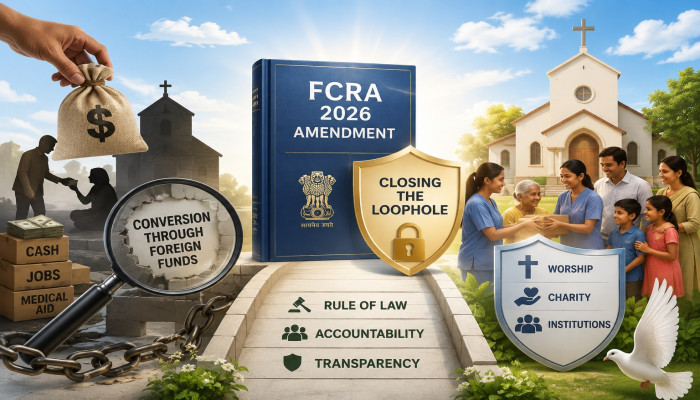
First, the Rules explicitly exclude "proselytisation" from the list of permissible religious activities that may be funded with foreign contributions. Permitted activities are enumerated specifically: construction, maintenance, and renovation of places of worship; the printing, digitisation, and translation of sacred texts; the religious education of an organisation's own members, "provided it does not aim at conversion"; assistance to pilgrims; community soup kitchens and housing; and the protection of indigenous and tribal religious traditions. Religious worship, teaching, and charity remain fully permissible; conversion-directed activity funded from abroad does not.
Second, the Bill introduces the concept of "deemed cessation" of FCRA registration — extending beyond formal cancellation or voluntary surrender to cover cases where an organisation's renewal application is refused, not applied for, or not granted before expiry.
Third, the Bill omits the existing Section 15 of the Act and replaces it with a new framework under which foreign contributions and the assets created from them vest, upon cancellation, surrender, or deemed cessation of registration, in a government-notified "Designated Authority," which manages those assets and — if registration is not restored within a prescribed period — may transfer or dispose of them.
Fourth, the Bill expands liability under the Act to "key functionaries," including trustees and office-bearers of affected organisations, alongside new minimum fund-utilisation requirements and geography-linked registration conditions.
The government's stated justification, articulated by Home Minister Amit Shah's ministry and by Parliamentary Affairs Minister Kiren Rijiju during the Bill's consideration, rests squarely on Article 25 of the Constitution — which guarantees freedom of conscience and the right to profess, practise, and propagate religion, but subject to public order, morality, and health, and which the Supreme Court, in Rev. Stanislaus v. State of Madhya Pradesh (1977), has already authoritatively held does not extend to a right to convert another person. Rijiju has stated publicly that the amendment "is not against any religion and does not target any particular organisation." The Press Information Bureau issued a clarification on 22 July 2026 confirming that places of worship will retain their religious character "in all cases" under the Designated Authority framework, even where an organisation's broader registration has lapsed.
Part Three: The Church's Objections
The CBCI, in a memorandum to Home Minister Amit Shah signed by CBCI president Cardinal Anthony Poola and secretary general Archbishop Anil Couto, raised four principal objections: that the "deemed cessation" concept sweeps too broadly, capturing organisations whose renewal is delayed rather than substantively refused; that the vesting of assets in a Designated Authority could result in properties "built lawfully over decades" — schools, hospitals, shelters — being taken from institutions that continue to serve genuine humanitarian need; that extending liability to individual trustees and office-bearers creates what the CBCI called a "presumption of culpability" disproportionate to any individual's actual conduct; and that the overall architecture goes beyond legitimate transparency regulation into territory that could "undermine charitable institutions."
The All India Christian Council went further, describing "the seizure of assets" as "the heart of our objection," and arguing that properties purchased with funds "legitimately received from within India and abroad" could be "taken over by an arm of the state upon the lapse of a licence," despite no organisation having "signed any undertaking agreeing" to such a consequence. The AICC additionally objected that the Bill was reintroduced without the "widespread consultation with minority community leaders that was promised." International bodies amplified these concerns: Christian Solidarity Worldwide called the amendment "a deeply alarming escalation," the Washington-based Religious Freedom Institute argued that "an accusation of conversion alone is now enough for a group to lose its FCRA license." Amnesty International characterised the Rules as inconsistent with the Financial Action Task Force's 2024 recommendation for a "targeted, risk-based approach" rather than "blanket" restriction.
Part Four: Why These Objections Do Not Hold Up
On "asset seizure." The Designated Authority mechanism activates only after an organisation's own FCRA registration has already been cancelled for cause, voluntarily surrendered, or allowed to lapse without renewal — not while an organisation remains compliant and operational. Framing this as "seizure" elides the essential precondition: the mechanism exists to determine what happens to assets built from foreign charitable funds once the very authorisation permitting receipt of those funds has ended, not to confiscate the property of a functioning, compliant institution. This is a standard feature of regulatory law, not a novelty invented to target religious bodies: when any regulated entity's licence to hold or manage funds for a stated public purpose lapses — whether a bank, an insurer, or a registered trust — the law routinely provides for supervised, custodial handling of the underlying assets rather than leaving them in the unsupervised control of an entity no longer authorised to manage them. The PIB's explicit 22 July clarification that places of worship retain their religious character "in all cases" directly answers the specific fear the CBCI and AICC raised about churches themselves being repurposed.
On the "presumption of culpability" for key functionaries. Extending accountability to trustees and office-bearers addresses a documented enforcement gap: the same individuals who ran an organisation before its FCRA registration was cancelled for cause have, in past cases, continued the same activities informally or through successor entities, effectively evading the consequence of cancellation altogether. Personal liability for those actually responsible for an organisation's compliance is a conventional feature of regulatory law across sectors — company directors, trust trustees, and society office-bearers all carry comparable personal accountability under Indian law — and does not amount to a presumption of guilt so much as a recognition that institutional accountability requires individual accountability behind it.
On "vagueness" of the proselytisation exclusion. The claim that "proselytisation" is undefined and therefore legally uncertain does not withstand comparison with existing Indian jurisprudence. The distinction the Rules draw between religious worship, teaching, and charity (all permitted) and conversion-directed activity (not permitted) tracks precisely the line the Supreme Court itself drew in 1977 in Stanislaus, reaffirmed in the Court's own 2022 observations on allurement-based conversion, and now codified in state anti-conversion statutes across a dozen states over nearly six decades. This is settled legal ground, not an open-ended discretionary standard invented for this amendment.
On "no consultation." The claim that the Bill proceeded without engagement is difficult to reconcile with the documented sequence of events: the Bill was in fact referred to a Joint Parliamentary Committee after opposition objections, the CBCI's own memorandum was formally received and responded to by the Home Minister's office, Amit Shah reportedly met directly with CBCI representatives on 10 July 2026, and the Ministry issued a public clarification addressing the specific concern the CBCI had raised. A formal memorandum, a ministerial meeting, and a public clarificatory response constitute a documented consultative exchange, despite any disagreement that remains about the ultimate policy outcome.
On disproportionate targeting of Christian institutions. The numbers cited in the Church's own reporting on this dispute undercut the claim of specific targeting: Christian organisations, per figures reportedly shared with the CBCI by the Home Minister's office, receive under 15 per cent of India's total foreign contributions. The more than 22,000 FCRA cancellations recorded over the past decade span human-rights organisations, environmental groups, and development-sector NGOs of every religious and secular character, a pattern of broad-based enforcement across the entire foreign-funded sector, not a campaign confined to Christian institutions. That the largest and most visible objections have come from Christian bodies reflects the scale and organisation of their institutional response, not evidence that the underlying law is confined to them.
On the international religious-freedom framing. Article 25 of the Constitution has never been read, by the Supreme Court or otherwise, as guaranteeing an unrestricted right to receive unlimited foreign funding for religious activity of any kind; it is, on its own text, subject to public order, morality, and health, and to reasonable regulation. A foreign government's or foreign advocacy organisation's preference that India regulate its own domestic foreign-funding law differently is a matter of diplomatic opinion, not a constitutional constraint binding on Indian legislative sovereignty.
Conclusion
The 2026 FCRA amendment does not prohibit Christian worship, Christian charity, or Christian institutional life in India — each remains, on the plain text of the Rules and the government's own repeated public clarification, fully protected. What it withdraws is the ability to fund religious conversion specifically with money from abroad, and it introduces a supervised mechanism for handling the assets of organisations whose authorisation to receive such funds has already lapsed. Given the documented history this article and its companion pieces have traced — from the Niyogi Committee's 1956 findings, through a decade of FCRA cancellations affecting major Christian institutions, to a 2025 court record describing cash, medical treatment, and employment offered explicitly in exchange for conversion — the amendment addresses a real and recurring pattern rather than an imagined one. The Church's objections, examined individually, rest substantially on a characterisation of the Bill's mechanics that the Bill's actual text, the government's clarifications, and existing Supreme Court precedent do not support.
Pulpit and Plunder: How the Church Justified Colonial Atrocities and the Theft of Indian Wealth Part 4



 Loading...please wait
Comments